Fort Matanzas by the Numbers: A 50-Foot Coquina Tower, 1742 Cannon Fire and a Free Ferry South of St. Augustine
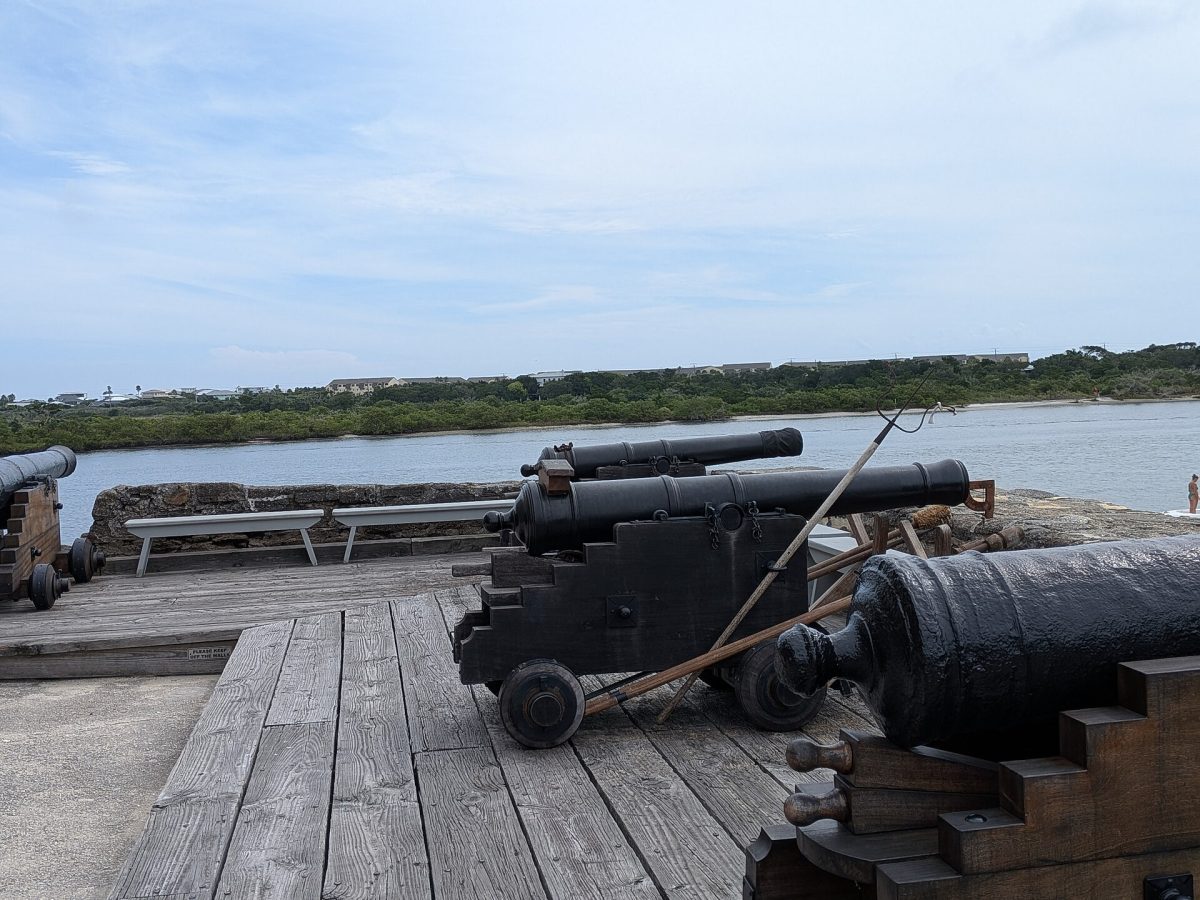
Cannons on the gun deck of Fort Matanzas, which once held five guns guarding the inlet (file photo). Photo: Saph / Wikimedia Commons (CC0)
ST. AUGUSTINE, Fla. - About 15 miles south of St. Augustine, a small coquina tower stands on Rattlesnake Island at the mouth of the Matanzas River. Fort Matanzas looks modest next to the Castillo de San Marcos, but it was built for a specific job: guarding the "back door" to Spanish St. Augustine. Here is the story of the fort and the national monument around it, told through the numbers the National Park Service uses to describe it.
Fort Matanzas at a Glance
| Number | What it means |
|---|---|
| 1565 | Year of the killings at Matanzas Inlet that gave the river its name |
| 245 | French prisoners killed in two separate episodes that fall, according to NPS figures (111, then 134) |
| 1740-1742 | Construction years of the fort |
| 50 feet | Length of each side of the fort |
| 30 feet | Height of its tower |
| 5 | Cannon on the gun deck |
| 7 to 10 | Soldiers usually on duty, plus one officer |
| 50 | Planned fighting strength in wartime |
| Oct. 15, 1924 | Date President Calvin Coolidge proclaimed it a national monument |
| Nearly 300 | Acres in today's monument |
| $0 | Cost of park admission and the ferry ride to the fort |
1565: How Matanzas Got Its Name
The European history of the site begins nearly two centuries before the fort was built. In 1565, Jean Ribault sailed from France with more than 600 soldiers and settlers to resupply Fort Caroline, the French Huguenot colony near present-day Jacksonville, according to the National Park Service. Spain's Pedro Menéndez de Avilés founded St. Augustine that September, and a hurricane soon wrecked Ribault's ships on the coast far to the south while Menéndez captured Fort Caroline.
Shipwrecked Frenchmen trying to walk back north were stopped by an inlet south of St. Augustine. The NPS says they surrendered after losing most of their food and weapons, and 111 were killed, with only 16 spared. Two weeks later, more survivors, including Ribault, reached the inlet, and on Oct. 12, 1565, another 134 were killed.
From then on, the inlet was called Matanzas, the Spanish word for "slaughters." The NPS notes that the episode began 235 years of Spanish control of Florida. Its own history pages leave open whether the killings were driven by religion, by royal orders or by fear that there was not enough food to keep prisoners alive through the winter.
1740: A Watchtower for the Back Door
By 1740, the main threat to Spanish Florida came from the British, not the French. British forces from Georgia, led by James Oglethorpe, besieged St. Augustine that year, after an earlier failed attempt in 1702. Matanzas Inlet was the southern entrance to the river leading to the city, and Gov. Manuel de Montiano ordered a fort built to guard that approach.
Work started in the fall of 1740. Coquina stone was quarried south of the inlet and carried by boat to the site, and long wooden pilings were driven into the marsh to hold up the rising stonework, according to the NPS. Lime for the mortar came from burned oyster shells, and the finished walls were originally plastered and whitewashed.
British ships tried to disrupt the work. In July 1741, a British sloop and schooner attacked a Spanish sloop at the inlet, and two Spanish crewmen were killed before a Spanish galliot drove the British off. In September 1742, Oglethorpe returned, but by then Fort Matanzas was finished and fired its cannon, and the British withdrew without firing a shot.
Inside a 50-Foot Fort
The fort measures 50 feet on each side, with a 30-foot tower. Its gun deck is solid earth fill, built to carry five cannon, and a cistern beneath the deck stored rainwater because there was no fresh water on the island. The powder magazine sat inside the west wall and could be reached only through the officers' quarters upstairs.
Life at the post was small-scale. The NPS says seven to 10 soldiers and one officer were usually on duty, rotated from the St. Augustine garrison for one-month tours, with a planned fighting strength of 50 men in battle. Supplies came once a month by boat, and at first a pull-up ladder was the only way into the fort.
The fort's location has also shifted with the coastline. In 1740, the inlet was about half a mile closer to the fort than it is now. The fort was built on less than two acres of dry ground, but Rattlesnake Island has since grown to more than 200 acres.
After Spain: Abandonment and Rescue
Florida passed to Britain in 1763 and back to Spain in 1784, and the fort saw little change in those years. The watchtower was abandoned after the United States acquired Florida, and American soldiers never used it, according to the NPS. Erosion and rainwater took a heavy toll over the following decades.
Visitors drawn by Henry Flagler's St. Augustine resorts began traveling to see the ruins and asked Congress to save them. Federal restoration began in 1916, and on Oct. 15, 1924, Coolidge signed a proclamation making Fort Matanzas a national monument. The same proclamation also covered the Castillo, Georgia's Fort Pulaski and the Statue of Liberty.
The visitor center was built of coquina in 1937 as a Works Progress Administration project. The NPS reconstructed the fort's chimney in 1999 and added two replica iron six-pounder cannon for firing demonstrations. New passenger ferries were bought in 2011 to keep up with growing visitation.
Visiting the Fort
The park is at 8635 A1A South, on the south end of Anastasia Island. It is open daily from 9 a.m. to 5:30 p.m., except Thanksgiving and Dec. 25, and there is no fee to enter the park or ride the ferry. Parking is limited, and the park recommends carpooling.
The free passenger ferry runs Thursday through Monday, with departures on the half hour from 9:30 a.m. to 3:30 p.m. There is no ferry service on Tuesdays and Wednesdays. Free boarding passes are handed out in person at the visitor center on a first-come, first-served basis, and the NPS says it is common for all passes to be gone before 11 a.m.
Everyone riding the boat needs a pass, including babies. A trip lasts about 45 to 55 minutes, food and drink are not allowed on the boat or at the fort, and pets other than service animals must stay off the boat. Trips can be canceled without notice for lightning or high wind.
Visitors who miss the ferry can still see the fort from the shore. The monument includes beaches on the river and ocean sides and a 0.6-mile nature trail through coastal hammock, dunes and salt marsh, and leashed pets are welcome on the beach and trails. The nature trail is wheelchair accessible, according to the NPS.
More Information
Ferry times, alerts and history are posted by the National Park Service at nps.gov/foma. Visitors can also call the park at 904-471-0116 before making the drive. Because boarding passes cannot be reserved, the park advises arriving early on ferry days.
Source: National Park Service, Fort Matanzas National Monument (nps.gov/foma, accessed Oct. 29, 2026)
News organizations may republish this story with credit. See our guidelines.
Know someone who'd want to read this? Email it to a friend.
Own a Jacksonville business? Introductory ad rates from $125/month. See ad options Follow Jax Times on FacebookLocal news, events and people, in your feed every day.Most read this week
- Florida's 3 Constitutional Amendments on the Nov. 3 Ballot, Explained in Plain English
- Clay County Voter Guide: 7 Early Voting Sites, Key Races and What to Know Before Nov. 3
- Jacksonville Fair 2026 Guide: Dates, Gate Times, Ticket Prices, Free Days and Every Concert (Nov. 5-15)
- Early Voting in Jacksonville Starts Tuesday: All 24 Sites, the Hours, What to Bring and What's on Your Ballot
- Coastal Flood Warning for Jacksonville: Water Peaks Sunday and Monday Mornings in 5 Flood-Prone Areas
More stories
 Education 27 St. Johns County Schools Named Florida Schools of Excellence as District Earns Top State Label
 Local Fort Mose at 288: The 1738 Settlement Near St. Augustine Was the First Legally Sanctioned Free Black Town in the U.S.
 Politics 107,463 Duval Voters Have Cast Ballots as Early Voting Continues Across Northeast Florida
 Local Anastasia State Park by the Numbers: 1,600 Acres, 4 Miles of Beach and the Quarry That Built the Castillo
Comments
Be respectful. No personal attacks, hate speech, spam or anyone's private information. Every comment is reviewed before it appears. Comment rules
No comments yet. Be the first to share your thoughts.