Fort Mose at 288: The 1738 Settlement Near St. Augustine Was the First Legally Sanctioned Free Black Town in the U.S.
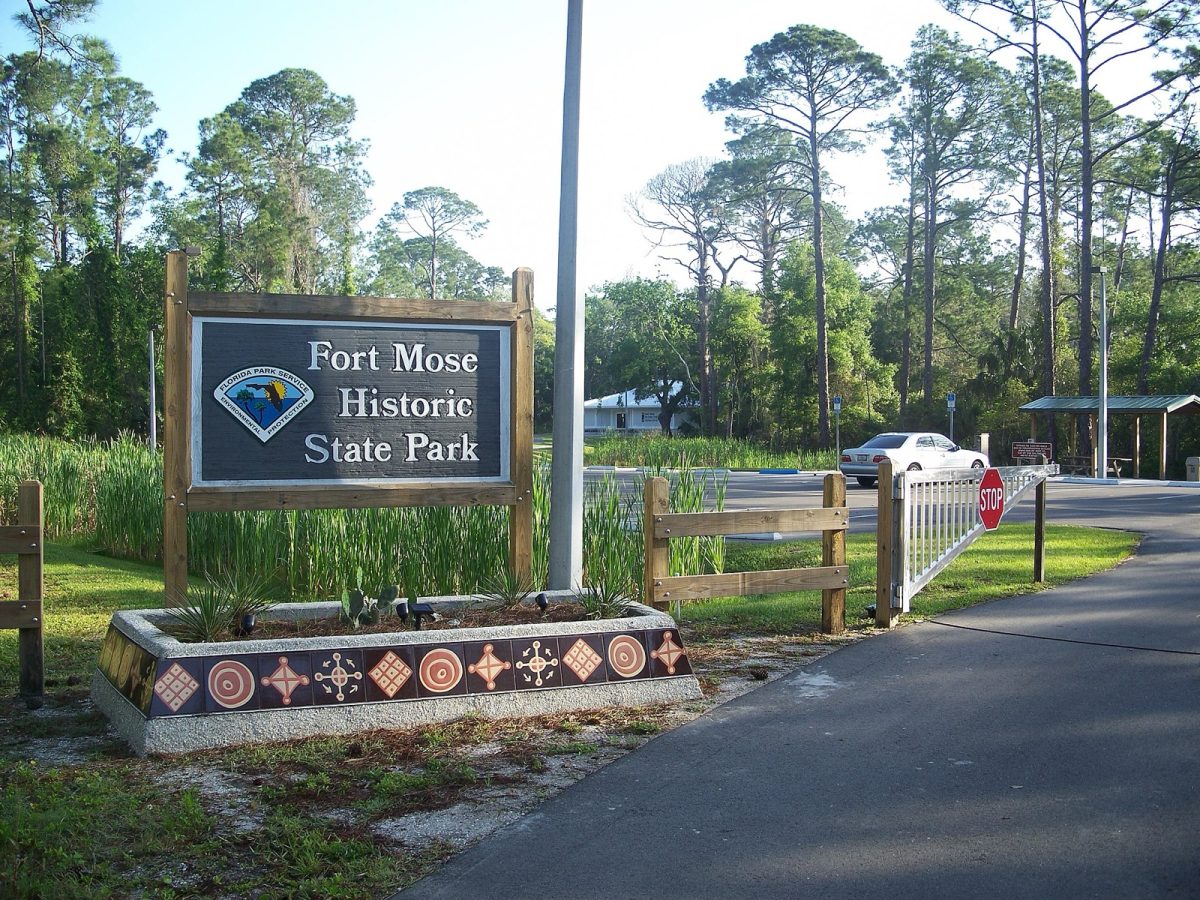
The entrance sign at Fort Mose Historic State Park (file photo). Photo: Ebyabe / Wikimedia Commons (CC BY-SA 3.0)
ST. AUGUSTINE, Fla. - In 1738, Spanish authorities established Fort Mose about two miles north of St. Augustine, creating the first legally sanctioned free Black settlement in what is now the United States. The community, formally named Gracia Real de Santa Teresa de Mose, offered freedom to people who had escaped slavery in the British colonies. Now, 288 years after its founding, the site is preserved as Fort Mose Historic State Park, where visitors can explore a history that includes freedom, military service, conflict and the people who built a community under Spanish rule.
The settlement's story began decades before its official founding and continued long after its original fort was destroyed. Its history centers on people who escaped enslavement, secured their freedom in Spanish Florida and defended the community they established. Among them was Francisco Menendez, a formerly enslaved African who became Fort Mose's civil and military leader.
1689-1693: Spanish Florida Opens a Path to Freedom
Spanish Florida began offering asylum to people escaping slavery in the British colonies in 1689. That policy created an opportunity for enslaved people seeking freedom beyond British colonial authority. Four years later, Spain formalized the conditions under which those fugitives could obtain legal freedom.
In 1693, King Charles II of Spain issued a royal decree granting freedom to runaways who converted to Catholicism and served four years in the militia. The decree connected freedom with religious conversion and military service. Those conditions shaped the foundation of the community that would eventually become Fort Mose.
1704-1717: Francisco Menendez Escapes Enslavement
Francisco Menendez was born around 1704 among the Mandinka people in the Gambia region of West Africa. Between 1709 and 1711, slave traders captured and sold him, and he was probably transported to the British colony of Carolina. His early life reflected the forced movement of Africans through the Atlantic slave trade.
During the Yamasee War, which lasted from 1715 to 1717, Menendez escaped bondage and fled to Spanish Florida with his wife, Ana Maria de Escobar. Their escape placed them in territory where Spanish policies offered a possible route to freedom. Menendez would later become one of the most important figures in the history of Fort Mose.
1726-1728: A Military Leader Emerges
In 1726, Menendez joined St. Augustine's Black militia and eventually became its captain. His military service placed him among the men responsible for defending the Spanish settlement. That responsibility became especially important as British forces challenged Spanish control of the region.
In 1728, Menendez distinguished himself while defending St. Augustine against a British attack led by John Palmer. His role in that defense established him as an experienced military leader. A decade later, Spanish authorities would appoint him to lead a new settlement for formerly enslaved people.
1738: Fort Mose Becomes a Free Black Settlement
On March 15, 1738, Florida Gov. Manuel de Montiano granted unconditional freedom to all fugitives who had arrived from the British colonies, including Menendez. That decision marked a significant development in the history of Black freedom in Spanish Florida. Montiano established Fort Mose that same year, approximately two miles north of St. Augustine.
Menendez became the settlement's civil and military leader, responsible for a community of approximately 100 residents. Fort Mose was more than a military outpost because it was also a legally recognized community of free Black residents. Its establishment distinguished it from the British colonies where many of its residents had previously been enslaved.
The settlement's existence soon became connected to events elsewhere in the colonies. In September 1739, the Stono Rebellion broke out in South Carolina. Historians believe Fort Mose's existence helped inspire that rebellion, underscoring the significance of a recognized free Black community near British colonial territory.
1740: The Battle of Bloody Mose
In 1740, Fort Mose became a battlefield during British Gen. James Oglethorpe's siege of St. Augustine. The siege lasted from June 24 to July 20 during the War of Jenkins' Ear. British forces occupied Fort Mose with approximately 120 Highlander rangers and 30 Native allies.
On June 26, approximately 300 Spanish soldiers, free Black militia members and Native auxiliaries launched a counterattack. They retook the fort in a battle that became known as the Battle of Bloody Mose. The fighting killed 68 British troops and resulted in 34 British prisoners, while Spanish losses totaled 10 killed.
The fighting destroyed the fort, leaving the original settlement unable to continue at that location. Oglethorpe abandoned his siege of St. Augustine and withdrew to Georgia in July 1740. The battle became a defining event in Fort Mose's history and demonstrated the military role of the free Black community.
1741-1759: Captivity, Rebuilding and Return
Menendez's life took another difficult turn in 1741 when the Boston privateer Revenge captured him at sea. His captors gave him 200 lashes and sold him into slavery in the Bahamas. The man who had helped lead a free Black community in Spanish Florida was again subjected to enslavement.
Meanwhile, Spanish authorities eventually rebuilt Fort Mose at a slightly different location nearby by 1752. The community continued after the destruction of the original fort, maintaining its place in Spanish Florida. By 1759, Menendez had returned and was again leading the Mose community.
Records from 1759 describe a village containing 22 palm-thatched huts. The settlement housed 37 men, 15 women, seven boys and eight girls, a total of 67 residents. Those figures provide a picture of the community more than two decades after its founding.
1763: The Community Leaves Florida
The Treaty of Paris in 1763 transferred Florida from Spain to Britain. As Spanish authorities evacuated, approximately 400 enslaved and free Black residents of Spanish Florida, including the people of Mose, departed for Cuba. The transfer brought an end to Fort Mose's existence as a free Black settlement under Spanish authority in Florida.
Menendez helped establish a settlement called San Agustin de la Nueva Florida near Matanzas, Cuba. He later retired to Havana on a government pension and died around the 1770s. His life had taken him from West Africa through enslavement, military leadership, renewed captivity and eventually Cuba.
1968-1994: Rediscovering Fort Mose
In 1968, Frederick Eugene "Jack" Williams identified the general location of Fort Mose using an old map. His work helped bring renewed attention to the location of the historic settlement. Archaeological investigations followed from 1986 to 1988 under the leadership of Kathleen Deagan, Jane Landers and John Marron.
On Oct. 12, 1994, the site received designation as a National Historic Landmark. The protected historic site encompasses 24 acres and is now Fort Mose Historic State Park. Its preservation provides a physical connection to the people and events associated with the first legally sanctioned free Black settlement in what became the United States.
2025-2026: A Reconstructed Fort Welcomes Visitors
A replica of Fort Mose was constructed during 2024 and 2025 and opened to the public in May 2025. The reconstruction provides visitors with another way to engage with the settlement's history. It joins the historic grounds and museum in presenting the story of Fort Mose.
Fort Mose Historic State Park is located at 15 Fort Mose Trail in St. Augustine, FL 32084. The park grounds are open daily from 9 a.m. to 5 p.m., and admission to the grounds is free. The visitor center and museum operate Thursday through Monday from 9 a.m. to 5 p.m., with museum admission costing $2 for adults and free admission for children younger than 6.
The Fort Mose Historical Society also holds events, including Flight to Freedom. Visitors can contact the park at 904-823-2232 for information. The site remains a place where the history of Fort Mose and the community established in 1738 can be explored.
How We Did This
This history feature draws on Wikipedia entries titled "Fort Mose Historic State Park," "Fort Mose," "Francisco Menendez (Black soldier)" and "Siege of St. Augustine (1740)," reviewed Oct. 27, 2026. Visitor information and details about the site's historical programs come from the Fort Mose Historical Society at fortmose.org, also reviewed Oct. 27, 2026. The account follows the documented dates, people and events in those sources without adding reconstructed dialogue, imagined scenes or unsupported historical details.
Sources: Wikipedia (Fort Mose Historic State Park, Francisco Menendez, Siege of St. Augustine 1740); Fort Mose Historical Society
News organizations may republish this story with credit. See our guidelines.
Know someone who'd want to read this? Email it to a friend.
Own a Jacksonville business? Introductory ad rates from $125/month. See ad options Follow Jax Times on FacebookLocal news, events and people, in your feed every day.Most read this week
- Florida's 3 Constitutional Amendments on the Nov. 3 Ballot, Explained in Plain English
- Jacksonville Fair 2026 Guide: Dates, Gate Times, Ticket Prices, Free Days and Every Concert (Nov. 5-15)
- Coastal Flood Warning for Jacksonville: Water Peaks Sunday and Monday Mornings in 5 Flood-Prone Areas
- Florida Is Holding $3 Billion in Unclaimed Money. Here's How Jacksonville and St. Augustine Residents Can Search for Free
- St. Augustine Artist Dara Dodson Paints 'A Land Remembered,' With Shows at the Karpeles Museum and the St. Augustine Art Association
More stories
 Local Jacksonville-Area Beaches Compared: Dog Rules, Parking and Fees at 7 Beaches From Hanna Park to St. Augustine Beach
 Local The St. Augustine Alligator Farm at 133: 24 Crocodilian Species, 7 Acres and a Famous Bird Rookery
 Local St. Johns County Under Coastal Flood Warning Through Monday: What Residents Need to Know
 Local St. Augustine Lighthouse: 165 Feet Tall, First Lit in 1874, and 10 Milestones in Its History
Comments
Be respectful. No personal attacks, hate speech, spam or anyone's private information. Every comment is reviewed before it appears. Comment rules
No comments yet. Be the first to share your thoughts.