Lightner Museum by the Numbers: Flagler's 1888 Hotel Alcazar, 300 Guest Rooms and a Pool That Hosted National Swim Meets
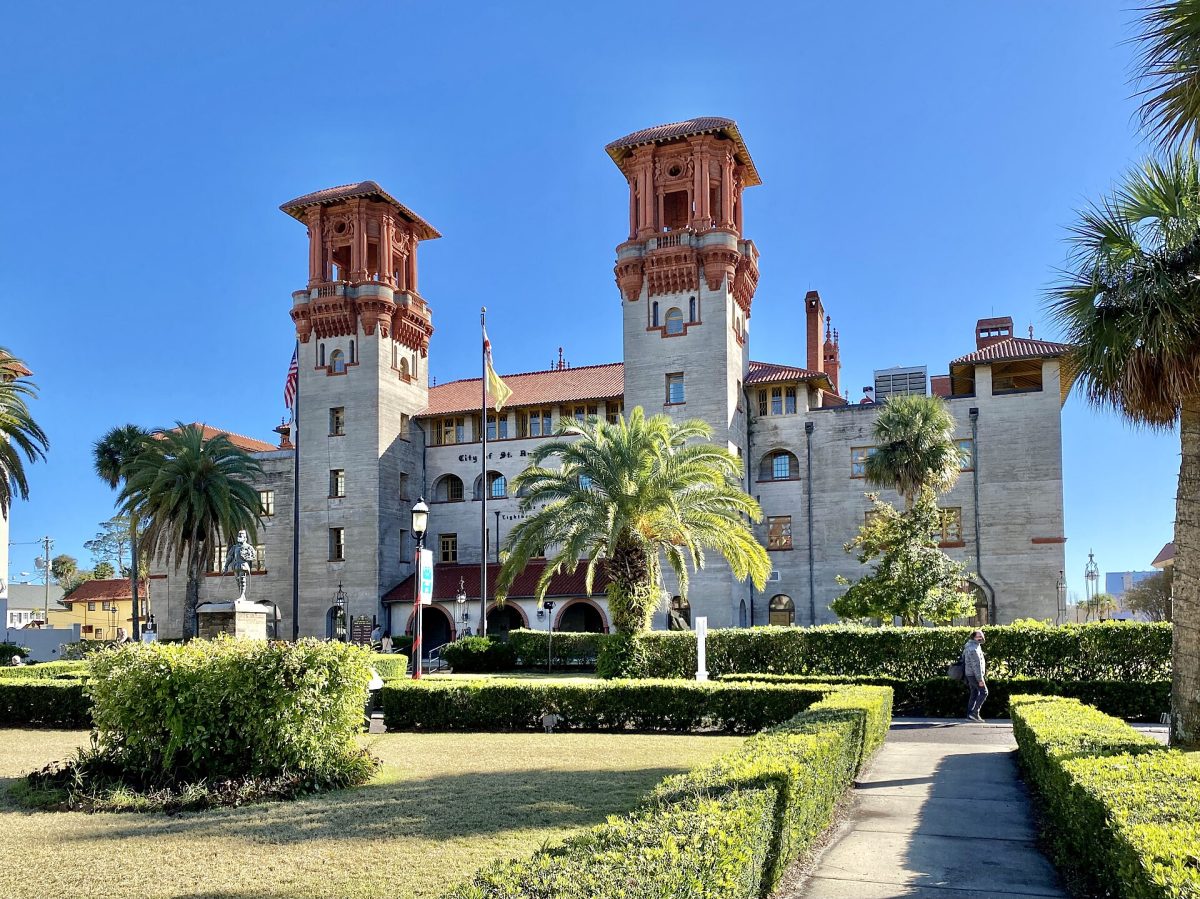
The twin towers of the former Hotel Alcazar on King Street, home to the Lightner Museum and St. Augustine City Hall (file photo). Photo: w_lemay / Wikimedia Commons (CC BY-SA 2.0)
ST. AUGUSTINE, Fla. - Across King Street from Flagler College, the twin towers of the former Hotel Alcazar rise over downtown St. Augustine. The building has been a Gilded Age resort, an empty shell, a museum of hobbies and, since 1973, St. Augustine City Hall, all under one red tile roof. Here is the Lightner Museum and the hotel that houses it, by the numbers, drawn from the museum, a St. Johns County historical marker and the building's 1970 National Register of Historic Places nomination.
The Alcazar at a Glance
| Number | What it means |
|---|---|
| 1887-1889 | Construction years, according to the National Register nomination |
| 1888 | Year the hotel opened, as a companion to the Hotel Ponce de Leon |
| $1 million+ | Construction cost cited in the nomination |
| 250 by 450 feet | Ground area of the four-story building |
| 300 | Original guest rooms, later cut to 170 when private baths were added |
| 44 | Staff rooms on the fourth floor of the Casino |
| 1931 | Year the hotel closed for good, according to the museum |
| 1948 | Year the Lightner Museum of Hobbies opened |
| April 27, 1973 | Date the building was dedicated as St. Augustine City Hall |
| $20 | Adult admission today, with St. Johns County residents paying $12 |
Flagler's Second Hotel
Standard Oil executive Henry Flagler set out in the mid-1880s to turn St. Augustine into a winter resort to rival destinations in Italy, Egypt and Spain, according to the Lightner Museum. The Alcazar was the second resort hotel he built in the city. It was first planned as a recreation annex to the grander Hotel Ponce de Leon across the street, but the design was expanded into a separate hotel that opened in December 1888.
The architects were John Merven Carrère and Thomas Hastings, young New York designers trained at the École des Beaux-Arts in Paris. Flagler hired them to design two hotels and two churches in St. Augustine between 1886 and 1890, and the commissions launched their national careers. The firm later designed the New York Public Library, completed in 1911, and the Henry Clay Frick residence in New York, completed in 1914.
The hotel's name comes from the Arabic word for royal castle, and its facade was modeled on a Moorish palace in southern Spain, according to the nomination and the county historical marker. Flagler's St. Augustine hotels were the first large multistory concrete buildings in the United States, the museum says. The poured concrete walls are trimmed with terra-cotta, and twin towers topped with terra-cotta and red brick belvederes rise above the street.
Hotel, Baths and Casino
The Alcazar was built in three parts. The hotel rooms at the north end surrounded a courtyard lined with a covered arcade of shops. The middle section held Turkish and Russian baths and massage rooms, fed by water from a free-flowing artesian well on the property, which the 1970 nomination says was believed to have medicinal benefits.
The south end held the Casino, a four-story space with an indoor swimming pool, a ballroom and a bowling alley, with a croquet lawn and tennis courts beyond. The nomination calls the pool "in all probability the largest indoor swimming pool in the nation" in its day. A program from February 1925 lists a national AAU swimming championship meet there, with entrants including Gertrude Ederle, Aileen Riggin and Sybil Bauer.
Running a resort that size took a large staff. The museum says 44 staff rooms were tucked into the fourth floor of the Casino, high above the pool and ballroom. The nomination also lists tennis champions of the era, including Tilden, Richards and Doeg, among the players on the hotel's courts.
From Shuttered Hotel to Museum of Hobbies
Changing travel habits and the Great Depression emptied Flagler's hotels. The Alcazar closed permanently after the winter season of 1931, according to the museum, though the county historical marker gives 1932. The building sat empty for more than a decade.
Otto C. Lightner, a Chicago magazine publisher born in Norwich, Kansas, in 1887, was a leading voice of the American hobby movement through his magazine, Hobbies. He opened a Museum of Hobbies in Chicago in 1934, filled with art and furnishings bought from the city's Gilded Age mansions and with collections donated by readers. After a stay at the Hotel Ponce de Leon in 1946, he bought the Alcazar to give his collection a permanent home.
The museum dates the purchase to 1946, while the historical marker and the National Register nomination give 1947. The nomination says Lightner spent $150,000 of his own money repairing the first two floors and the Casino. The Lightner Museum of Hobbies opened in 1948, and Lightner deeded the building to the city for use as a museum, according to the marker. Lightner died in 1950.
City Hall Moves In
The building's second big change came two decades later. In 1969, St. Augustine voters approved a bond issue to renovate the old hotel for both the museum and city offices, according to the marker. After remodeling, the building was dedicated as St. Augustine City Hall on April 27, 1973.
The Lightner Museum reopened to the public on Aug. 12, 1974, with the city sharing the building. The museum's elevator reaches every floor except the historic pool, which has its own accessible entrance on Cordova Street. The Alcazar was listed on the National Register of Historic Places in 1971.
Visiting the Lightner Museum
The museum is open daily from 9 a.m. to 5 p.m., with last admission at 4 p.m. and upper floors closing at 4:30 p.m. It is closed on Easter Sunday, Thanksgiving, Dec. 25 and Jan. 1. The collection ranges from Gilded Age furniture and American art glass to vintage typewriters and mechanical musical instruments, which Lightner called a "collection of collections."
| Ticket | Price |
|---|---|
| Adult | $20 |
| Senior, student or military | $17 |
| Youth, 12-17 | $13 |
| St. Johns County resident, with valid ID | $12 |
| Child, 11 and under | Free |
Free volunteer-led Pool Talks on the building's history are held daily at 11 a.m. and 2 p.m. and are included with admission. A free digital guide is available through the Bloomberg Connects app. A paid public parking lot sits directly behind the museum.
More Information
Hours, tickets, exhibitions and the museum's history series are posted at lightnermuseum.org. The museum is at 75 King St. in downtown St. Augustine, about an hour's drive from Jacksonville. The museum also hosts several free Community Open House evenings each year, which are announced on its website.
Sources: Lightner Museum (lightnermuseum.org, accessed Oct. 29, 2026); National Park Service, National Register of Historic Places nomination, Alcazar Hotel (listed 1971); St. Johns County historical marker, Alcazar Hotel/City Hall
News organizations may republish this story with credit. See our guidelines.
Know someone who'd want to read this? Email it to a friend.
Own a Jacksonville business? Introductory ad rates from $125/month. See ad options Follow Jax Times on FacebookLocal news, events and people, in your feed every day.Most read this week
- Florida's 3 Constitutional Amendments on the Nov. 3 Ballot, Explained in Plain English
- Clay County Voter Guide: 7 Early Voting Sites, Key Races and What to Know Before Nov. 3
- Jacksonville Fair 2026 Guide: Dates, Gate Times, Ticket Prices, Free Days and Every Concert (Nov. 5-15)
- Early Voting in Jacksonville Starts Tuesday: All 24 Sites, the Hours, What to Bring and What's on Your Ballot
- Coastal Flood Warning for Jacksonville: Water Peaks Sunday and Monday Mornings in 5 Flood-Prone Areas
More stories
 Arts & Culture Jacksonville Had More Than 30 Silent Film Studios. Here's Why Hollywood Left and What's Still Standing
 Arts & Culture St. Augustine Artist Dara Dodson Paints 'A Land Remembered,' With Shows at the Karpeles Museum and the St. Augustine Art Association
 Arts & Culture How Jacksonville Built Southern Rock: Lynyrd Skynyrd, the Allman Brothers, 38 Special, Molly Hatchet and the Bands
 Real Estate Riverside Historic District by the Numbers: 687 Acres, 2,550 Buildings and a Boom After Jacksonville's 1901 Fire
Comments
Be respectful. No personal attacks, hate speech, spam or anyone's private information. Every comment is reviewed before it appears. Comment rules
No comments yet. Be the first to share your thoughts.