Riverside Historic District by the Numbers: 687 Acres, 2,550 Buildings and a Boom After Jacksonville's 1901 Fire
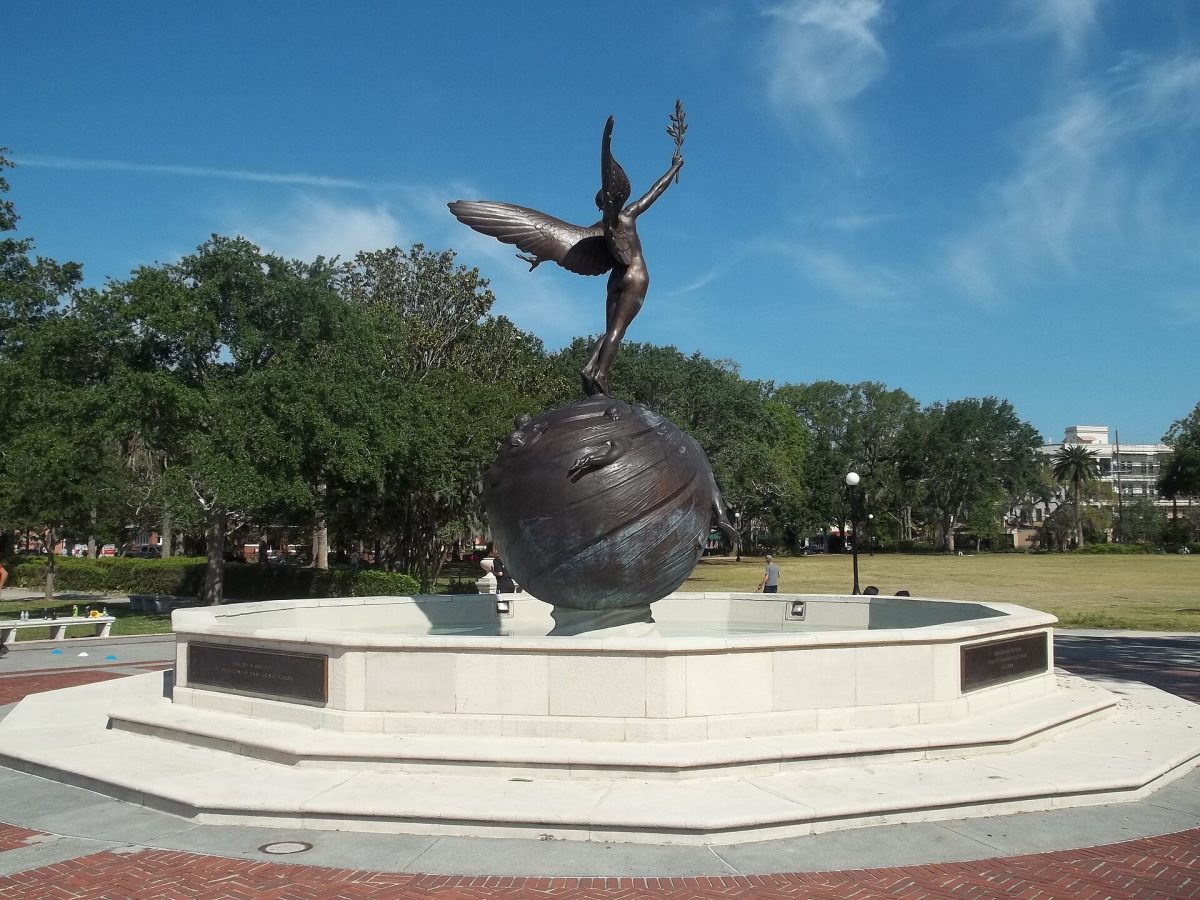
Charles Adrian Pillars' World War I memorial sculpture in Memorial Park, on the St. Johns River in Riverside (file photo). Photo: Ebyabe / Wikimedia Commons (CC BY-SA 4.0)
JACKSONVILLE, Fla. - Riverside's bungalows, Prairie School homes and oak-shaded streets are among the best-known sights in Jacksonville, but the neighborhood's history is written down in surprising detail. When the Riverside Historic District was added to the National Register of Historic Places on March 22, 1985, the nomination prepared by the Florida Division of Archives counted every building and traced the area from plantation land to streetcar suburb. Here is Riverside by the numbers, drawn from that federal record and from the American Planning Association's profile of the neighborhood.
Riverside Historic District at a Glance
| Number | What it means |
|---|---|
| 687 | Acres in the district as nominated in 1985 |
| 2,550 | Buildings counted in the district |
| 2,120 | Of those, buildings that contribute to its historic character |
| 1871-1935 | The district's period of historic significance |
| 30+ | Subdivisions inside the district |
| 3 | Major parks: Riverside, Willow Branch and Memorial |
| 16 | Churches counted in the 1985 nomination |
| ~60% | Share of buildings with bungalow details or influences |
| 40+ | Bungalows built entirely of coquina block |
| 1989 | Year neighboring Avondale was listed as its own historic district |
From Plantations to a Platted Suburb
Long before it was a neighborhood, the land west of downtown was farmland. The nomination says working plantations existed near Riverside as early as 1801, raising cattle, cotton, rice, sugarcane and sweet potatoes, among other crops. Elias Jaudon bought Magnolia Plantation in the area in 1850, and his death in 1871 marked the start of the shift from farming to houses.
John Forbes, who began selling tracts from his plantation in the 1860s, had a plat drawn that he called Riverside, giving the neighborhood its name. In 1878, Robert Lightbody subdivided the first tract for homes in what became Riverside Annex. When Jacksonville's city limits were pushed west to the line of King Street in 1887, development picked up on both sides of that boundary.
Riverside Annex was the most heavily promoted early subdivision, with 150 lots priced from $250 to $600. Promoters advertised graded streets, a streetcar connection and water from seven artesian wells. By 1895, Riverside had about 2,500 residents and a viaduct over McCoy's Creek linking it to downtown.
1901: The Fire That Filled Riverside
The Great Fire of 1901 burned 146 city blocks and destroyed 2,368 buildings, according to the nomination. Many of Jacksonville's leading families who lost their homes moved to Riverside, and Riverside Avenue became known as "the Row." The Cummer family, lumber dealers whose homes later became the site of the Cummer art museum, built three large estates there.
Growth after the fire was fast. Jacksonville's population roughly doubled from 28,429 in 1900 to 57,699 in 1910, and new subdivisions pushed west of Stockton Street. Only four subdivisions had been platted in Riverside before 1901, compared with more than 20 created between 1901 and 1939.
In 1909, the New Riverside subdivision opened with lots sold for 10% down and 10% every six months, and more than 100 lots sold within a week. Builder J.G. Heagy, promoting land west of King Street in 1914, built custom bungalows starting at $2,500 and did not allow two-story houses. Between 1918 and 1930, 12 more subdivisions opened, and by 1930 every farm in Riverside had been replaced by houses.
The Architecture by the Numbers
The bungalow dominates Riverside, with almost 60% of the district's buildings showing details of the style. Most were one-story frame houses built from builders' standard plans rather than designed by architects. The nomination notes several local twists, including heavy use of brick veneer and at least 40 bungalows built entirely of coquina block, the shell stone used in St. Augustine's forts.
Prairie School homes, the horizontal style associated with the Midwest, were rarely built anywhere in Florida at the turn of the century outside Jacksonville. The best examples line St. Johns and Riverside avenues, including the Roberts House at 1804 Elizabeth Place, designed by W.D. Camp in 1914. Local lore credits architect H.J. Klutho with many of them, but the nomination says building records show many were designed by others.
The firm of Marsh and Saxelbye, formed in 1914, designed more Riverside homes than any other architects. Addison Mizner designed Riverside Baptist Church in 1925 as a Mediterranean Revival building with an octagonal nave. The Park Lane Apartments at 1846 Margaret St., built in 1924, was the first of Riverside's high-rises and was controversial when it went up.
| Building count in 1985 | Number | Share |
|---|---|---|
| Contributing | 1,675 | 65% |
| Contributing but altered | 445 | 17% |
| Non-contributing | 430 | 16% |
| Total | 2,550 |
Parks, Shops and Churches
Forbes set aside 12 acres in his plat for a park, and in 1895 the city cleared the brush, laid walks and built five artificial lakes, making Riverside Park the largest park in the city at the time. Willow Branch Park was bought for public use in 1911, and Memorial Park was created after World War I. Memorial Park was landscaped by the Olmsted firm and features a sculpture by Charles Adrian Pillars honoring Floridians who died in that war.
Commercial buildings in Riverside were modest, clustered in four areas built from the 1910s on. The largest is Five Points, a group of one- and two-story stucco buildings at the northeast corner of the district, anchored by the Five Points Theater on Park Street. The 1985 count also listed four public schools, two parochial schools, two fire stations, two hospitals and a library inside the district.
Decline, Revival and Avondale
The nomination is blunt about the neighborhood's history. During its period of significance, Riverside was a cross section of the white population of Jacksonville, and subdivision advertising made clear it was intended to be a white neighborhood. Residents ranged from bankers and lawyers on the riverfront avenues to railroad workers, dry cleaners and teachers in the bungalow blocks.
By 1935, Riverside was essentially built out, and new construction moved to Avondale and Ortega. After World War II, many single-family homes were split into rentals, hospital expansion along Riverside Avenue claimed most of the old riverfront mansions north of King Street, and the interstate and expressway system also took a toll. The decline slowed in the mid-1970s as new families moved in, and the group Riverside Avondale Preservation, founded in 1974, helped secure the National Register listing, according to the APA.
Avondale, the newer subdivision to the west, was listed as its own National Register district in 1989. The American Planning Association, which named Riverside Avondale one of its Great Places in America in 2010, described the combined neighborhood as having about 5,000 buildings, with 70% of them contributing to its historic status. The two areas were later combined into a single local historic district, in which work is reviewed for consistency with city design guidelines.
More Information
The full Riverside Historic District nomination, including its street-by-street boundary, is available through the National Park Service's National Register of Historic Places program. Riverside Avondale Preservation, the nonprofit neighborhood group founded in 1974, posts history and preservation information at riversideavondale.org. The 2010 American Planning Association profile of the neighborhood is posted at planning.org.
Sources: National Park Service, National Register of Historic Places nomination, Riverside Historic District (listed March 22, 1985); American Planning Association, Great Places in America: Riverside Avondale (2010)
News organizations may republish this story with credit. See our guidelines.
Know someone who'd want to read this? Email it to a friend.
Own a Jacksonville business? Introductory ad rates from $125/month. See ad options Follow Jax Times on FacebookLocal news, events and people, in your feed every day.Most read this week
- Florida's 3 Constitutional Amendments on the Nov. 3 Ballot, Explained in Plain English
- Clay County Voter Guide: 7 Early Voting Sites, Key Races and What to Know Before Nov. 3
- Jacksonville Fair 2026 Guide: Dates, Gate Times, Ticket Prices, Free Days and Every Concert (Nov. 5-15)
- Early Voting in Jacksonville Starts Tuesday: All 24 Sites, the Hours, What to Bring and What's on Your Ballot
- Coastal Flood Warning for Jacksonville: Water Peaks Sunday and Monday Mornings in 5 Flood-Prone Areas
More stories
 Real Estate 59 Jacksonville-Area ZIP Codes Ranked by Home Value: Prices, Gains and Declines in 2026
 Real Estate Duval vs. St. Johns County: Homes Cost $185,700 More South of the Line, and Incomes Are $38,500 Higher. 13 Questions, Answered
 Real Estate Rent in Jacksonville and St. Johns County by ZIP Code: From $1,216 to $2,897 a Month
 Arts & Culture Lightner Museum by the Numbers: Flagler's 1888 Hotel Alcazar, 300 Guest Rooms and a Pool That Hosted National Swim Meets
Comments
Be respectful. No personal attacks, hate speech, spam or anyone's private information. Every comment is reviewed before it appears. Comment rules
No comments yet. Be the first to share your thoughts.