Jacksonville vs. Tampa, Orlando and Miami: 14 Questions Answered on Pay, Rent and Home Prices
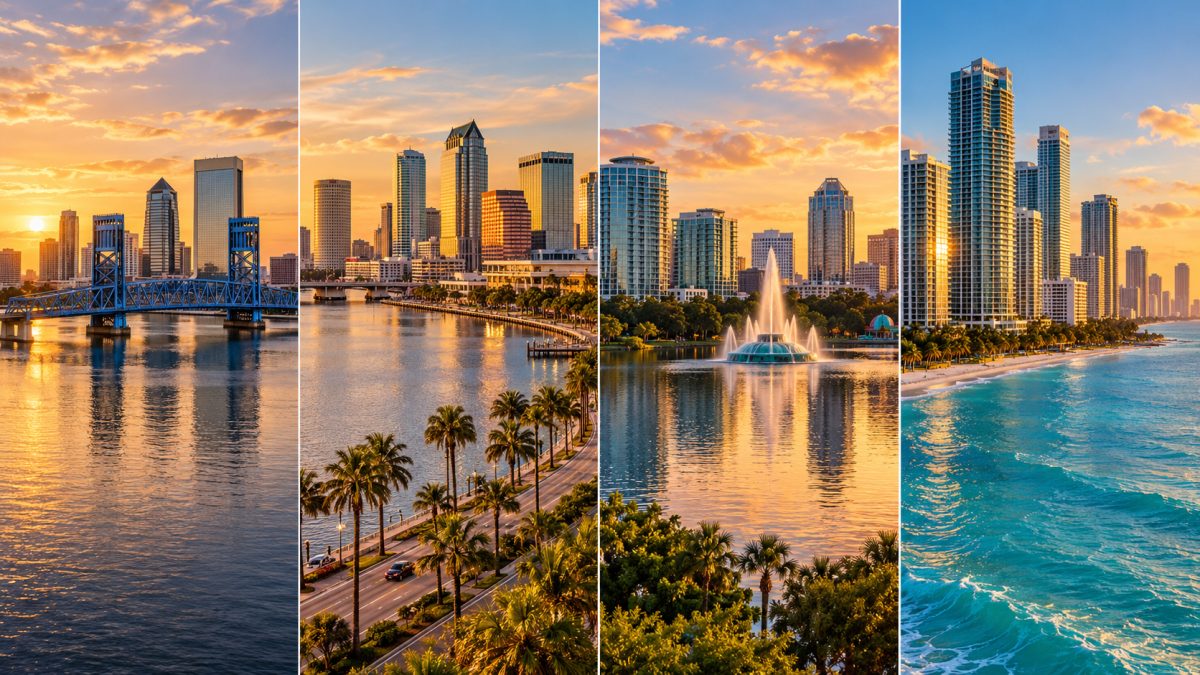
Jacksonville, Tampa, Orlando and Miami compared on pay, rent, home prices and more. Illustration: AI-generated
Jacksonville has the lowest typical home values, lowest rents, shortest average commutes and highest median household income among Florida's four major metropolitan areas when compared with Tampa, Orlando and Miami. But the differences go beyond housing costs, with each city showing distinct advantages in population, education, homeownership and employment patterns.
The Jacksonville metropolitan area's median household income was $82,053, compared with $81,044 in Orlando, $80,625 in Miami and $78,275 in Tampa, according to the U.S. Census Bureau's 2024 American Community Survey. Jacksonville also had the lowest metropolitan poverty rate of the four at 10.3%.
Meanwhile, September 2026 Zillow data placed Jacksonville's typical metro home value at $350,574, below Tampa's $356,843, Orlando's $383,302 and Miami's $476,815.
Jax Times compared the four cities using Census Bureau figures, Zillow housing data and the MIT Living Wage Calculator. Here are the answers to 14 questions residents might ask when deciding how Jacksonville measures up.
First, how do the four metropolitan areas compare?
Before examining individual categories, it is important to distinguish a city from its metropolitan area. City figures describe residents within municipal boundaries, while metro figures include the broader regional population. Mixing the two can produce misleading comparisons.
The following table shows metropolitan-area figures. Population, household income and commute times come from the 2024 Census American Community Survey. Home values and rents come from Zillow's September 2026 estimates.
| Metro area | Population | Median household income | Typical home value | Typical monthly rent | Average commute |
|---|---|---|---|---|---|
| Jacksonville | 1,760,548 | $82,053 | $350,574 | $1,680 | 27.4 min. |
| Tampa | 3,424,560 | $78,275 | $356,843 | $1,991 | 29.4 min. |
| Orlando | 2,940,513 | $81,044 | $383,302 | $1,929 | 29.0 min. |
| Miami | 6,457,988 | $80,625 | $476,815 | $2,654 | 30.2 min. |
Jacksonville leads this group on several financial measures, but a broader comparison also reveals meaningful differences in homeownership rates, educational attainment and the income needed to cover basic living expenses.
1. Which Florida city has the biggest population?
Jacksonville is the largest of the four cities by population within city limits, with 1,009,831 residents in 2024.
Miami followed with 487,006 residents, Tampa had 414,575 and Orlando had 334,871. Jacksonville's city population was larger than Tampa's and Orlando's combined total of 749,446.
The reason is partly geographic. Jacksonville consolidated with Duval County in 1968, creating municipal boundaries that encompass a much larger area than those of the other three cities. Jacksonville covers approximately 875 square miles, making it the largest city by area in the contiguous United States.
That distinction matters whenever city population figures are used to compare Jacksonville with its Florida counterparts. A larger population within city limits does not necessarily mean a larger surrounding metropolitan region.
2. Which metropolitan area is the biggest?
Miami has the largest metropolitan population of the four, while Jacksonville has the smallest.
The Miami metro had 6,457,988 residents in the 2024 Census estimates. Tampa followed with 3,424,560, Orlando with 2,940,513 and Jacksonville with 1,760,548.
Miami's metro population was more than three times Jacksonville's. Tampa and Orlando also had substantially larger metropolitan populations, even though neither Tampa nor Orlando approaches Jacksonville's city-limits population.
The comparison reverses the ranking seen when looking only at incorporated cities. For readers comparing regional housing markets, incomes or commutes, metropolitan figures provide a more consistent picture of the larger areas rather than their individual municipal boundaries.
3. Where are household incomes highest?
Jacksonville has the highest median household income among the four metropolitan areas, at $82,053.
Orlando ranked second at $81,044, followed by Miami at $80,625 and Tampa at $78,275. Jacksonville's metro median was $3,778 higher than Tampa's and $1,428 higher than Miami's.
The results change when looking at city limits. Tampa city had the highest median household income at $84,114, followed by Orlando at $77,597, Jacksonville at $72,389 and Miami at $66,337.
This is an important example of why city and metro data should not be combined. Jacksonville leads the four metros on median household income, but Tampa leads when comparing the cities themselves.
For broader context, Florida's median household income was $77,735, while the U.S. figure was $81,604 in the same 2024 Census data.
4. Where are home prices the lowest?
Jacksonville has the lowest typical home value of the four metropolitan areas, according to Zillow's September 2026 figures.
Jacksonville's typical metro home value was $350,574, compared with $356,843 in Tampa, $383,302 in Orlando and $476,815 in Miami.
That puts Jacksonville $6,269 below Tampa, $32,728 below Orlando and $126,241 below Miami. The U.S. typical home value was $366,157, meaning Jacksonville also remained below the national figure.
The year-over-year trends differed. Jacksonville declined 0.1%, Tampa fell 0.9%, Orlando dropped 1.4% and Miami increased 0.3%.
City-limits figures from the 2024 Census tell a similar affordability story, although they measure a different period and use a different definition. Jacksonville city's median owner-occupied home value was $325,300, compared with $430,200 in Orlando, $494,400 in Tampa and $598,200 in Miami.
Zillow's typical home value and the Census median home value are different measures and should not be treated as interchangeable.
5. Which city has the cheapest rent?
Jacksonville has the lowest typical monthly rent among the four metropolitan areas, at $1,680 in September 2026.
Zillow's Observed Rent Index showed Orlando at $1,929, Tampa at $1,991 and Miami at $2,654. The national figure was $1,932.
Jacksonville's typical rent was $249 less per month than Orlando's, $311 less than Tampa's and $974 less than Miami's. Across 12 months, those differences amount to $2,988, $3,732 and $11,688, respectively, if monthly amounts remained unchanged.
The 2024 Census city-limits figures also placed Jacksonville lowest. Median gross rent was $1,568 in Jacksonville city, $1,841 in Orlando, $1,898 in Tampa and $1,975 in Miami.
For renters comparing the four regions, Jacksonville's lower figures are among its clearest financial advantages. However, these are broad regional and citywide measures, not prices for an individual apartment.
6. How much do you need to earn to live in each city?
Jacksonville has the lowest estimated living-wage requirement among the four metropolitan areas for both a single adult and a family with two working adults and two children.
The MIT Living Wage Calculator, updated Feb. 15, 2026, estimates the hourly wage and annual pretax income needed to cover basic living expenses in each metro.
| Metro | Single adult hourly wage | Single adult annual income | 2 working adults, 2 children — combined annual income |
|---|---|---|---|
| Jacksonville | $23.09 | $48,037 | $109,985 |
| Tampa | $24.33 | $50,611 | $111,255 |
| Orlando | $25.16 | $52,333 | $112,351 |
| Miami | $25.86 | $53,793 | $118,583 |
A single adult without children needs an estimated $48,037 annually before taxes in Jacksonville, compared with $53,793 in Miami. That is a difference of $5,756.
For a household with two working adults and two children, Jacksonville's estimated combined requirement was $109,985, compared with $111,255 in Tampa, $112,351 in Orlando and $118,583 in Miami.
Housing contributes to the difference. MIT estimated annual housing expenses for a single adult at $16,253 in Jacksonville, $19,214 in Tampa, $19,902 in Orlando and $21,584 in Miami.
These figures are estimates of basic living needs, not an income threshold that guarantees a particular lifestyle. They also differ from median household income, which measures what households actually earn.
7. Where are commute times the shortest?
Jacksonville has the shortest average commute of the four metropolitan areas, at 27.4 minutes.
Orlando's average was 29 minutes, Tampa's was 29.4 minutes and Miami's was 30.2 minutes, according to the 2024 Census estimates.
The difference between Jacksonville and Miami was 2.8 minutes per commute. Although that may appear modest, it establishes Jacksonville's lead on the average travel-time measure used here.
Looking strictly within city limits, Jacksonville also had the shortest average at 25.6 minutes. Tampa and Orlando both averaged 26.1 minutes, while Miami averaged 27.5 minutes.
These figures describe averages, not the time a resident will spend traveling on a particular route. They also do not measure the same thing as total daily travel time or provide information about traffic on individual roads.
8. Where do the most people work from home?
Tampa has the highest work-from-home percentage among the four metropolitan areas, at 19.3%.
Jacksonville followed at 17.4%, Orlando at 16.8% and Miami at 14.3%, according to the 2024 Census estimates.
That places Jacksonville second in the metro comparison, ahead of Orlando and Miami but below Tampa. The difference between Tampa and Jacksonville was 1.9 percentage points.
City-limits figures show a somewhat different order. Tampa again led at 19.9%, followed by Miami at 15.7%, Jacksonville at 15% and Orlando at 13.2%.
The percentages describe existing work patterns rather than the availability of remote jobs. They do not establish how many employers currently offer work-from-home positions or how those opportunities may change.
9. Where do more people own their homes?
Tampa has the highest homeownership rate among the four metropolitan areas, at 68%, narrowly ahead of Jacksonville's 67.4%.
Orlando's metro homeownership rate was 61.7%, while Miami's was 60.8%. Jacksonville therefore ranked second and stood considerably above Orlando and Miami on this measure.
Within city limits, however, Jacksonville ranked first. Its homeownership rate was 58.1%, compared with 50% in Tampa, 37.2% in Orlando and 32.7% in Miami.
This difference reinforces how much municipal boundaries affect city-level comparisons. Jacksonville's city rate is notably higher than Miami's, but the gap between their overall metro rates is smaller.
For statewide perspective, Florida's homeownership rate was 68%, the same as Tampa's metropolitan figure and slightly above Jacksonville's.
10. Which Florida metro has the lowest poverty rate?
Jacksonville has the lowest poverty rate among the four metropolitan areas, at 10.3%.
Tampa followed at 11%, Orlando at 11.5% and Miami at 12.7%, according to the 2024 Census data.
Jacksonville's metro rate was also below Florida's statewide rate of 12%. Its combination of the highest median household income and lowest poverty rate gives it a favorable position on both measures among the four metros.
Within the individual cities, however, Jacksonville's poverty rate was 12.3%. Orlando stood at 14%, Tampa at 14.7% and Miami at 19.9%.
These percentages describe the share of residents below the Census poverty threshold. They do not mean the same thing as MIT's living-wage estimates, which measure the income needed for basic expenses.
11. Which city has the most college graduates?
Miami has the highest share of adults with bachelor's degrees or higher among the four metropolitan areas, at 38.7%.
Orlando was close behind at 38.5%, Jacksonville followed at 38.3% and Tampa had 36.5%. These figures refer to residents age 25 and older.
The gap between Jacksonville, Orlando and Miami was relatively small, with just 0.4 percentage points separating the three metropolitan areas.
The city-limits rankings look different. Tampa led with 48.4% of adults holding at least a bachelor's degree, followed by Orlando at 42.5%, Miami at 39.8% and Jacksonville at 34.4%.
Jacksonville city therefore had the lowest percentage among the four cities, despite its metro ranking closely behind Miami and Orlando.
12. Which of the four cities is the youngest?
Orlando has the youngest population by median age within city limits, at 35.1 years.
Tampa followed at 35.8 years, Jacksonville at 37 and Miami at 38.8, according to the 2024 Census estimates.
At the metropolitan level, Orlando also ranked youngest, with a median age of 38.7. Jacksonville followed at 39.8, Miami at 41.8 and Tampa at 42.2.
Jacksonville's metro population was younger than Florida overall, which had a median age of 42.7. The U.S. median age was 39.2, so the Jacksonville metro is slightly older than the nation but younger than Florida.
Median age describes the midpoint of a population's age distribution. It does not establish which city is growing fastest or explain why residents of different ages choose particular communities.
13. Which city has the tallest building and biggest skyline?
Jacksonville has the tallest building among Jacksonville, Tampa and Orlando, but Miami has far more buildings exceeding 300 feet.
Jacksonville's Bank of America Tower stands 617 feet tall and was completed in 1990. Tampa's tallest, 100 North Tampa, reaches 579 feet, while Orlando's 200 South Orange stands 441 feet.
Jacksonville's tallest tower is therefore 38 feet taller than Tampa's and 176 feet taller than Orlando's.
Miami presents a different scale of high-rise development. It has 166 buildings taller than 300 feet, compared with nine in Jacksonville.
The comparison nevertheless shows why the tallest individual building and the overall size of a skyline are separate measures.
14. So which Florida city offers the best overall deal?
Jacksonville offers the strongest combination of lower housing costs, higher median household income and shorter commutes among the four metropolitan areas in this comparison.
Its typical home value of $350,574 and monthly rent of $1,680 were the lowest of the group, while its $82,053 median household income was the highest. Jacksonville also recorded the lowest poverty rate and lowest estimated living-wage requirement.
That does not mean Jacksonville ranks first in every category. Tampa leads in metropolitan homeownership and working from home. Orlando has the youngest metro population, while Miami has the highest share of metropolitan residents with bachelor's degrees.
For residents prioritizing affordability relative to typical local household income, Jacksonville's numbers are particularly favorable. Those prioritizing other measures may reach a different conclusion.
The final decision depends on personal circumstances, but the numbers make Jacksonville's financial position clear: among these four metropolitan areas, it combines the lowest Zillow housing costs with the highest Census median household income.
City limits comparison: Jacksonville, Tampa, Orlando and Miami
The following table summarizes the 2024 Census figures for the cities themselves, rather than the surrounding metropolitan areas. These numbers should not be mixed with the Zillow metro figures presented earlier.
| Measure | Jacksonville city | Tampa city | Orlando city | Miami city |
|---|---|---|---|---|
| Population | 1,009,831 | 414,575 | 334,871 | 487,006 |
| Median age | 37.0 | 35.8 | 35.1 | 38.8 |
| Median household income | $72,389 | $84,114 | $77,597 | $66,337 |
| Median home value | $325,300 | $494,400 | $430,200 | $598,200 |
| Median gross rent | $1,568 | $1,898 | $1,841 | $1,975 |
| Homeownership rate | 58.1% | 50.0% | 37.2% | 32.7% |
| Poverty rate | 12.3% | 14.7% | 14.0% | 19.9% |
| Bachelor's degree or higher | 34.4% | 48.4% | 42.5% | 39.8% |
| Mean commute | 25.6 min. | 26.1 min. | 26.1 min. | 27.5 min. |
| Work from home | 15.0% | 19.9% | 13.2% | 15.7% |
The city figures underline several differences that broader metropolitan comparisons can obscure. Jacksonville has the most residents, lowest median home value, lowest median gross rent, highest homeownership rate and shortest commute among the four cities. Tampa leads in city household income, college attainment and work-from-home share.
Neither set of boundaries tells the whole story by itself. Comparing city figures with city figures and metro figures with metro figures provides a clearer basis for understanding where Jacksonville stands.
How we did this
Jax Times compared the four cities using the U.S. Census Bureau's 2024 American Community Survey one-year estimates, accessed through Census Reporter, for population, income, housing, homeownership, poverty, education, commuting and work-from-home figures.
Housing market estimates came from Zillow's September 2026 Home Value Index and Observed Rent Index. Living-wage figures came from the MIT Living Wage Calculator, updated Feb. 15, 2026. Building comparisons came from Wikipedia's skyline lists.
City-limits and metropolitan-area figures are identified separately throughout. Census median home values and gross rents are different measures from Zillow's more recent typical home values and rents.
Source: U.S. Census Bureau ACS 2024; Zillow (Sept. 2026); MIT Living Wage Calculator

News organizations may republish this story with credit. See our guidelines.
Know someone who'd want to read this? Email it to a friend.
Own a Jacksonville business? Introductory ad rates from $125/month. See ad optionsPlan your weekend with Jax Times
Get This Weekend in Jacksonville every Thursday: the best local events, free things to do and family fun, plus each evening's local news. Free, and you can unsubscribe anytime.
Most read this week
- Florida's 3 Constitutional Amendments on the Nov. 3 Ballot, Explained in Plain English
- Florida Is Holding $3 Billion in Unclaimed Money. Here's How Jacksonville and St. Augustine Residents Can Search for Free
- Early Voting in Jacksonville Starts Tuesday: All 24 Sites, the Hours, What to Bring and What's on Your Ballot
- Jacksonville and St. Augustine High School Football: Where Every Team Stands, and the Games to Watch Friday
- Duval and St. Johns School Calendars 2026-27: Every Day Off Left This School Year, Side by Side
More stories
 Local Jacksonville Is the Biggest City in the Lower 48: 874 Square Miles, Room for 2½ New York Cities and 15 More Facts About Its Size
 Local 15 Famous People From Jacksonville: The Song Behind the Black National Anthem, King Kong, Lynyrd Skynyrd, Twilight and More
 Local Gone but Not Forgotten: 10 Jacksonville Places We Still Miss, From the Landing to the Coliseum and Wolfson Park
 Local St. Johns Is Florida's Fastest-Growing County, Adding 36 People a Day, as Northeast Florida Passes 2 Million
Comments
Be respectful. No personal attacks, hate speech, spam or anyone's private information. Every comment is reviewed before it appears. Comment rules
No comments yet. Be the first to share your thoughts.