Camp Blanding at 87: How a 1939 Clay County Guard Camp Trained 9 Infantry Divisions in World War II
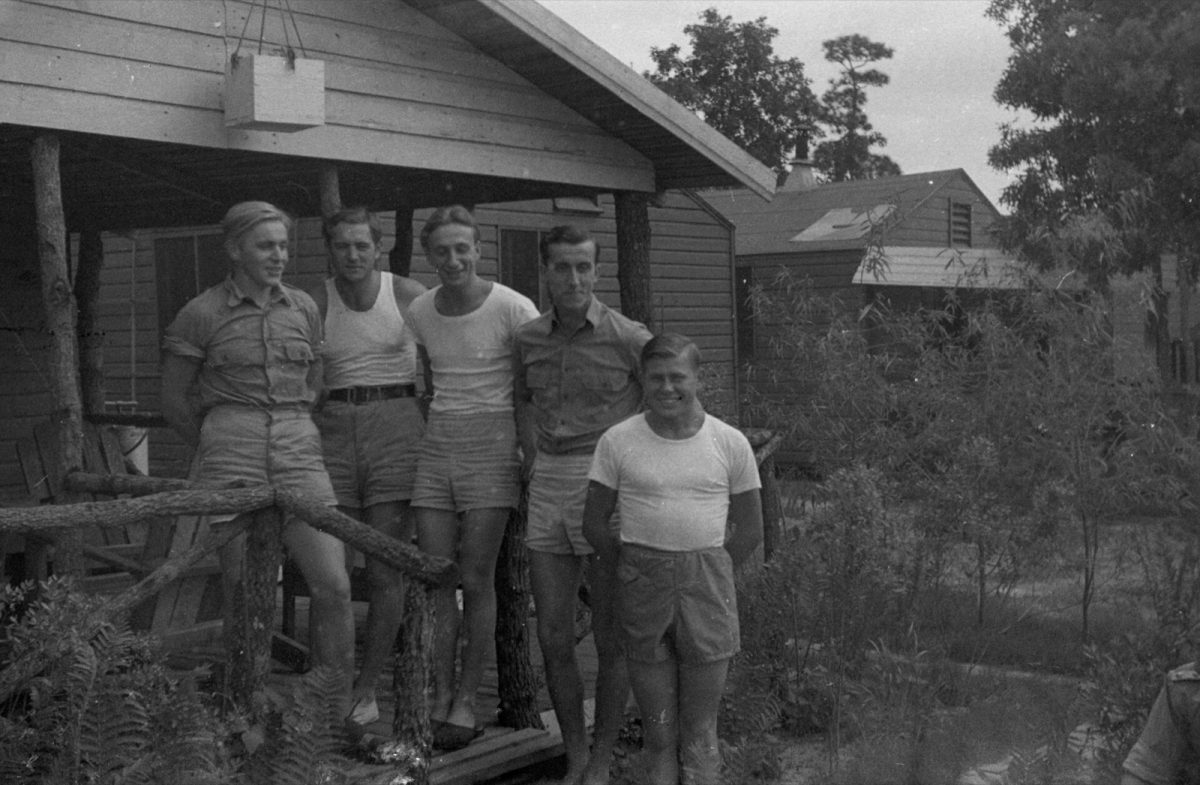
Men outside a wooden barracks in a 1944 photo labeled as the Camp Blanding prisoner of war camp. Photo: foundin a attic / Wikimedia Commons (CC BY 2.0)
STARKE, Fla. - Camp Blanding marks 87 years in 2026, tracing its history to a Florida National Guard training camp established in 1939 that went on to train nine U.S. Army infantry divisions during World War II. The installation grew from an original state acquisition of just over 28,000 acres into a wartime military center that handled hundreds of thousands of personnel. Today, Camp Blanding Joint Training Center covers about 73,000 acres in Clay County and remains the Florida National Guard's primary military reservation and training base.
Although Camp Blanding uses a Starke mailing address, the installation lies entirely in Clay County, while Starke itself is in neighboring Bradford County. The military reservation includes Kingsley Lake and provides training areas for multiple branches of the armed forces. Its history stretches from the rapid mobilization of World War II through modern military operations and emergency management training.
1939-1940: A New Camp Takes Shape at Kingsley Lake
Camp Blanding began as a replacement for the Florida National Guard's earlier training site, Camp Joseph E. Johnston, which the Guard called Camp Foster. That property was sold to the federal government and became Naval Air Station Jacksonville. Florida's state Armory Board selected land near Kingsley Lake to maintain a National Guard training location close to Jacksonville.
Between December 1939 and November 1940, the state acquired just over 28,000 acres through purchases and eminent domain, according to the Camp Blanding Museum. The Work Projects Administration initially supplied funding and labor to construct water and sewer systems, fences and roads. The Florida Adjutant General's fiscal 2025 report identifies 1939 as the year the installation was organized.
The original plans called for a training camp large enough for one infantry regiment, but military requirements quickly changed. By early 1940, planners expanded the proposed capacity to a brigade, and by the end of that year, the camp was designed to accommodate two infantry divisions and supporting units. The installation was named for Maj. Gen. Albert Hazen Blanding, who had commanded the 31st "Dixie" Infantry Division, served as Chief of the National Guard Bureau and received his Florida National Guard commission in 1899.
1940-1943: Nine Infantry Divisions Train for World War II
In August 1940, the federal government took control of Camp Blanding for Army training. Federal authorities acquired approximately 40,000 additional acres and leased roughly 80,000 acres east of the installation for military maneuvers, expanding the wartime training area to about 150,000 acres. The camp's transformation accelerated after the National Guard mobilized in November 1940.
The 31st and 43rd Infantry Divisions arrived for initial organization and training, according to the Camp Blanding Museum. Units of the 31st Division, including Florida National Guard personnel, converged on the installation in December 1940. The Florida Department of Military Affairs says Florida mobilized 3,940 National Guard officers and enlisted personnel during World War II.
Between 1940 and 1943, nine Army infantry divisions trained at Camp Blanding, according to both the museum and Wikipedia. They were the 1st, 29th, 30th, 31st, 36th, 43rd, 63rd, 66th and 79th Infantry Divisions. The 508th Parachute Infantry Regiment was also established at Camp Blanding in October 1942.
The installation developed into a military community with infrastructure comparable to a city. According to Wikipedia, Camp Blanding had approximately 10,000 buildings, 125 miles of paved roads and Florida's largest hospital at its wartime peak. Both Wikipedia and the Camp Blanding Museum describe the installation's peak population as equivalent to Florida's fourth-largest city.
Camp Blanding also published newspapers, including The Bulletin, the Bayonet and the Camp Blanding Report, according to Wikipedia. Japanese-American volunteers preparing to join the 442nd Regimental Combat Team as replacements also trained at the installation. In August 1943, the last infantry divisions departed, and Camp Blanding became an Infantry Replacement Training Center. The museum reports that nearly 175,000 men trained at the replacement center. The museum estimates that more than 745,000 military personnel served at Camp Blanding during the war, while Wikipedia reports that more than 800,000 soldiers trained there. The two sources give different totals, so Jax Times attributes each one.
1942-1946: German Prisoners of War Held at Camp Blanding
Camp Blanding also operated a German prisoner-of-war camp from September 1942 through April 1946, according to the Camp Blanding Museum. The detention operation lasted approximately three years and seven months. The museum reports that more than 4,000 men, including German soldiers, submarine sailors and civilian enemy aliens, were detained there during the war.
Wikipedia reports that the camp held about 1,200 Germans at its peak and describes 15 smaller camps holding 250 to 300 prisoners each. The museum's figure of more than 4,000 represents people detained over time, rather than the number held at one moment. According to Wikipedia, six German prisoners who died at Camp Blanding were later moved to Fort Benning, Georgia, in April 1946. Their original grave markers remain at Camp Blanding.
1947-1991: The Camp Returns to State Control and Changes Roles
After World War II, control of Camp Blanding returned to Florida's state Armory Board. The state retained approximately 28,000 acres along with the roads, sewer systems and water infrastructure developed during the war. Most of the camp's buildings were dismantled or sold between 1947 and 1949, according to the Camp Blanding Museum.
In December 1947, DuPont agreed to mine ilmenite, staurolite and zircon at Camp Blanding. The museum reports that the mining arrangement provided a major funding source for approximately 60 years. A sub-caliber tank range was built in 1956 to support the 48th Armored Division. Camp Blanding added Officer Candidate School in 1961, a Jungle Warfare Training Site for Special Forces in 1965 and a Non-Commissioned Officers School in 1975. During Desert Shield and Desert Storm, Camp Blanding supported the 101st Airborne Division as it awaited transportation to Jacksonville for deployment.
2025-2026: More Than 336,000 Personnel Train at Camp Blanding
Camp Blanding supported training operations on 309 days during fiscal 2025, according to Florida's Adjutant General's report. The installation recorded 336,566 personnel trained, including 279,735 from the five military branches and 56,831 from non-Defense agencies, based on Jax Times calculations from the report. Army personnel accounted for 261,483 of the total, representing 192 units.
The installation provides approximately 55,000 acres for maneuver training and more than 50 live-fire ranges. Additional facilities include more than 60 helicopter landing zones, drop zones, an air assault strip, an urban terrain training facility and waterborne training areas. Camp Blanding also hosts the Regional Training Institute and Florida Division of Emergency Management academies while serving as a mobilization and deployment hub.
The installation reported $31 million in construction completed during 2025, with more than $142 million in projects underway for fiscal 2026 completion and another $47 million in design for fiscal 2027. Planned facilities include an Operational Readiness Training Complex with billeting, unit headquarters and dining facilities, along with a new multipurpose machine gun range. Col. Jeremy T. Hopkins is identified as the installation commander in the fiscal 2025 report.
Camp Blanding remains the primary training site for most Florida National Guard units and the 53rd Infantry Brigade. According to Wikipedia, it also supports Special Forces, infantry, airfield operations and Air National Guard units, including the 202nd RED HORSE Squadron. The installation serves as Florida's alternate Emergency Operations Center and hosts Florida State Guard training.
1990-Today: Visiting the Camp Blanding Museum
The Camp Blanding Museum was established in 1990, and its displays focus on Camp Blanding's World War II history. Located at 5629 State Road 16 West, Building 3040, Starke, FL 32091, the museum displays uniforms, weapons, equipment, vehicles and aircraft from the 1940s. Its outdoor Memorial Park includes larger artifacts from World War II, Vietnam and Desert Storm, along with monuments honoring military units that trained at Camp Blanding.
According to Wikipedia, the museum occupies a restored World War II building just outside the installation's main gate. Its exhibits include "Firebase Florida," a re-creation of a Vietnam-era artillery firebase. The museum also operates a gift shop and has outlined a three-phase expansion involving preservation and research facilities, restoration of the existing museum building and additional exhibits covering post-World War II conflicts.
The museum lists daily operating hours from noon to 4 p.m., with free admission and donations appreciated. Tours outside regular hours are available by appointment, and visitors can call (904) 682-3196 to confirm hours and arrangements before traveling. Museum president Matt Johnson and curator Greg Parsons oversee an institution dedicated to preserving the history of a military installation that has operated for 87 years.
## How we did this Jax Times compiled this history using the Camp Blanding Museum's official history and visitor information, the Florida Department of Military Affairs' fiscal 2025 Adjutant General's Report and Wikipedia, with information reviewed Oct. 28, 2026. Where sources differed, including estimates of wartime personnel, original acreage and prisoner-of-war populations, we identified the source and distinguished cumulative totals from peak populations. Jax Times calculated the installation's 87-year history from 1939 to 2026 and verified the fiscal 2025 personnel total by adding the military branch and non-Defense agency figures published in the state report.
Source: Camp Blanding Museum, Florida Department of Military Affairs (FY2025 Adjutant General's Report and WWII commemoration page) and Wikipedia
News organizations may republish this story with credit. See our guidelines.
Know someone who'd want to read this? Email it to a friend.
Own a Jacksonville business? Introductory ad rates from $125/month. See ad options Follow Jax Times on FacebookLocal news, events and people, in your feed every day.Most read this week
- Florida's 3 Constitutional Amendments on the Nov. 3 Ballot, Explained in Plain English
- Jacksonville Fair 2026 Guide: Dates, Gate Times, Ticket Prices, Free Days and Every Concert (Nov. 5-15)
- Coastal Flood Warning for Jacksonville: Water Peaks Sunday and Monday Mornings in 5 Flood-Prone Areas
- Early Voting in Jacksonville Starts Tuesday: All 24 Sites, the Hours, What to Bring and What's on Your Ballot
- St. Augustine Artist Dara Dodson Paints 'A Land Remembered,' With Shows at the Karpeles Museum and the St. Augustine Art Association
More stories
 Local How to Get a Florida Saltwater Fishing License in 6 Steps: $17 for Residents, $47 for Visitors
 Local Jacksonville Terminal by the Numbers: A 1919 Rail Station, 14 Columns and 78,000 Square Feet of Exhibit Halls
 Local St. Johns County's $191.8 Million SR 207 Water Plant Is Running, Built to Save 13 Billion Gallons
 Local How to Adopt a Pet From Jacksonville's City Shelter in 5 Steps: Fees From $80 to Free
Comments
Be respectful. No personal attacks, hate speech, spam or anyone's private information. Every comment is reviewed before it appears. Comment rules
No comments yet. Be the first to share your thoughts.