Duval County Property Taxes 2026: 8 Steps to Read Your Bill, Get Discounts and Save Money
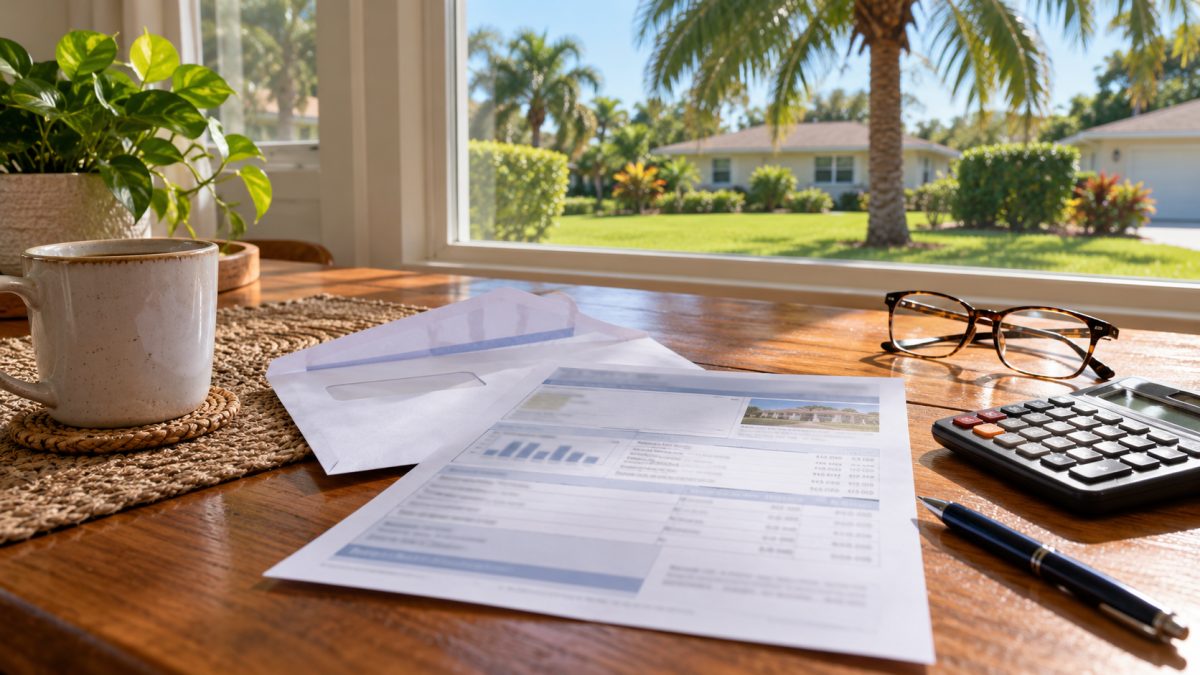
Duval County property tax bills go out in November, when paying early earns a 4% discount. Illustration: AI-generated
Duval County property tax bills go out in November, and homeowners who pay during November receive a 4% discount on their property taxes. Waiting until December reduces that discount to 3%, and the savings continue shrinking each month until March, when the full amount is due.
For a Jacksonville homeowner with a $300,000 assessed property value and a standard homestead exemption, the tax calculation using last year's general Jacksonville rates comes to approximately $4,593.88 before additional assessments. A 4% November discount would save about $183.76 on that amount.
The actual 2026 bill depends on the property's assessed value, exemptions, taxing district, current millage rates and any additional assessments. Homeowners should review those details before making a payment rather than assuming their bill will match last year's amount.
The Duval County Tax Collector offers online payments and an installment program, while Florida's homestead exemption can significantly reduce the taxable value of an eligible primary residence.
Here is a step-by-step guide to understanding your bill, checking the calculations and avoiding unnecessary charges.
Step 1: Know when your property tax bill arrives and how the discounts work
Duval County sends annual property tax notices in November, with discounts available for early payment.
The largest standard discount is available during November. Each following month reduces the discount by one percentage point until March, when no early-payment discount remains.
| Payment month | Discount | What it means |
|---|---|---|
| November | 4% | Largest standard discount |
| December | 3% | Discount decreases |
| January | 2% | Smaller early-payment savings |
| February | 1% | Final discount month |
| March | 0% | Full amount due |
| April 1 or later | None | Taxes become delinquent; minimum 3% mandatory interest applies |
Property taxes become delinquent April 1. At that point, a minimum mandatory interest charge of 3% applies, along with advertising costs and inclusion in the tax certificate sale process.
The difference between paying early and paying late can therefore involve both losing the available discount and incurring additional charges.
Homeowners can make payments through the Duval County Tax Collector's website at taxcollector.jacksonville.gov. The site also provides information about partial payments, which residents can review if they are unable to pay the entire amount at once.
The discount calendar applies statewide, but the amount of the bill itself depends on local tax rates and the property's taxable value.
Step 2: Understand the five main parts of your property tax bill
Before paying, homeowners should identify the assessed value, exemptions, taxable value, millage rates and any non-ad valorem assessments.
These pieces work together to determine the amount owed. Understanding the difference between them is particularly important because the property's assessed value is not necessarily the amount subject to every tax.
Assessed value: Florida property assessments are based on Jan. 1 values. This is the value used as the starting point for determining taxable value, after applying any relevant assessment limitations.
Exemptions: Eligible homeowners may receive exemptions that reduce the amount of property value subject to certain taxes. The homestead exemption is particularly important for qualifying permanent residences.
Taxable value: This is the amount remaining after applicable exemptions are deducted from the assessed value. A property can have different taxable values for school taxes and other property taxes because not every exemption applies equally.
Millage rate: This determines the tax charged for each $1,000 of taxable value. Rates vary depending on the taxing authorities that apply to the property's location.
Non-ad valorem assessments: These are charges listed separately from the value-based property tax calculation. Examples include solid waste and stormwater fees, which can increase the total amount shown on the bill.
The key is to examine the individual components rather than looking only at the final amount due.
For example, a homeowner receiving a homestead exemption should recognize that the taxable value used for school taxes can differ from the taxable value used for other local taxes.
That distinction becomes especially important when estimating whether the correct exemptions have been applied.
Step 3: Learn what a mill is and how Jacksonville property taxes are calculated
A mill is simply $1 in property tax for every $1,000 of taxable property value.
If a property has $100,000 in taxable value, each mill represents $100 in annual property tax. The total millage rate is made up of the rates imposed by the applicable taxing authorities.
In Duval County, those authorities include schools, city government, the St. Johns River Water Management District and the Florida Inland Navigation District. Some locations also have separate municipal tax components.
To calculate a property tax amount, divide the taxable value by 1,000 and multiply by the applicable millage rate.
For instance, 1 mill on $100,000 of taxable value produces $100 in tax. A rate of 17 mills on that same taxable value would produce $1,700 before any exemptions or other factors affecting the calculation.
One important caution: the following district rates are from 2025, not 2026. They are useful for understanding how Duval County's tax system works, but residents should check the 2026 rates printed on their current bill or August Truth in Millage (TRIM) notice.
Duval County's 2025 property tax rates by district
| Taxing district | Schools | Jacksonville GSD | Local city | Water district | Navigation district | Total mills |
|---|---|---|---|---|---|---|
| General Services District (USD1) | 6.3430 | 11.1919 | — | 0.1793 | 0.0270 | 17.7412 |
| Jacksonville Beach (USD2) | 6.3430 | 7.9012 | 3.9947 | 0.1793 | 0.0270 | 18.4452 |
| Atlantic Beach (USD3) | 6.3430 | 7.9012 | 2.7499 | 0.1793 | 0.0270 | 17.2004 |
| Neptune Beach (USD4) | 6.3430 | 7.9012 | 3.3656 | 0.1793 | 0.0270 | 17.8161 |
| Baldwin (USD5) | 6.3430 | 9.4208 | 3.0000 | 0.1793 | 0.0270 | 18.9701 |
The General Services District covers most of Jacksonville and had a total 2025 millage rate of 17.7412.
The other districts have different combinations of general services and local municipal rates. Baldwin had the highest combined rate listed in the 2025 schedule at 18.9701 mills, while Atlantic Beach had the lowest at 17.2004 mills.
That does not mean homeowners in Baldwin necessarily have larger tax bills than homeowners in Atlantic Beach. The actual amount depends on taxable property values, exemptions and additional assessments, not solely on the millage rate.
Did Jacksonville's tax rate fall last year?
Yes. The General Services District city millage rate declined from 11.3169 mills in 2024 to 11.1919 mills in 2025.
The total General Services District rate also decreased, from 17.8650 mills in 2024 to 17.7412 mills in 2025.
Over that period, the school rate changed from 6.3400 to 6.3430 mills, while the Florida Inland Navigation District rate declined from 0.0288 to 0.0270 mills. The water management district rate remained 0.1793 mills.
These figures describe the change between 2024 and 2025 only. They do not establish whether an individual homeowner's 2026 tax bill increased or decreased.
For that answer, property owners need to compare their own bills and verify the current year's rates.
Step 4: See what property taxes could look like on a $300,000 Jacksonville home
To demonstrate how the calculation works, consider a home with a $300,000 assessed value in Jacksonville's General Services District.
The example uses the final 2025 millage rates and assumes the standard homestead exemption applies. It is not a prediction of the property's 2026 tax bill.
Example A: $300,000 assessed value with homestead exemption
For school taxes, the first $25,000 homestead exemption reduces the taxable value from $300,000 to $275,000.
The school millage rate in this example is 6.3430.
School tax calculation:
$300,000 − $25,000 = $275,000 taxable value
$275,000 ÷ 1,000 = 275
275 × 6.3430 = $1,744.33
For non-school property taxes, the example applies a total $50,000 homestead reduction, leaving $250,000 in taxable value.
The combined non-school millage rate is 11.3982, consisting of Jacksonville's 11.1919 rate, the water management district's 0.1793 rate and the navigation district's 0.0270 rate.
Non-school tax calculation:
$300,000 − $50,000 = $250,000 taxable value
$250,000 ÷ 1,000 = 250
11.1919 + 0.1793 + 0.0270 = 11.3982 mills
250 × 11.3982 = $2,849.55
Total estimated value-based property taxes:
$1,744.33 + $2,849.55 = $4,593.88
Paying that amount during November would produce a 4% discount of approximately $183.76.
That calculation does not include non-ad valorem assessments, such as any separately listed solid waste or stormwater charges.
Example B: The same $300,000 home without homestead exemption
Without the homestead exemption, the entire $300,000 assessed value is taxable in this simplified example.
Using the same General Services District total rate of 17.7412 mills:
$300,000 ÷ 1,000 = 300
300 × 17.7412 = $5,322.36
| Example | Calculated property tax |
|---|---|
| $300,000 assessed value, with homestead | $4,593.88 |
| $300,000 assessed value, without homestead | $5,322.36 |
| Difference | $728.48 |
The difference is $728.48 before early-payment discounts or additional assessments.
The example shows why homestead status matters, even when two properties have the same assessed value. It also demonstrates why the final tax bill cannot be determined from the property's assessed value alone.
Step 5: Check whether you qualify for the homestead exemption
Florida's homestead exemption is available for eligible owner-occupied properties used as permanent residences.
The exemption removes the first $25,000 of assessed value from property taxes and provides an additional exemption for qualifying assessed value above $50,000. The additional portion applies to non-school taxes, not school taxes.
The second exemption has been adjusted for inflation since 2025, following approval of Amendment 5 in 2024. Because that amount can change, homeowners should check the applicable exemption listed in their property records rather than assume the maximum is exactly $50,000 in 2026.
Qualifying for homestead can also activate Florida's Save Our Homes assessment limitation.
Under Save Our Homes, annual increases in assessed value for qualifying homestead property are generally limited to 3% or the change in the Consumer Price Index, whichever is lower.
That limitation is separate from the exemption itself. The exemption reduces taxable value, while Save Our Homes limits qualifying increases in assessed value over time.
Florida also allows eligible homeowners to transfer accumulated Save Our Homes assessment savings when moving from one Florida homestead to another through a provision called portability.
Non-homestead property operates under different rules. Current law generally caps annual assessed-value increases at 10% for non-school property taxes.
When is the homestead filing deadline?
The regular homestead exemption application deadline is March 1.
The Duval County Property Appraiser permits late filing through early September, but homeowners should not assume that late filing will be available indefinitely or that an exemption will automatically appear without an application.
Property owners should verify whether their existing exemption is reflected correctly and whether they need to apply after purchasing or changing their permanent residence.
Step 6: Consider Duval County's property tax installment plan
Homeowners who prefer to spread their property tax payments across the year can review the installment program offered through the Duval County Tax Collector.
The program divides payments into four scheduled installments rather than requiring the entire bill to be paid during the normal November-through-March payment period.
Applications are due by April 30 of the year you want to start. For example, to pay your 2027 taxes in installments, you'd apply by April 30, 2027, and make the first payment by June 30, 2027. It's too late to use the plan for the 2026 bills arriving in November.
The installment schedule is:
| Installment | Payment deadline | Discount |
|---|---|---|
| First | June 30 | 6% |
| Second | Sept. 30 | 4.5% |
| Third | Dec. 31 | 3% |
| Fourth | March 31 | 0% |
The first installment is particularly important because it must be paid to remain in the program.
The 6%, 4.5% and 3% installment discounts apply to the respective installments under the program's schedule. They should not be interpreted as discounts applied to the entire annual tax bill.
For residents interested in predictable payments throughout the year, the installment plan provides an alternative payment structure. However, eligibility, application timing and the requirement to make the first payment should be reviewed before choosing it.
Information about applying is available through the Duval County Tax Collector's website.
Step 7: Know what the Nov. 3 ballot could change about future property taxes
Duval County voters will see two questions on the Nov. 3, 2026, ballot that could affect property taxation.
Neither should be confused with the rates used to calculate the current 2026 tax bill.
Florida Amendment 3
Amendment 3 proposes changes to Florida's property tax structure, including a larger homestead exemption for non-school taxes.
Under the proposal, the non-school homestead exemption would increase to $150,000 in 2027 and $250,000 in 2028, with inflation adjustments afterward.
The amendment would also reduce the current non-homestead assessed-value increase cap from 10% to 5% and place restrictions on what local property taxes could fund.
For people who become Florida residents after Dec. 31, 2026, the proposal would delay access to the larger exemption until their fifth year.
If approved, the changes would begin Jan. 1, 2027. As a state constitutional amendment, it requires at least 60% voter approval.
The proposal concerns future tax rules. It would not change the November 2026 discount schedule or automatically alter the calculation of taxes already assessed for 2026.
Duval County's school tax question
Duval voters will also decide whether to continue the school district's existing 1-mill operating tax from July 1, 2027, through June 30, 2031.
One mill equals $100 annually for each $100,000 of taxable property value.
The measure concerns continuation of an existing school operating tax, rather than introducing an entirely separate method of calculating property taxes.
Voters evaluating the measures should distinguish between the proposed statewide constitutional changes and Duval County's local school tax continuation question.
Step 8: Review your bill before paying and avoid unnecessary penalties
Once the November bill arrives, compare the information with your property records and confirm that the correct exemptions and taxing district are reflected.
Check the assessed value, taxable values, millage components and any separately listed fees. Then determine whether paying in November is feasible, since that provides the largest standard early-payment discount.
If an installment plan is more appropriate for a future tax year, review the April 30 application deadline and the four required payment dates.
Property owners should also compare their current 2026 rates with the figures listed on their August TRIM notice rather than relying on the older 2025 millage table in this guide.
The main deadlines are straightforward: November offers the 4% discount, March is the final month to pay without delinquency, and April 1 begins the period when mandatory interest and additional collection costs apply.
Checking the details early gives homeowners an opportunity to identify differences in their assessments or exemptions before focusing only on the amount due.
What about property owners in St. Johns, Clay and Nassau counties?
The same general early-payment discount schedule applies throughout Florida, including St. Johns, Clay and Nassau counties.
That means the standard discounts are 4% in November, 3% in December, 2% in January and 1% in February, with no discount in March. Taxes become delinquent April 1 under the statewide schedule.
However, the millage rates and taxing authorities differ by county and location. The Duval County rates shown above should not be used to calculate property taxes on homes in surrounding counties.
St. Johns County homeowners can review payment and tax information through the St. Johns County Tax Collector at sjctax.us.
Clay and Nassau property owners should use the information supplied by their respective county tax offices and review the rates and assessments listed on their own bills.
How we did this
Jax Times used information from the Duval County Tax Collector at taxcollector.jacksonville.gov, including real estate tax payment deadlines, early-payment discounts, delinquency rules and installment plan procedures.
Millage figures came from the Duval County Property Appraiser's final 2024 and 2025 millage charts, available through jacksonville.gov. The worked $300,000 property examples use the 2025 General Services District rates, not unverified 2026 rates.
Information about homestead exemptions, Save Our Homes and portability came from the Duval County Property Appraiser. Ballot descriptions come from the official ballot language for Florida Amendment 3 and Duval County's Nov. 3, 2026, school tax referendum, as summarized in Jax Times' earlier amendments guide.
Readers should use their actual 2026 property tax bill and TRIM notice for current rates, taxable values and charges.
Source: Duval County Tax Collector; Duval County Property Appraiser

News organizations may republish this story with credit. See our guidelines.
Know someone who'd want to read this? Email it to a friend.
Own a Jacksonville business? Introductory ad rates from $125/month. See ad optionsPlan your weekend with Jax Times
Get This Weekend in Jacksonville every Thursday: the best local events, free things to do and family fun, plus each evening's local news. Free, and you can unsubscribe anytime.
Most read this week
- Florida's 3 Constitutional Amendments on the Nov. 3 Ballot, Explained in Plain English
- Florida Is Holding $3 Billion in Unclaimed Money. Here's How Jacksonville and St. Augustine Residents Can Search for Free
- Early Voting in Jacksonville Starts Tuesday: All 24 Sites, the Hours, What to Bring and What's on Your Ballot
- Jacksonville and St. Augustine High School Football: Where Every Team Stands, and the Games to Watch Friday
- Duval and St. Johns School Calendars 2026-27: Every Day Off Left This School Year, Side by Side
More stories
 Local Jacksonville vs. Tampa, Orlando and Miami: 14 Questions Answered on Pay, Rent and Home Prices
 Local Jacksonville's 23 Tallest Buildings Ranked, From 212 to 617 Feet
 Real Estate 59 Jacksonville-Area ZIP Codes Ranked by Home Value: Prices, Gains and Declines in 2026
 Local The Great Fire of 1901: How a Pile of Spanish Moss Burned Down Jacksonville in 8 Hours, and Built the City We Know
Comments
Be respectful. No personal attacks, hate speech, spam or anyone's private information. Every comment is reviewed before it appears. Comment rules
No comments yet. Be the first to share your thoughts.