Jacksonville's New $15 Minimum Wage: What 20, 30 and 40 Hours a Week Actually Pays in 2026
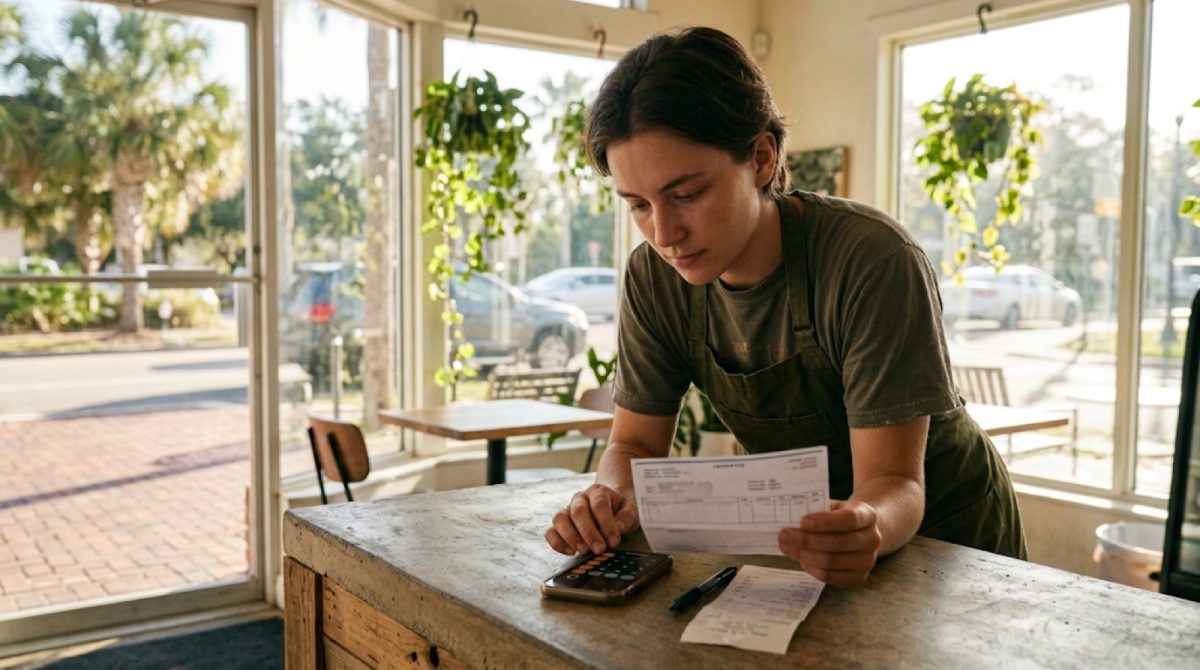
Florida’s minimum wage rose to $15 an hour on Sept. 30, 2026. Illustration: AI-generated
Jacksonville workers earning minimum wage must now receive at least $15 an hour, following Florida's latest increase on Sept. 30, 2026. That works out to $600 a week, $2,600 a month or $31,200 a year for someone working 40 hours every week, before taxes and other deductions.
The new rate also applies in St. Augustine, Orange Park, Ponte Vedra Beach, Fernandina Beach and the rest of Northeast Florida. For employees working fewer than 40 hours, however, annual earnings can be considerably lower.
A worker scheduled for 20 hours a week earns $15,600 a year at the new minimum. Someone working 30 hours earns $23,400, assuming the same schedule continues throughout the year.
Florida's Department of Commerce confirms that the $15 rate took effect Sept. 30 and will remain in place through Dec. 31, 2027. The increase completed the scheduled dollar-a-year raises approved by Florida voters in November 2020.
Here's what the new wage means in actual dollars, how it compares with the previous rate, and what workers need to know about tips, overtime and paycheck calculations.
How much does $15 an hour pay in Jacksonville?
The amount depends on how many hours an employee actually works. For someone paid $15 an hour, every additional hour adds $15 in gross wages, until overtime rules require a higher rate.
The following table assumes a worker receives the same number of paid hours every week for 52 weeks. Monthly income is calculated by dividing annual earnings by 12, rather than assuming every month contains exactly four weeks.
| Hours per week | Weekly pay | Average monthly pay | Annual pay |
|---|---|---|---|
| 10 | $150 | $650 | $7,800 |
| 15 | $225 | $975 | $11,700 |
| 20 | $300 | $1,300 | $15,600 |
| 25 | $375 | $1,625 | $19,500 |
| 30 | $450 | $1,950 | $23,400 |
| 35 | $525 | $2,275 | $27,300 |
| 40 | $600 | $2,600 | $31,200 |
Source: JAX TIMES calculations using Florida's $15 hourly minimum wage, 52 weeks per year and 12 months per year. All amounts are gross earnings before deductions and exclude overtime.
The difference between part-time and full-time schedules is substantial. A worker receiving 20 hours instead of 40 hours earns exactly half as much, even though both workers receive the same hourly wage.
That distinction matters when comparing job offers in Jacksonville. An employer offering $15 an hour for 25 hours a week is offering a very different amount of annual income from an employer guaranteeing 40 hours.
The calculations also assume steady employment throughout the year. Unpaid time off, changes in schedules or periods without work would reduce the actual annual total.
How much more money does the 2026 increase provide?
Florida's minimum wage increased from $14 to $15 an hour on Sept. 30. The additional dollar represents a 7.14% increase in the hourly minimum.
For workers who were earning exactly $14 and moved to $15, the gain depends on their number of paid hours. A full-time employee working 40 hours receives $40 more per week before deductions.
| Weekly hours | Weekly increase | Annualized increase |
|---|---|---|
| 15 | $15 | $780 |
| 20 | $20 | $1,040 |
| 25 | $25 | $1,300 |
| 30 | $30 | $1,560 |
| 35 | $35 | $1,820 |
| 40 | $40 | $2,080 |
Calculations compare $14 and $15 hourly wages over 52 weeks at unchanged hours.
For a full-time minimum-wage worker, annual gross pay rises from $29,120 to $31,200. That is an additional $2,080 over a hypothetical full 52-week year at the new rate.
The actual increase received during calendar year 2026 will be smaller because the higher wage took effect near the end of September. Workers receive the new legal minimum for covered hours worked beginning on the effective date, not retroactively for every hour worked earlier in the year.
The increase also does not mean every employee receives an automatic $1 raise. Someone already earning $16 an hour is not entitled to $17 solely because the legal minimum moved from $14 to $15.
How much is $15 an hour every two weeks?
A Jacksonville employee working 40 hours each week would earn $1,200 in gross wages over two weeks, assuming no overtime or additional compensation.
That is different from receiving two checks totaling the same amount every month. A biweekly payroll generally produces 26 regular paychecks over 52 weeks, while a twice-monthly payroll normally produces 24.
For a consistently employed worker earning $31,200 annually, the difference looks like this:
| Pay schedule | Gross amount per paycheck |
|---|---|
| Weekly, 40 hours | $600 |
| Every two weeks, 80 hours | $1,200 |
| Twice monthly, annual average | $1,300 |
| Monthly, annual average | $2,600 |
These figures do not represent take-home pay. Federal income tax withholding, Social Security and Medicare taxes, insurance premiums and other applicable deductions can lower the deposit appearing in a worker's bank account.
Workers should also distinguish their hourly rate from the hours shown on each pay statement. Someone paid $15 an hour for 72 hours during a two-week period would receive $1,080 before deductions, not the $1,200 shown for an 80-hour period.
What happened to Florida's minimum wage over the past five years?
Florida voters approved the constitutional amendment raising the minimum wage in the Nov. 3, 2020, election. Instead of immediately increasing to $15, the measure established a schedule of increases through September 2026.
The Florida Department of State's official constitutional initiative record documents the increases. Under that schedule, the wage reached $10 in September 2021 and increased by another dollar each September until reaching $15.
| Effective date | Minimum hourly wage |
|---|---|
| Sept. 30, 2021 | $10 |
| Sept. 30, 2022 | $11 |
| Sept. 30, 2023 | $12 |
| Sept. 30, 2024 | $13 |
| Sept. 30, 2025 | $14 |
| Sept. 30, 2026 | $15 |
Over those five annual steps, Florida's scheduled minimum wage rose 50%, from $10 to $15 an hour.
At 40 hours a week for 52 weeks, $10 an hour equals $20,800 in annual gross pay. At $15, the same schedule produces $31,200, a difference of $10,400.
Those are nominal earnings, not inflation-adjusted figures. The comparison demonstrates the size of the statutory increase but does not measure whether workers can purchase proportionally more goods and services.
What is the new minimum wage for restaurant servers and tipped workers?
Florida permits qualifying employers to count a limited amount of employees' tips toward their minimum-wage obligations.
Beginning Sept. 30, 2026, the minimum direct cash wage for qualifying tipped workers is $11.98 an hour, plus tips. The combined amount must meet at least Florida's $15 hourly minimum.
The difference is $3.02 per hour, which is the maximum tip credit used in this example. Employers must satisfy the applicable legal requirements before claiming that credit.
Consider a tipped employee working 30 hours in a week:
| Component | Weekly amount |
|---|---|
| Direct wages at $11.98 | $359.40 |
| Maximum tip credit at $3.02 | $90.60 |
| Combined minimum required | $450.00 |
If the employee receives sufficient qualifying tips, the combination of direct wages and tips can satisfy the $450 minimum for those 30 hours.
But the employer cannot simply assume tips will cover the difference. The U.S. Department of Labor explains that an employer claiming a tip credit must ensure the worker receives enough in direct wages and qualifying tips to meet the applicable minimum-wage requirement.
Federal rules also prohibit employers, managers and supervisors from keeping employees' tips. Tip-pooling arrangements have additional requirements, and employers cannot treat every type of worker or every payment as interchangeable.
For Jacksonville restaurant workers, the important comparison is between the direct cash wage, actual tips received and total legally required compensation. A lower direct hourly wage does not eliminate the employer's responsibility to meet the full applicable minimum.
Does overtime increase the $15 hourly wage?
Yes, for covered employees who are not exempt from overtime requirements.
Under the federal Fair Labor Standards Act, most covered nonexempt employees must receive at least one and a half times their regular rate for hours worked beyond 40 in a workweek.
At a regular rate of $15, time-and-a-half equals $22.50 an hour. The U.S. Department of Labor explains that overtime is generally determined separately for each workweek, rather than averaging hours over multiple weeks.
| Hours worked in a week | Gross weekly pay |
|---|---|
| 40 | $600 |
| 42 | $645 |
| 45 | $712.50 |
| 48 | $780 |
| 50 | $825 |
Calculations assume an eligible nonexempt worker earning $15 an hour, with all hours beyond 40 paid at $22.50.
An employee working 45 hours, for example, receives $600 for the first 40 hours and another $112.50 for five overtime hours.
Working on Saturday or Sunday does not automatically produce overtime under the federal law. The determining factor is generally whether the employee exceeds 40 hours in the applicable workweek, although contracts and other applicable requirements can provide additional benefits.
Some salaried employees and workers in specific occupations are exempt from ordinary overtime requirements. An employee's classification and actual job duties matter, so the examples should not be interpreted as applying to every position.
Are paid breaks included when calculating the minimum wage?
Workers should be paid for time legally classified as hours worked. Determining that time can require looking beyond the scheduled beginning and ending of a shift.
According to the U.S. Department of Labor, short rest periods lasting about five to 20 minutes generally count as compensable working time under federal law. Genuine meal periods, typically lasting at least 30 minutes, generally can be unpaid when employees are completely relieved of their duties.
A worker scheduled from 9 a.m. to 5 p.m. with a qualifying unpaid 30-minute meal period would generally have 7.5 paid hours, rather than eight.
At $15 an hour, that difference is $7.50 per shift. Across five such shifts, the difference would equal $37.50 in weekly gross pay.
However, an employer cannot automatically treat every meal break as unpaid. If the worker continues performing duties during the period, that time may count as work under federal requirements.
The Department of Labor also addresses required training, certain travel between job locations and other activities that may qualify as compensable work. Workers questioning the hours on their paycheck should begin by comparing their actual duties and time records with the hours recorded by their employer.
Does Florida's $15 minimum wage apply in St. Augustine and surrounding counties?
The $15 statewide minimum is not limited to Jacksonville or Duval County. It is Florida's statewide standard for covered employees, rather than a wage rate established by Jacksonville's city government.
That means covered jobs in St. Johns, Clay, Nassau, Baker and Flagler counties generally fall under the same statewide minimum-wage requirement.
An employee moving from a qualifying minimum-wage position in Jacksonville to a comparable covered job in St. Augustine does not encounter a different state minimum merely because the job is in another county.
The same distinction matters for employers with multiple locations. A business operating stores in Jacksonville and Ponte Vedra Beach must apply the relevant Florida minimum-wage requirements to covered work at each location.
Individual workers can have different pay arrangements because of job duties, valid exemptions, tips or employment agreements. But local differences in living expenses do not alter the statewide hourly minimum.
What should workers do if their paycheck still shows $14 an hour?
Employees who believe they received less than the applicable minimum should first review the dates and hours covered by the paycheck. A payment issued after Sept. 30 could still include work performed before the increase became effective.
For hours covered by the new rate, a worker can compare the stated hourly wage, hours worked, tips if applicable and gross wages against the legal minimum.
The Florida Constitution and implementing law provide protections for workers asserting their minimum-wage rights. Florida law also establishes a written-notice process giving an employer 15 days to resolve an unpaid minimum-wage claim before an employee may pursue certain civil remedies.
Employees can review the official state minimum-wage materials and the U.S. Department of Labor's wage guidance before deciding what action to take.
The federal Wage and Hour Division also provides information through its website and at 1-866-487-9243. Whether a particular federal enforcement option applies depends on the worker, employer and legal requirements involved.
Keeping personal records of shifts, hours and payments can make discrepancies easier to identify. Employers covered by federal recordkeeping requirements must maintain specified payroll information, including hours worked, wage rates and payments.
Will Florida's minimum wage increase again in 2027?
Florida's Department of Commerce states that the $15 minimum wage effective Sept. 30, 2026, remains in effect through Dec. 31, 2027.
The constitutional amendment established a new system after the final scheduled dollar increase. Future adjustments are tied to inflation rather than continuing the automatic $1 annual increases.
That means workers should not assume the minimum will rise to $16 on Sept. 30, 2027.
The next amount will depend on the state's inflation-based calculation and applicable effective-date rules. The official state minimum-wage page is the appropriate place to check for updated announcements and required employer notices.
For workers considering new employment during the remainder of 2026, the confirmed $15 hourly rate provides a useful starting point. A job's actual value also depends on guaranteed hours, overtime eligibility, benefits and other compensation.
What is the biggest takeaway for Jacksonville workers?
At Florida's new minimum wage, a steady 40-hour workweek produces $31,200 in annual gross wages. But workers receiving only 20 hours a week earn $15,600, and those scheduled for 30 hours earn $23,400.
That makes the number of paid hours nearly as important as the hourly wage itself when comparing minimum-wage job opportunities.
Employees should compare the total expected weekly pay, verify whether their hours are guaranteed and determine whether tips or overtime rules affect their compensation.
For Jacksonville and St. Augustine workers, those details provide a clearer picture of earnings than the $15 headline alone.
How we did this
JAX TIMES used Florida Department of Commerce minimum-wage information, Florida's official constitutional initiative records, state statutes and U.S. Department of Labor wage guidance.
Weekly earnings were calculated by multiplying the applicable hourly rate by paid hours. Annual earnings assume 52 identical workweeks, and average monthly earnings divide the annual amount by 12.
All examples show gross wages before deductions. Calculations are illustrative, not individual payroll estimates, and do not account for unpaid absences, variable schedules or job-specific exemptions.
Source: Florida Department of Commerce; U.S. Department of Labor; Florida Department of State; Florida Legislature

News organizations may republish this story with credit. See our guidelines.
Know someone who'd want to read this? Email it to a friend.
Own a Jacksonville business? Introductory ad rates from $125/month. See ad optionsPlan your weekend with Jax Times
Get This Weekend in Jacksonville every Thursday: the best local events, free things to do and family fun, plus each evening's local news. Free, and you can unsubscribe anytime.
Most read this week
- Florida's 3 Constitutional Amendments on the Nov. 3 Ballot, Explained in Plain English
- Florida Is Holding $3 Billion in Unclaimed Money. Here's How Jacksonville and St. Augustine Residents Can Search for Free
- Fire Destroys Golf Carts of St. Augustine Building on U.S. 1: What We Know, What Happens Next and 9 Golf Cart Battery Safety Rules
- Early Voting in Jacksonville Starts Tuesday: All 24 Sites, the Hours, What to Bring and What's on Your Ballot
- St. Johns Is Florida's Fastest-Growing County, Adding 36 People a Day, as Northeast Florida Passes 2 Million
More stories
 Community St. Augustine and Jacksonville Weddings in 2026: 12 Questions About $61 Marriage Licenses, Waiting Periods and Beach Ceremonies
 Local Jacksonville Area's 10 Biggest Cities in 2025: 1 Million in Jacksonville, Palm Coast Up 23% and 4 Cities Shrinking
 Local Jacksonville's St. Johns River Ferry: 152 Years of History, $7 Car Crossings and Higher Fares Coming in 2027
 Community St. Augustine Passports in 2026: 10 Steps to Apply, 3 Local Offices and Fees From $50 to $195
Comments
Be respectful. No personal attacks, hate speech, spam or anyone's private information. Every comment is reviewed before it appears. Comment rules
No comments yet. Be the first to share your thoughts.