Jacksonville Area's 10 Biggest Cities in 2025: 1 Million in Jacksonville, Palm Coast Up 23% and 4 Cities Shrinking
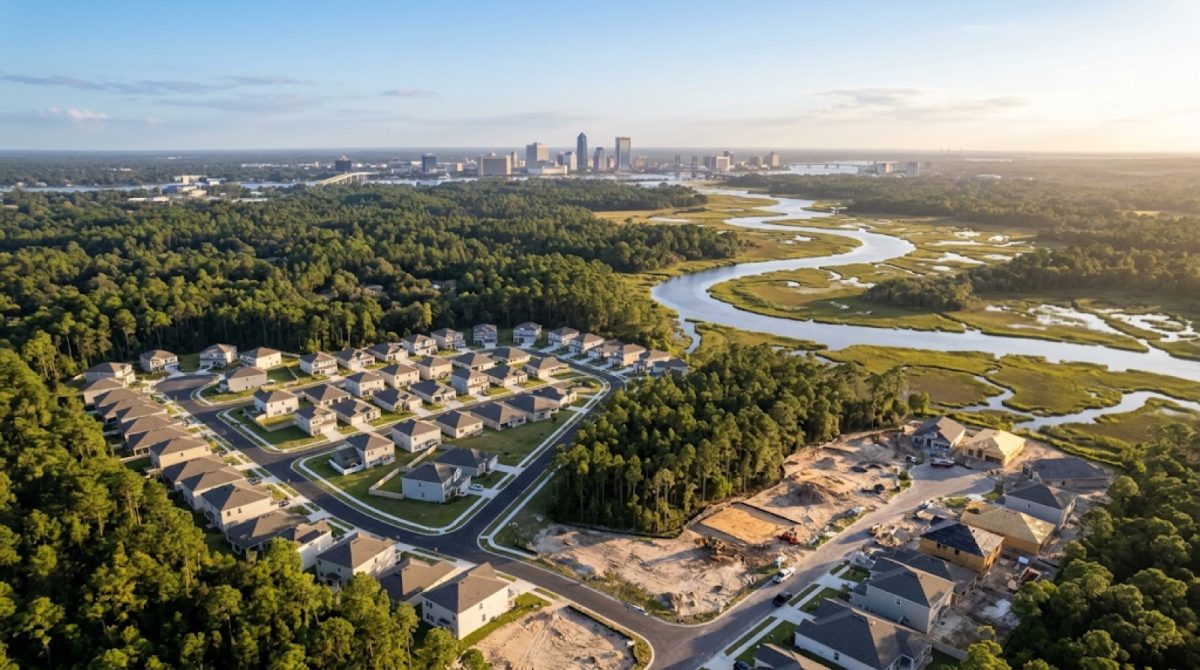
Census Bureau estimates put Jacksonville above 1 million residents as of July 1, 2025. Illustration: AI-generated
Jacksonville has surpassed 1 million residents, reaching an estimated 1,017,689 people as of July 1, 2025, according to the U.S. Census Bureau. Palm Coast ranks second among Northeast Florida's incorporated cities with 109,886 residents, while Jacksonville Beach remains third with 23,615.
The latest estimates show a region where some cities are growing rapidly while others have lost population since the 2020 Census.
Palm Coast added an estimated 20,628 residents, growing 23.1% in five years. St. Augustine grew 12.6%, while Fernandina Beach overtook Atlantic Beach to become the region's fifth-largest incorporated municipality.
But not every city grew. Jacksonville Beach, Atlantic Beach, Orange Park and Neptune Beach all had estimated populations below their 2020 Census counts.
JAX TIMES analyzed the Census Bureau's Vintage 2025 population estimates for incorporated municipalities across five Northeast Florida counties: Duval, St. Johns, Clay, Nassau and Flagler.
The rankings use the newest available city and town estimates as of October 2026, with the April 1, 2020, Census providing the comparison baseline. The 2025 figures are estimates, not a new physical count of every resident.
Northeast Florida's 10 biggest incorporated cities in 2025
| Rank | City or town | 2020 Census | 2025 estimate | Change | Change % |
|---|---|---|---|---|---|
| 1 | Jacksonville | 949,611 | 1,017,689 | +68,078 | +7.2% |
| 2 | Palm Coast | 89,258 | 109,886 | +20,628 | +23.1% |
| 3 | Jacksonville Beach | 23,830 | 23,615 | -215 | -0.9% |
| 4 | St. Augustine | 14,329 | 16,141 | +1,812 | +12.6% |
| 5 | Fernandina Beach | 13,052 | 13,869 | +817 | +6.3% |
| 6 | Atlantic Beach | 13,513 | 13,245 | -268 | -2.0% |
| 7 | Green Cove Springs | 9,786 | 10,079 | +293 | +3.0% |
| 8 | Orange Park (town) | 9,089 | 8,953 | -136 | -1.5% |
| 9 | Neptune Beach | 7,217 | 7,020 | -197 | -2.7% |
| 10 | St. Augustine Beach | 6,803 | 6,810 | +7 | +0.1% |
Source: U.S. Census Bureau, Vintage 2025 Subcounty Population Estimates, July 1, 2025, compared with April 1, 2020, Census counts. Changes and percentages calculated by JAX TIMES. Percentages rounded to one decimal place.
The largest percentage increase belonged to Palm Coast, while Jacksonville recorded the largest numerical gain.
The countdown includes incorporated cities and towns only. It does not rank unincorporated communities such as Ponte Vedra Beach, Fleming Island or Yulee, which are tracked using different geographic classifications.
Here are the 10 municipalities, beginning with the smallest.
No. 10: St. Augustine Beach, 6,810 residents
2020: 6,803 | Change: +7 | Growth: +0.1%
St. Augustine Beach barely grew between the 2020 Census and July 2025, according to the latest federal estimates. Its population increased by just seven people, from 6,803 to 6,810.
That is a change of approximately 0.1%, making it the slowest-growing municipality among the six top-10 communities with estimated population gains.
The city remains separate from nearby St. Augustine, even though the two share a familiar name and are part of the same coastal region. St. Augustine Beach is counted within its own incorporated boundaries, not combined with St. Augustine's population.
The difference between the two municipalities has widened considerably. Historic St. Augustine added an estimated 1,812 residents, while St. Augustine Beach's estimate was almost unchanged.
That does not necessarily mean the surrounding beach area has experienced no development or population movement. It means the federal estimate for residents living inside St. Augustine Beach's official city limits changed very little.
No. 9: Neptune Beach, 7,020 residents
2020: 7,217 | Change: -197 | Decline: -2.7%
Neptune Beach recorded the largest percentage population decline among the top 10 municipalities.
The Census Bureau estimates its population fell from 7,217 in 2020 to 7,020 in 2025, a loss of 197 residents, or approximately 2.7%.
Neptune Beach is one of three separately incorporated Beaches cities in Duval County. Jacksonville Beach and Atlantic Beach also posted estimated declines, meaning all three had fewer residents in 2025 than were counted in 2020.
Together, those three cities had an estimated 43,880 residents in 2025, compared with 44,560 in 2020. That is a combined decrease of 680 people, or approximately 1.5%.
The federal estimates do not establish why individual municipalities gained or lost population. Changes can reflect multiple demographic factors, and the figures should not be interpreted as proof that residents left because of housing prices, employment or any other specific cause.
No. 8: Orange Park, 8,953 residents
2020: 9,089 | Change: -136 | Decline: -1.5%
Orange Park is the fourth municipality in the top 10 with an estimated population decline.
The Clay County town had 9,089 residents in the 2020 Census. Its July 2025 estimate was 8,953, a decrease of 136 people, or about 1.5%.
Officially, Orange Park is incorporated as a town rather than a city. It is included because the ranking covers incorporated municipalities, regardless of whether their formal designation is city or town.
The incorporated town also should not be confused with every community that has an Orange Park mailing address. Its official population reflects only residents inside the municipal boundary.
That distinction helps explain why population statistics for Orange Park can look surprisingly small to people familiar with the surrounding developed area.
Orange Park's estimated decline contrasts with nearby Green Cove Springs, another Clay County municipality, which added residents over the same period.
No. 7: Green Cove Springs, 10,079 residents
2020: 9,786 | Change: +293 | Growth: +3.0%
Green Cove Springs crossed an estimated population milestone, reaching 10,079 residents by July 2025.
The Clay County city had 9,786 residents in 2020, meaning its estimated population increased by 293 people, or approximately 3%.
The city remains ahead of Orange Park in the municipal rankings. In 2020, the gap between the two communities was 697 residents. By 2025, it had widened to 1,126.
That change reflects two different trends. Green Cove Springs gained an estimated 293 residents, while Orange Park lost an estimated 136.
Green Cove Springs' population was still below the next municipality in the ranking, Atlantic Beach, by 3,166 residents.
The city is one of three municipalities among the top 10 with populations between approximately 8,900 and 13,300. Those relatively modest figures illustrate how much of the region's population lives outside its smaller municipal boundaries.
No. 6: Atlantic Beach, 13,245 residents
2020: 13,513 | Change: -268 | Decline: -2.0%
Atlantic Beach dropped from fifth to sixth place in Northeast Florida's incorporated-municipality population rankings.
Its population declined from 13,513 in the 2020 Census to an estimated 13,245 in July 2025. That is a loss of 268 people, or approximately 2%.
Atlantic Beach experienced the largest numerical population decrease among the top 10 municipalities in this comparison.
The ranking change occurred because Fernandina Beach moved in the opposite direction. Fernandina Beach added an estimated 817 residents while Atlantic Beach lost population.
In 2020, Atlantic Beach had 461 more residents than Fernandina Beach. By 2025, Fernandina Beach had 624 more.
That represents a reversal of 1,085 residents in the population difference between the two municipalities.
Atlantic Beach remains larger than Neptune Beach but considerably smaller than Jacksonville Beach. All three coastal cities are separately incorporated within Duval County.
No. 5: Fernandina Beach, 13,869 residents
2020: 13,052 | Change: +817 | Growth: +6.3%
Fernandina Beach moved into fifth place after adding an estimated 817 residents between April 2020 and July 2025.
The Nassau County city's population increased from 13,052 to 13,869, a gain of approximately 6.3%.
That growth was enough to move Fernandina Beach ahead of Atlantic Beach in the regional ranking.
Fernandina Beach remains far smaller than Jacksonville, Palm Coast and Jacksonville Beach, but its change in ranking demonstrates how population shifts can affect closely matched municipalities.
In 2020, St. Augustine exceeded Fernandina Beach by 1,277 residents. By 2025, the gap had widened to 2,272.
Fernandina Beach is the only Nassau County municipality among the 10 largest incorporated places in this five-county comparison.
Its estimated population should not be confused with the population of Amelia Island as a whole or Nassau County overall. The figure applies to the city's official incorporated boundaries.
No. 4: St. Augustine, 16,141 residents
2020: 14,329 | Change: +1,812 | Growth: +12.6%
St. Augustine experienced the second-fastest percentage growth among the top 10 municipalities, trailing only Palm Coast.
The nation's oldest continuously occupied European-established city grew from 14,329 residents in 2020 to an estimated 16,141 in July 2025, an increase of 1,812 people, or approximately 12.6%.
That is a notable change for a historic city with a much smaller population than Jacksonville or Palm Coast. Its numerical gain was more than twice Fernandina Beach's increase of 817 residents.
St. Augustine also widened its lead over Atlantic Beach and Fernandina Beach. While those municipalities were close to St. Augustine's population in 2020, the newest estimates place the historic city more than 2,200 residents ahead of Fernandina Beach.
Still, the city of St. Augustine represents only one part of St. Johns County. Other communities, including areas outside incorporated city boundaries, are not included in the city's population estimate.
The increase does not measure visitors, commuters or temporary occupants. It is an estimate of the city's resident population as of July 1, 2025.
No. 3: Jacksonville Beach, 23,615 residents
2020: 23,830 | Change: -215 | Decline: -0.9%
Jacksonville Beach remains Northeast Florida's third-largest incorporated municipality despite an estimated population decline.
The city had 23,830 residents in 2020 and an estimated 23,615 in July 2025, a decrease of 215 people, or approximately 0.9%.
Jacksonville Beach is also the largest of Duval County's three separately incorporated Beaches municipalities. Its estimated population was 10,370 higher than Atlantic Beach's and 16,595 higher than Neptune Beach's.
Although all three municipalities recorded declines, Jacksonville Beach had the smallest percentage decrease among them.
Its third-place regional ranking remains secure. Jacksonville Beach had 7,474 more estimated residents than fourth-place St. Augustine in 2025.
The population figures also reinforce an important geographic distinction. Jacksonville Beach is not included within Jacksonville city's population estimate, even though both municipalities are in Duval County.
For readers comparing communities along the coast, the incorporated-place figures provide a consistent measure. They do not, however, describe the total population of the entire Beaches area, which includes residents outside these three municipal boundaries.
No. 2: Palm Coast, 109,886 residents
2020: 89,258 | Change: +20,628 | Growth: +23.1%
Palm Coast was the fastest-growing municipality by percentage among Northeast Florida's 10 largest incorporated cities and towns.
The Flagler County city's estimated population increased from 89,258 in 2020 to 109,886 in July 2025. That represents 20,628 additional residents, or approximately 23.1% growth.
Palm Coast also passed the 100,000-resident mark in the latest estimate, placing it in a population category far above most of the region's smaller coastal municipalities.
The city had more than four times as many estimated residents as Jacksonville Beach, which ranked third with 23,615.
Palm Coast's numerical gain was also more than 11 times St. Augustine's increase of 1,812 residents.
Yet Palm Coast remains substantially smaller than Jacksonville. Its 2025 estimated population was approximately 10.8% of Jacksonville's total.
The contrast is striking: Palm Coast grew much faster in percentage terms, but Jacksonville added more than three times as many residents in absolute numbers.
That difference demonstrates why both measures belong in a population ranking. Percentage growth shows how rapidly a community is changing relative to its original size, while numerical growth shows the actual estimated increase in residents.
No. 1: Jacksonville, 1,017,689 residents
2020: 949,611 | Change: +68,078 | Growth: +7.2%
Jacksonville remains the overwhelming population leader in Northeast Florida and has surpassed the 1 million-resident mark.
The Census Bureau estimates that the consolidated city had 1,017,689 residents on July 1, 2025, compared with 949,611 counted in April 2020.
That represents an estimated increase of 68,078 people, or approximately 7.2%.
Jacksonville's population gain alone was more than three times Palm Coast's increase of 20,628 residents.
The city's geographic size is also unusual. Census TIGERweb records show approximately 747 square miles of land within Jacksonville's consolidated city boundaries. That substantial area is an important consideration when comparing Jacksonville with geographically smaller incorporated cities.
Jacksonville's consolidated government includes much of Duval County, but Jacksonville Beach, Atlantic Beach, Neptune Beach and Baldwin remain separately incorporated municipalities.
The new population milestone does not mean Jacksonville suddenly gained tens of thousands of people in a single year. The 68,078 increase is the difference between the April 2020 Census count and the July 2025 estimate, a period of slightly more than five years.
The population figures make Jacksonville the region's clear leader, with more than nine times Palm Coast's estimated population and more than 43 times Jacksonville Beach's.
Of the combined 1,227,307 estimated residents in the 10 municipalities ranked here, Jacksonville accounted for approximately 82.9%.
Which Northeast Florida cities are growing fastest?
Population growth looks different when measured by percentages rather than raw numbers.
Among the municipalities in this ranking, Palm Coast led in percentage growth, followed by St. Augustine, Jacksonville, Fernandina Beach, Green Cove Springs and St. Augustine Beach.
| Municipality | Estimated growth, 2020-2025 |
|---|---|
| Palm Coast | +23.1% |
| St. Augustine | +12.6% |
| Jacksonville | +7.2% |
| Fernandina Beach | +6.3% |
| Green Cove Springs | +3.0% |
| St. Augustine Beach | +0.1% |
The four other top-10 municipalities posted estimated declines.
Jacksonville added the most residents in absolute terms, with 68,078. Palm Coast followed with 20,628, while St. Augustine added 1,812.
These different measures tell complementary stories. A smaller municipality can grow rapidly by percentage while adding fewer actual residents than a larger city experiencing a slower percentage increase.
What about smaller municipalities outside the top 10?
Six additional incorporated municipalities in the selected counties fall below the top-10 cutoff.
| Municipality | 2025 population estimate |
|---|---|
| Flagler Beach | 5,595 |
| Bunnell | 4,298 |
| Hilliard | 3,161 |
| Callahan | 1,830 |
| Keystone Heights | 1,579 |
| Baldwin | 1,394 |
Flagler Beach comes closest to entering the top 10, but its estimated population is 1,215 below St. Augustine Beach's 6,810.
These figures also show why municipal population rankings should not be confused with county population rankings. Some incorporated towns have relatively small resident populations despite being located within larger regional communities.
Why aren't Ponte Vedra Beach, Fleming Island and Yulee ranked?
The ranking includes incorporated municipalities, meaning places with legally established city or town boundaries.
Ponte Vedra Beach, Fleming Island and Yulee are not separate incorporated municipalities. The Census Bureau can report population information for unincorporated communities through other geographic categories, including census-designated places.
Combining those areas with incorporated cities would produce a different ranking.
A Jacksonville or Orange Park mailing address also does not necessarily mean the resident lives within that municipality's limits. Postal boundaries and municipal boundaries are not interchangeable.
This matters whenever readers compare population, tax information, municipal services or community growth.
Are these the actual populations in October 2026?
No. The July 1, 2025, figures are the newest available Census Bureau city and town population estimates as of October 22, 2026, not exact population counts conducted this month.
The Census Bureau's Vintage 2025 population estimates use demographic data and statistical methods to update the population picture between decennial censuses.
The 2020 figures, by comparison, come from the decennial census enumeration.
Future estimates may revise earlier figures as additional information becomes available. The Census Bureau cautions against mixing population estimates from different vintages because each new vintage can revise the previous time series.
For that reason, the main ranking uses one consistent vintage, and the changes are calculated against the supplied April 2020 Census counts.
The estimates indicate how populations have changed, but they do not explain the causes of growth or decline. They also do not include people who moved after July 1, 2025, as a separate update through October 2026.
How we did this
JAX TIMES used the U.S. Census Bureau's Vintage 2025 Subcounty Population Estimates, specifically the July 1, 2025, figures for incorporated places, alongside April 1, 2020, Census population counts.
We ranked municipalities in Duval, St. Johns, Clay, Nassau and Flagler counties by their 2025 estimates. Population changes were calculated by subtracting each municipality's 2020 count from its 2025 estimate, then dividing that difference by the 2020 population to calculate percentage change.
Percentages are rounded to one decimal place. All figures represent incorporated municipalities, and the 2025 values remain estimates rather than new census counts.
Source: U.S. Census Bureau, Vintage 2025 City and Town Population Estimates; 2020 Census; Census TIGERweb
News organizations may republish this story with credit. See our guidelines.
Know someone who'd want to read this? Email it to a friend.
Own a Jacksonville business? Introductory ad rates from $125/month. See ad optionsPlan your weekend with Jax Times
Get This Weekend in Jacksonville every Thursday: the best local events, free things to do and family fun, plus each evening's local news. Free, and you can unsubscribe anytime.
Most read this week
- Florida's 3 Constitutional Amendments on the Nov. 3 Ballot, Explained in Plain English
- Florida Is Holding $3 Billion in Unclaimed Money. Here's How Jacksonville and St. Augustine Residents Can Search for Free
- Fire Destroys Golf Carts of St. Augustine Building on U.S. 1: What We Know, What Happens Next and 9 Golf Cart Battery Safety Rules
- Early Voting in Jacksonville Starts Tuesday: All 24 Sites, the Hours, What to Bring and What's on Your Ballot
- St. Johns Is Florida's Fastest-Growing County, Adding 36 People a Day, as Northeast Florida Passes 2 Million
More stories
 Local Jacksonville Cruises in 2026: 2 Cruise Lines, $17 Daily Parking and 10 Steps Before You Sail
 Local Jacksonville's 22 Career Fields Ranked by Pay in 2026: From $17.57 to $65.97 an Hour
 Local Jacksonville and St. Augustine State Parks: 10 Questions About $3–$8 Admission, Annual Passes and Savings
 Local JAXPORT by the Numbers: Jacksonville Port's Last 5 Years Ranked, From 9.96 Million to 10.35 Million Tons
Comments
Be respectful. No personal attacks, hate speech, spam or anyone's private information. Every comment is reviewed before it appears. Comment rules
No comments yet. Be the first to share your thoughts.