Amelia Island's 8 Flags: How a 13-Mile Island Near Jacksonville Changed Hands So Many Times
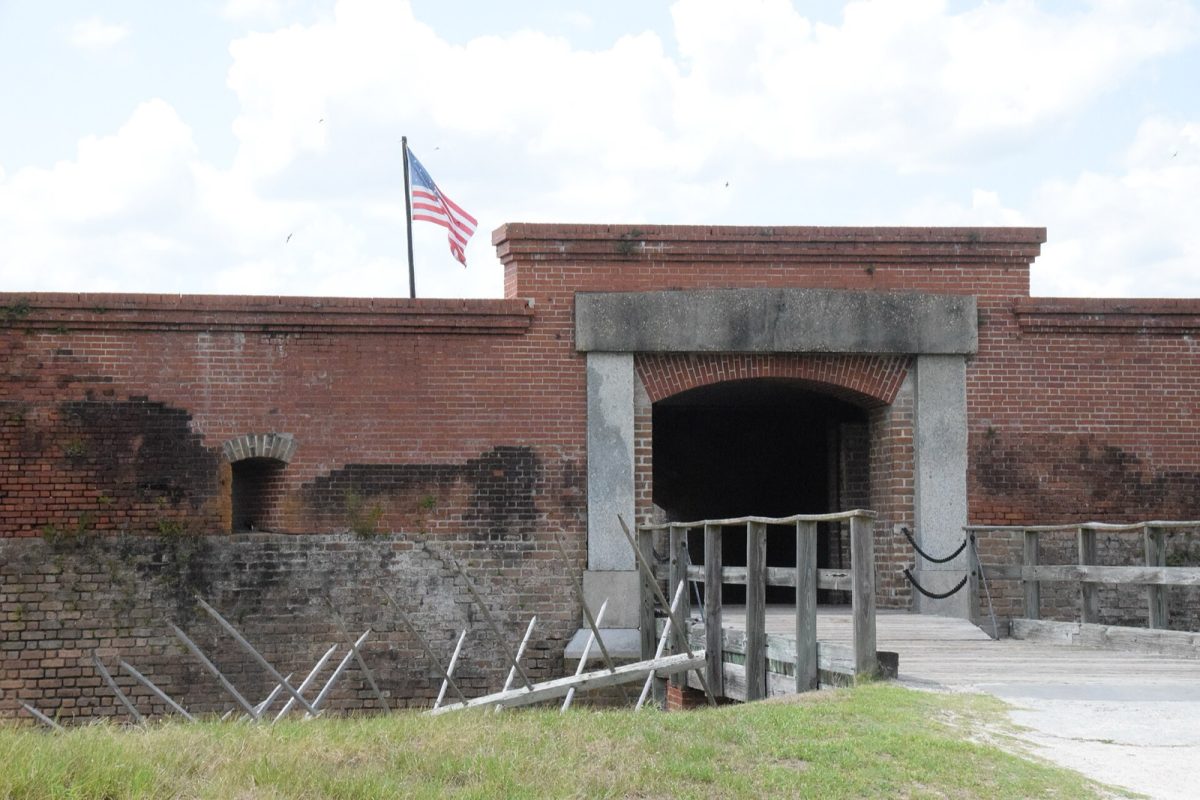
Fort Clinch, built from 1847 to 1869. Confederate forces seized it in 1861. Photo: bubba73 / Wikimedia Commons (CC BY-SA 3.0)
Jacksonville, Fla. - Amelia Island, a 13-mile-long island in Nassau County, has flown eight different flags since 1562. Its history includes a French explorer, Spanish governors, British rule, two short-lived republics, Mexico, the United States and the Confederacy.
Today the island is part of the Jacksonville metro area and is home to Fernandina Beach, Amelia City and American Beach. It is about 13 miles long and up to about 4 miles wide.
Why eight flags?
Different governments and military leaders claimed the island over the centuries, sometimes holding it for only a few months.
The eight flags are France, Spain, Great Britain, the Republic of East Florida, the Green Cross of Florida, Mexico, the United States and the Confederacy.
Spain actually controlled the island twice, but its flag is counted only once.
Timeline: The eight flags of Amelia Island
| Flag | Date | What happened |
|---|---|---|
| 1. France | 1562 | Jean Ribault arrives |
| 2. Spain | From 1565 | Pedro Menendez de Aviles; Spanish control begins |
| 3. Great Britain | 1763-1783 | Britain gains Florida under the Treaty of Paris; Spain returns in 1783 |
| 4. Republic of East Florida ("Patriots" flag) | March 16, 1812 | Raised during Gen. George Mathews' invasion |
| 5. Green Cross of Florida | June 29, 1817 | Gregor MacGregor captures Fort San Carlos for his "Republic of the Floridas" |
| 6. Mexico | Late 1817 | Louis-Michel Aury sets up a "Supreme Council of the Floridas" |
| 7. United States | Dec. 23, 1817 | U.S. naval forces take the island; Spain formally transfers Florida under the Adams-Onis Treaty on Feb. 22, 1821 |
| 8. Confederacy | Jan. 8, 1861 | Confederate forces seize Fort Clinch; Union forces restore control March 3, 1862 |
Four of the eight flags flew in a span of less than six years, from March 1812 to December 1817. The Battle of Amelia Island was fought during that stretch, on Sept. 13, 1817.
Fernandina's Spanish roots
Spanish Gov. Enrique White named Fernandina on Jan. 1, 1811, in honor of King Ferdinand VII. The town was platted on May 10, 1811, making it the last town platted under Spain's Laws of the Indies in the Western Hemisphere.
Fernandina Beach had 13,052 residents in the 2020 census.
The railroad
Construction of David Levy Yulee's Florida Railroad began in 1855 and was finished in 1861, with its eastern end on Amelia Island.
That was the same year Confederate forces seized Fort Clinch.
Fort Clinch
Fort Clinch took more than two decades to build, from 1847 to 1869. It was named for Gen. Duncan Lamont Clinch after his death in 1849.
Confederate forces seized it Jan. 8, 1861. In March 1862, Gen. Robert E. Lee ordered it abandoned, and Union troops used it as a base. It was garrisoned again in 1898 for the Spanish-American War and abandoned that September.
The Civilian Conservation Corps restored the fort in the 1930s. Florida bought 256 acres in 1935, and Fort Clinch State Park opened in 1938. The fort was added to the National Register of Historic Places on Nov. 15, 1972.
Today the park draws about 167,000 visitors a year. Costumed reenactors portray 1860s soldiers, and cannon demonstrations are held the first weekend of each month.
American Beach
Amelia Island also holds an important chapter of Black history.
American Beach was founded in 1935 by Abraham Lincoln Lewis, Florida's first Black millionaire and president of the Afro-American Life Insurance Co. During Jim Crow, it was created as a place for "Recreation and Relaxation Without Humiliation."
The 216-acre community drew visitors including Zora Neale Hurston, Cab Calloway, Ray Charles, Hank Aaron and Joe Louis.
American Beach declined after desegregation in 1964. Lewis' granddaughter, MaVynee Betsch, known as "the Beach Lady," returned in 1977 to preserve it. She died in September 2005.
The American Beach Historic District, covering 40 acres and 67 buildings, was listed on the National Register of Historic Places on Jan. 28, 2002. The A.L. Lewis Museum opened Sept. 6, 2014.
By the numbers
| Number | What it means |
|---|---|
| 8 | Flags flown over the island |
| About 13 miles | Length of the island |
| Up to about 4 miles | Width of the island |
| 1562 | Jean Ribault, the first flag (France) |
| 1811 | Fernandina named and platted |
| 1861 | Florida Railroad completed |
| 256 | Acres Florida bought for Fort Clinch in 1935 |
| 1938 | Fort Clinch State Park opened |
| 167,000 | Fort Clinch visitors a year |
| 216 | Acres of American Beach |
| 67 | Buildings in the American Beach Historic District |
| 13,052 | Fernandina Beach residents (2020 census) |
| 150,000+ | Crowd at the Isle of Eight Flags Shrimp Festival |
The flags live on
The Isle of Eight Flags Shrimp Festival is held the first weekend in May each year and draws more than 150,000 people. Its name nods to the island's crowded history.
What it means for Northeast Florida
For a small island, Amelia packs in a lot of Florida's story. Fort Clinch preserves its military past, Fernandina recalls Spain's colonial town planning, and American Beach keeps alive a chapter of Black history that its founder and his granddaughter worked to protect. All of it sits inside the Jacksonville metro area.
Quick Q&A
Which flags flew over Amelia Island? France, Spain, Great Britain, the Republic of East Florida, the Green Cross of Florida, Mexico, the United States and the Confederacy.
Why only eight if Spain ruled twice? Spain's flag is counted once.
When did the island become part of the U.S. for good? U.S. naval forces took it Dec. 23, 1817, and Spain formally transferred Florida on Feb. 22, 1821. Union forces restored control after the Confederate period on March 3, 1862.
How we did this
This explainer uses Wikipedia's "Amelia Island," "Fernandina Beach, Florida," "Fort Clinch" and "American Beach, Florida" entries, reviewed Oct. 23, 2026. Spain's two periods of control are counted as one flag, as in those sources.
Sources: Wikipedia, "Amelia Island," "Fernandina Beach, Florida," "Fort Clinch" and "American Beach, Florida" (reviewed Oct. 23, 2026)
News organizations may republish this story with credit. See our guidelines.
Know someone who'd want to read this? Email it to a friend.
Own a Jacksonville business? Introductory ad rates from $125/month. See ad optionsPlan your weekend with Jax Times
Get This Weekend in Jacksonville every Thursday: the best local events, free things to do and family fun, plus each evening's local news. Free, and you can unsubscribe anytime.
Most read this week
- Florida's 3 Constitutional Amendments on the Nov. 3 Ballot, Explained in Plain English
- Florida Is Holding $3 Billion in Unclaimed Money. Here's How Jacksonville and St. Augustine Residents Can Search for Free
- Fire Destroys Golf Carts of St. Augustine Building on U.S. 1: What We Know, What Happens Next and 9 Golf Cart Battery Safety Rules
- St. Augustine Artist Dara Dodson Paints 'A Land Remembered,' With Shows at the Karpeles Museum and the St. Augustine Art Association
- St. Johns Is Florida's Fastest-Growing County, Adding 36 People a Day, as Northeast Florida Passes 2 Million
More stories
 Local Phase III Water Restrictions: Your 1 Watering Day by Address, the 10 Hours You Can't Water and What's Exempt
 Local Stay Out of the Ocean This Weekend: 7- to 11-Foot Waves and Dangerous Rip Currents at Northeast Florida Beaches
 Local Coastal Flood Warning for Jacksonville: Water Peaks Sunday and Monday Mornings in 5 Flood-Prone Areas
 Local Hurricane Dora Hit St. Augustine With 110 MPH Winds in 1964: Northeast Florida's Benchmark Storm
Comments
Be respectful. No personal attacks, hate speech, spam or anyone's private information. Every comment is reviewed before it appears. Comment rules
No comments yet. Be the first to share your thoughts.