Big Talbot Island and Boneyard Beach: 1,680 Acres and Skeleton Oaks, 20 Miles From Downtown Jacksonville
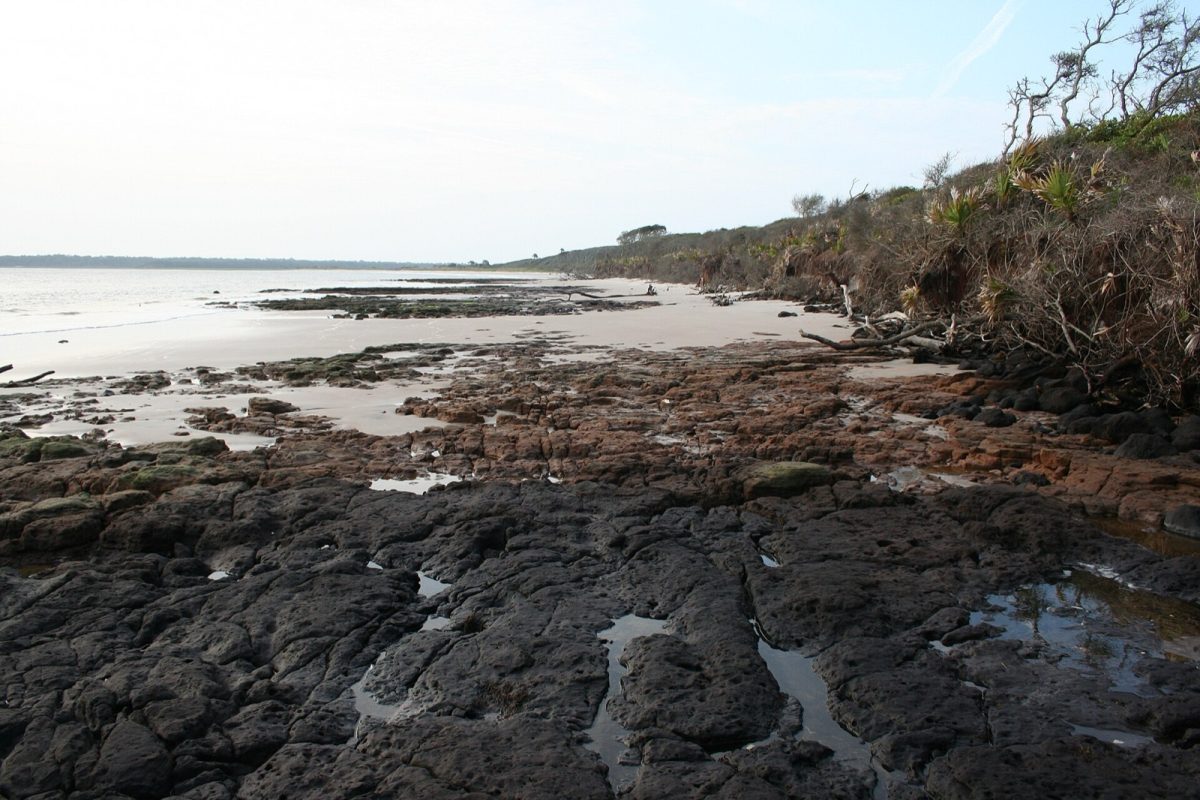
Blackrock Beach's dark formations are unusual for Florida's coast. Photo: Smokemob / Wikimedia Commons (CC BY 3.0)
Jacksonville, Fla. - Big Talbot Island State Park covers about 1,680 acres just 20 miles east of downtown Jacksonville, and its Boneyard Beach is lined with the bare skeletons of oak trees. The trees were left on the sand as coastal erosion claimed them, creating one of the most photographed shorelines in Northeast Florida.
The park sits in Duval County along A1A North, immediately north of Little Talbot Island State Park. It has been a state park since 1982 and is managed by the Florida Department of Environmental Protection.
One thing to know up front: Boneyard Beach is not recommended for swimming. People come for the views, the photos and the walk.
Big Talbot by the numbers
| Number | What it means |
|---|---|
| 1,679.82 acres | Park size (about 1,680) |
| 20 miles | Distance east of downtown Jacksonville |
| 1982 | Year it became a state park |
| 44 years | Time as a state park (my math, 1982 to 2026) |
| 1562 | Year French, English and Spanish claims began |
| 1735 | Year Gen. James Oglethorpe named the Talbot Islands |
| 10 | Activities listed for the park |
| 5 | Types of amenities: pavilions, nature trails, fishing pier, boat ramp, bike trails |
| 9 | Kinds of wildlife named, from alligators to scrub jays |
Boneyard Beach: oaks on the sand
Boneyard Beach is at the end of the Blackrock Trail.
What makes it famous is what's left behind. Oak trees that once stood near the shore were claimed by coastal erosion, and their trunks and branches now sit along the shoreline like driftwood sculptures.
It's a favorite spot for photographers. It's also a living lesson in how fast a coastline can change: the trees that once grew inland are now on the beach.
Again, swimming is not recommended here. Treat it as a place to walk, look and take pictures.
Blackrock Beach: dark rock on a sandy coast
The shoreline has something else most Florida beaches don't: rock-like sedimentary hardpan soil deposits.
At Blackrock Beach, those formations are darker, an appearance that's unusual for Florida's coast. Paired with the oak skeletons, they give Big Talbot a look that's very different from a typical white-sand beach day.
10 things to do
The park lists 10 activities, split here by land and water:
| On land | On the water |
|---|---|
| Nature study | Fishing |
| Bird-watching | Boating |
| Photography | Canoeing |
| Hiking | Kayaking |
| Bicycling | |
| Picnicking |
Amenities
- Picnic pavilions
- Nature trails
- A fishing pier
- A boat ramp
- Bike trails
The pier and boat ramp cover the water side. The nature and bike trails cover the land side.
Trees and plants
The island's plant life is classic coastal Northeast Florida: southern live oaks, magnolias, hollies, hickories, cabbage palmettos, saw palmettos and sea oats.
Those live oaks help explain Boneyard Beach. The skeletons on the sand are what's left of oaks that once grew back from the shore.
Big Talbot is a coastal barrier island, and the park also adjoins the Timucuan Ecological and Historic Preserve, so the natural land keeps going past the park line.
Wildlife to watch for
The park's wildlife includes:
- Alligators
- Sea turtles
- Manatees
- White-tailed deer
- Gopher tortoises
- River otters
- Bobcats
- Bald eagles
- Florida scrub jays
Bird-watchers will want to keep an eye out for bald eagles and Florida scrub jays. As with any wild place, sightings aren't guaranteed, so give animals plenty of room when you do spot them.
A history older than Florida
The Timucua were the first people to live on the island.
European interest came later. French, English and Spanish claims began in 1562. In 1735, Gen. James Oglethorpe named the Talbot Islands in honor of Charles Talbot, 1st Baron Talbot. That naming came 173 years after the first European claims (my math).
The island became a state park in 1982.
| When | What happened |
|---|---|
| Before 1562 | The Timucua live on the island |
| 1562 | French, English and Spanish claims begin |
| 1735 | Oglethorpe names the Talbot Islands for Charles Talbot |
| 1982 | Big Talbot Island becomes a state park |
Pick your kind of visit
| If you like... | Head for... |
|---|---|
| Photography | Boneyard Beach's oak skeletons and Blackrock Beach's dark formations |
| Birds | Watch for bald eagles and Florida scrub jays |
| Paddling | Canoeing and kayaking, with a boat ramp for launching |
| Fishing | The fishing pier |
| Biking and hiking | The bike trails and nature trails |
| A slow afternoon | The picnic pavilions |
Most visitors can mix two or three of these in one trip, since they're all inside the same 1,680 acres.
What to know before you go
Where is it? In Duval County on A1A North, about 20 miles east of downtown Jacksonville, just north of Little Talbot Island State Park.
How do I get to Boneyard Beach? It's at the end of the Blackrock Trail.
Can I swim at Boneyard Beach? It's not recommended.
What are the hours? The park is listed as open 8 a.m. to sundown, year-round. Confirm current hours, fees and parking with Florida State Parks before you go.
What should I bring? A camera. Boneyard Beach is popular with photographers for a reason.
Why it's worth the drive
Big Talbot packs a lot into 1,680 acres: skeleton oaks, dark rock formations that are rare on Florida's coast, eagles and scrub jays, and trails and water access for hikers, cyclists and paddlers. And it's only 20 miles from downtown.
How we did this
This guide is based on Wikipedia's "Big Talbot Island State Park" entry, reviewed Oct. 23, 2026. Acreage is rounded from 1,679.82. Trail lengths, fees and parking were not verified and are not included.
Source: Wikipedia, "Big Talbot Island State Park" (reviewed Oct. 23, 2026)
News organizations may republish this story with credit. See our guidelines.
Know someone who'd want to read this? Email it to a friend.
Own a Jacksonville business? Introductory ad rates from $125/month. See ad optionsPlan your weekend with Jax Times
Get This Weekend in Jacksonville every Thursday: the best local events, free things to do and family fun, plus each evening's local news. Free, and you can unsubscribe anytime.
Most read this week
- Florida Is Holding $3 Billion in Unclaimed Money. Here's How Jacksonville and St. Augustine Residents Can Search for Free
- Coastal Flood Warning for Jacksonville: Water Peaks Sunday and Monday Mornings in 5 Flood-Prone Areas
- Fire Destroys Golf Carts of St. Augustine Building on U.S. 1: What We Know, What Happens Next and 9 Golf Cart Battery Safety Rules
- Jacksonville Fair 2026 Guide: Dates, Gate Times, Ticket Prices, Free Days and Every Concert (Nov. 5-15)
- St. Augustine Artist Dara Dodson Paints 'A Land Remembered,' With Shows at the Karpeles Museum and the St. Augustine Art Association
More stories
 Local Amelia Island's 8 Flags: How a 13-Mile Island Near Jacksonville Changed Hands So Many Times
 Local Jacksonville Zoo by the Numbers: 112 Years, 122 Acres and More Than 2,000 Animals
 Local St. Augustine Lighthouse: 165 Feet Tall, First Lit in 1874, and 10 Milestones in Its History
 Local St. Johns River by the Numbers: 310 Miles, a Northward Flow and Less Than 30 Feet of Drop
Comments
Be respectful. No personal attacks, hate speech, spam or anyone's private information. Every comment is reviewed before it appears. Comment rules
No comments yet. Be the first to share your thoughts.