Florida's Phone-While-Driving Laws: 11 Questions About Texting, School Zones, 3 Points and Fines
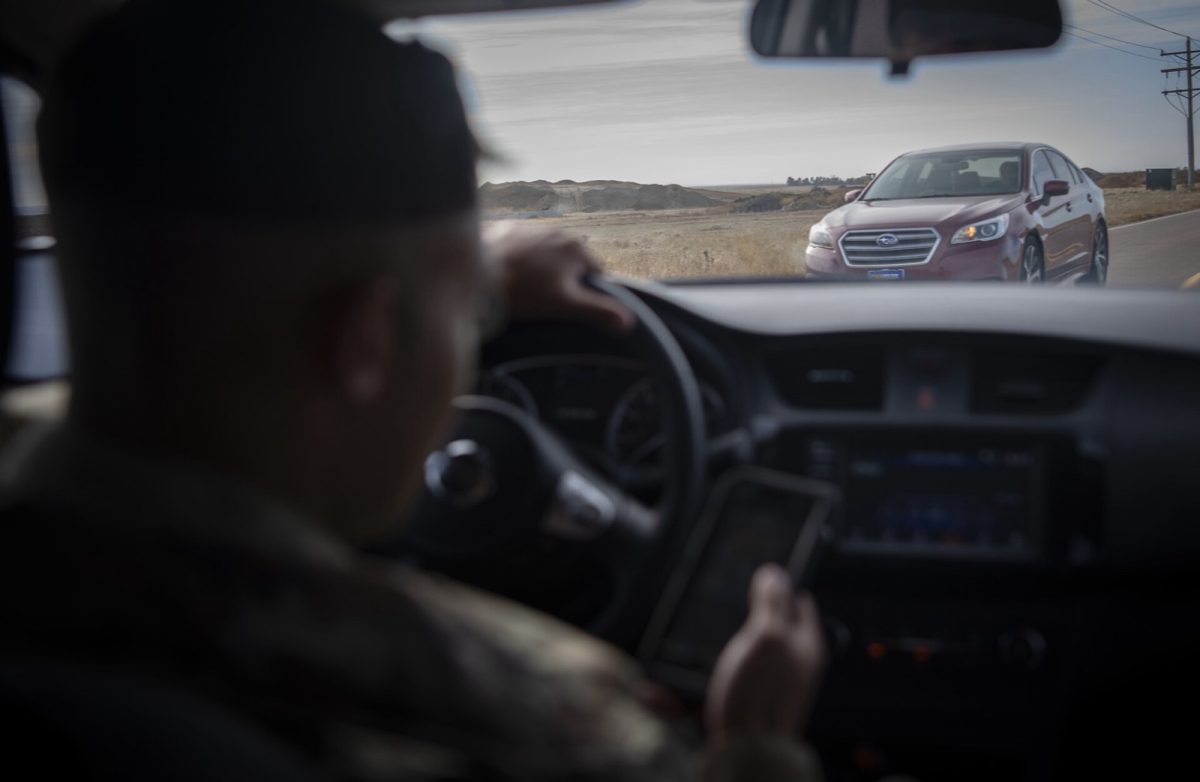
A driver looks at a phone while driving (U.S. Space Force photo). Photo: U.S. Space Force photo by Airman 1st Class Jonathan Whitely / Wikimedia Commons (public domain)
JACKSONVILLE, Fla. - Florida prohibits texting while driving and places additional restrictions on handheld phone use in school and work zones. Drivers can face fines, and handheld use in a school or active work zone carries three points on a license. A first texting ticket is a nonmoving violation with a $30 base penalty, while a second ticket within five years is treated as a moving violation.
The two rules cover different activities, so the difference matters for anyone driving through Duval, St. Johns, Clay or Nassau school zones. Florida law also provides exceptions, limits police access to drivers' phones and offers options for some first-time offenders. Here are 11 questions and answers about how the laws work, based on the state statutes and the Florida Department of Highway Safety and Motor Vehicles.
1. Is texting while driving illegal in Florida?
Yes. Florida Statute 316.305 prohibits drivers from manually typing or entering multiple letters, numbers, symbols or other characters into a wireless communications device while operating a vehicle. The law also prohibits sending or reading data for nonvoice communication, including text messages, emails and instant messages. Reading a text at highway speed counts the same as typing one.
The restriction applies while a person operates a moving vehicle. Under the statute, a stationary vehicle is not considered to be operating for purposes of the texting prohibition. Drivers who need to send or read messages can stop in a safe location before using their phones.
2. Can police stop someone just for texting?
Yes. Florida's Wireless Communications While Driving law made texting while driving a primary traffic offense, allowing officers to stop drivers solely for that violation. Previously, texting was a secondary offense, meaning an officer needed another reason to stop a vehicle. That change gave the texting ban real teeth on Florida roads.
The change took effect July 1, 2019. Officers issued warnings rather than citations from Oct. 1 through Dec. 31, 2019. Enforcement through citations followed that warning period, according to the Florida Department of Highway Safety and Motor Vehicles.
3. Is holding a phone while driving always illegal?
Florida's texting prohibition and handheld-device restrictions are separate rules. The texting law focuses on manually entering characters or sending and reading nonvoice communications while driving. A separate statute, 316.306, prohibits handheld use of wireless communications devices in designated school crossings, school zones and qualifying work zones.
The school and work zone restriction covers devices such as cell phones, tablets, laptops, two-way messaging devices and electronic games. It does not cover built-in vehicle features that do not require a handheld device. Drivers should understand that conduct prohibited under the texting law remains prohibited outside school and work zones.
4. What are the phone rules in school zones?
Florida prohibits drivers from using wireless communications devices in a handheld manner within designated school crossings and school zones. This restriction goes beyond the statewide texting prohibition because it addresses handheld use rather than only texting and other nonvoice communications. The school zone rule appears in Florida Statute 316.306.
The law allows hands-free and voice-operated communications, including factory-installed or aftermarket Bluetooth equipment. Hands-free navigation is also permitted under the statute. Citations for violations of the school and work zone handheld-device restrictions began Jan. 1, 2020.
5. When does the handheld phone ban apply in work zones?
Florida's handheld-device restriction applies in work zones when construction workers are present or operating equipment on or next to the roadway. The statute specifically establishes that condition for enforcement in work zones. The restriction addresses handheld use of wireless communications devices while operating a vehicle.
Drivers may use permitted hands-free or voice-operated communications while traveling through qualifying work zones. The law also allows hands-free navigation and certain emergency communications. The work zone provision is part of the same statute that regulates handheld devices in school crossings and school zones.
6. Can drivers use GPS, Bluetooth or voice commands?
Yes, Florida law provides exceptions for several common uses of wireless communications devices. Under the statewide texting law, drivers may use devices for navigation and communications that do not require manually entering multiple characters or reading text messages beyond what is necessary to activate, deactivate or start a feature. The statute also allows receiving information related to vehicle operation, navigation, safety alerts and radio broadcasts.
In school and work zones, drivers may use hands-free or voice-operated features, including factory or aftermarket Bluetooth systems. Hands-free navigation is permitted under the additional restrictions. Both statutes also recognize exceptions involving autonomous vehicles operating with their automated driving systems engaged.
7. Are there exceptions for emergencies and first responders?
Yes. Florida's texting law includes exceptions for emergency vehicle operators, law enforcement officers, fire service personnel and emergency medical services professionals performing their official duties. It also allows drivers to report emergencies or criminal or suspicious activity to law enforcement. These exceptions are narrow and tied to emergencies or official duties.
Other exceptions address messages involving emergency, traffic and weather alerts, data used primarily by the vehicle and radio broadcasts. The school and work zone statute includes corresponding emergency and first responder exceptions. These provisions recognize specific communications that remain permitted under the laws.
8. What happens if someone gets a texting ticket?
A first violation of Florida's texting law is a noncriminal traffic infraction treated as a nonmoving violation. Under Florida Statute 318.18, the base penalty for a nonmoving violation is $30. Court costs and other fees are additional and can vary.
A second or subsequent texting violation within five years of a prior conviction is treated as a moving violation. The statutory base penalty for a moving violation that does not require a court appearance is $60. Additional court costs and fees mean the total amount owed can exceed the base penalty.
The distinction between a first violation and a repeat violation affects how the state classifies the offense. The five-year period applies to a subsequent conviction under the texting statute. Drivers should not assume that the base penalty represents the full cost of a citation.
9. Can using a handheld phone in a school zone add 3 points?
Yes. Violating Florida's handheld-device restrictions in a school crossing, school zone or qualifying work zone is a noncriminal moving violation. The offense carries three points on the driver's license. That is the same three-point penalty in every Florida county.
Florida provides an alternative for some first-time offenders. A driver facing a first violation may complete an FLHSMV-approved wireless communications device driving safety program instead of receiving the usual penalty. After the driver completes the program, the clerk may waive the penalty and court costs, and the license points must be waived.
Another option involves purchasing equipment that enables hands-free communication. For a first-time violation, the clerk may dismiss the case when the driver provides proof of purchasing qualifying hands-free equipment. Court costs still apply under that dismissal option.
Money collected from school and work zone handheld-device violations goes to the Emergency Medical Services Trust Fund. This provision is part of the state's penalty framework for those offenses. The law treats these violations differently from first-time offenses under the general texting prohibition.
10. Can a police officer search or take a driver's phone?
Florida law limits police access to a driver's wireless communications device during enforcement of these restrictions. An officer who stops a driver for either offense must inform the driver of the right to decline a phone search. Officers cannot access the device without a warrant, confiscate it while waiting for a warrant or coerce the driver into consenting to a search.
The statutes also restrict the use of phone billing records as evidence. Under the texting law, those records may be used in a crash investigation involving death or personal injury. Under the school and work zone law, the applicable threshold is a crash involving death or serious bodily injury.
Florida's texting statute includes a separate reporting requirement. Officers must record the race and ethnicity of drivers cited under that law. The state reports the collected information annually to the governor and legislative leaders.
11. What does Florida recommend drivers do instead?
The Florida Department of Highway Safety and Motor Vehicles recommends pulling over to a safe location and putting the vehicle in park before texting, looking up directions or taking an important call. Drivers can also wait until they are no longer driving. Another option is asking a passenger to handle messages.
FLHSMV recommends using a phone's "Do Not Disturb" or driving focus setting to reduce distractions. These features can help drivers avoid unnecessary phone interactions while operating a vehicle. The agency emphasizes keeping attention on driving rather than handling communications.
The department says a focused driver traveling at 50 mph will cover nearly the length of a football field before coming to a complete stop. That distance illustrates why maintaining attention on the road matters. Florida's texting and handheld-device rules address different forms of distraction, but both encourage drivers to keep their attention on driving.
How we did this
Jax Times prepared this explainer using the 2025 Florida Statutes, including sections 316.305, 316.306 and 318.18, available through the Florida Senate at flsenate.gov. We also used the Florida Department of Highway Safety and Motor Vehicles' distracted driving information at flhsmv.gov, checked Oct. 25, 2026. This article provides general information about Florida's driving laws and is not legal advice.
Sources: Florida Statutes 316.305, 316.306 and 318.18; Florida Department of Highway Safety and Motor Vehicles

News organizations may republish this story with credit. See our guidelines.
Know someone who'd want to read this? Email it to a friend.
Own a Jacksonville business? Introductory ad rates from $125/month. See ad options Follow Jax Times on FacebookLocal news, events and people, in your feed every day.Most read this week
- Florida's 3 Constitutional Amendments on the Nov. 3 Ballot, Explained in Plain English
- Coastal Flood Warning for Jacksonville: Water Peaks Sunday and Monday Mornings in 5 Flood-Prone Areas
- Florida Is Holding $3 Billion in Unclaimed Money. Here's How Jacksonville and St. Augustine Residents Can Search for Free
- Jacksonville Fair 2026 Guide: Dates, Gate Times, Ticket Prices, Free Days and Every Concert (Nov. 5-15)
- Fire Destroys Golf Carts of St. Augustine Building on U.S. 1: What We Know, What Happens Next and 9 Golf Cart Battery Safety Rules
More stories
 Local Jacksonville Skyway Stops Running Nov. 2: Last Week to Ride and What Changes for JTA Riders
 Local Jacksonville Beach Pier by the Numbers: 1,300 Feet, 2 Hurricanes, a 6-Year Rebuild and a $2.50 Walk
 Local Anastasia State Park by the Numbers: 1,600 Acres, 4 Miles of Beach and the Quarry That Built the Castillo
 Local Fort Clinch State Park by the Numbers: A Fort Begun in 1847, 69 Campsites and a $2.50 Ticket to the Walls
Comments
Be respectful. No personal attacks, hate speech, spam or anyone's private information. Every comment is reviewed before it appears. Comment rules
No comments yet. Be the first to share your thoughts.