Jacksonville's 228-Year-Old Plantation House: Anna Kingsley's Remarkable Life and the 25 Surviving Slave Cabins
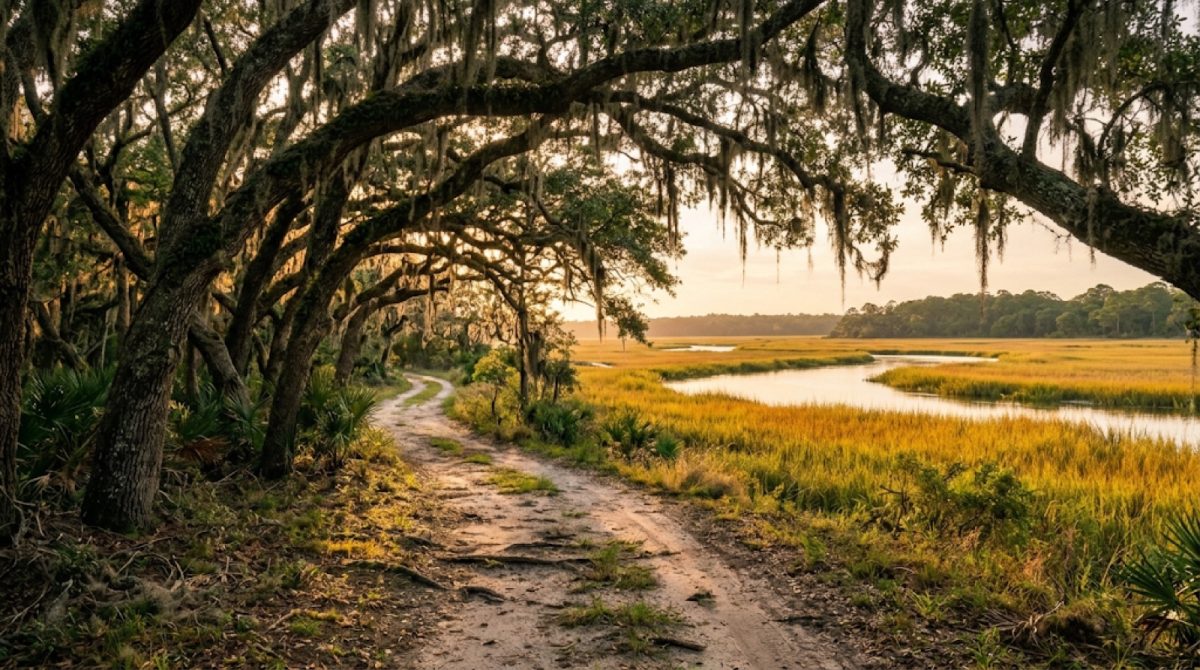
Kingsley Plantation on Fort George Island is free to visit Wednesday through Sunday. Illustration: AI-generated
Jacksonville is home to a 228-year-old plantation house and the remains of 25 historic slave cabins at Kingsley Plantation on Fort George Island, where Anna Madgigine Jai Kingsley lived from 1814 to 1837. Born in West Africa, sold into slavery and later freed, Anna became a plantation manager and property owner while overseeing enslaved workers whose labor supported the Kingsley family's wealth.
Today, the property is preserved within the National Park Service's Timucuan Ecological and Historic Preserve. Admission is free, and visitors can explore the plantation grounds, surviving tabby structures and exhibits documenting the lives of enslaved African Americans in early Florida.
The story of Kingsley Plantation reaches far beyond one family or one historic house. It reflects Florida's changing governments, the Atlantic slave trade, the struggle of free Black residents to protect their rights and the experiences of people who were forced to work without freedom.
The plantation also holds a distinction unusual among surviving historic sites in Florida. Its original main house, built in 1798, remains standing, and the semicircular arrangement of slave cabin ruins provides physical evidence of a plantation community that existed more than two centuries ago.
For Jacksonville residents, the site offers an opportunity to learn about a difficult part of Northeast Florida's history through buildings, archaeological research and official records rather than reconstructed attractions.
A plantation that existed before the Kingsleys arrived
Although the historic property carries the Kingsley name, the family did not establish its first plantation.
According to the National Park Service, Fort George Island had been used for plantation agriculture decades before Zephaniah Kingsley arrived. Richard Hazard operated an indigo plantation on the island during the 1760s, using enslaved labor.
John McQueen later acquired the property and developed a Sea Island cotton plantation. Enslaved craftsmen constructed the surviving plantation house, which was completed in 1798.
That makes the house 228 years old in 2026.
The island subsequently passed to John Houston McIntosh, whose ownership included the period surrounding the Patriots' Rebellion of 1812, an unsuccessful attempt by American forces and local supporters to end Spanish rule in East Florida.
Zephaniah Kingsley began renting the Fort George Island property in 1814 and purchased it in 1817 for $7,000, according to the National Park Service's history of his arrival in Florida.
By then, the plantation already had an established agricultural history. The Kingsleys became one of several families whose wealth depended on the labor of enslaved people on the island.
Who was Anna Madgigine Jai Kingsley?
Anna Madgigine Jai Kingsley was born in Senegal, West Africa, around 1793. The National Park Service timeline gives her African name as Anta Majigeen.
Her early life changed when she was captured and sold into the Atlantic slave trade. Zephaniah Kingsley, an English-born merchant and plantation owner, purchased her in Havana, Cuba, in 1806.
She was approximately 13 years old.
Kingsley brought her to Spanish Florida, where she became his wife and the mother of his children. Their relationship began in slavery and under an enormous imbalance of power, an essential part of understanding her history.
On March 1, 1811, Zephaniah Kingsley signed a legal document freeing Anna and their three children.
Anna was approximately 18 when she gained her legal freedom.
The National Park Service emphasizes that Anna left no known personal diaries, letters or descriptions of her life. Much of what historians know comes from government documents, property records and accounts written by others.
Her experiences therefore cannot be reconstructed from her own words. But surviving records show how she obtained property, operated businesses and navigated a society in which her rights were repeatedly threatened.
From enslaved teenager to landowner
After gaining her freedom, Anna began acquiring property and developing business interests in Spanish East Florida.
In 1813, Spanish authorities granted her five acres along the St. Johns River, across from Zephaniah Kingsley's Laurel Grove Plantation near present-day Orange Park.
Anna purchased livestock and other goods and sold products to neighboring settlers. She also purchased enslaved people, becoming a slaveholder herself.
This is one of the difficult contradictions in her life. Anna had survived enslavement, but after gaining freedom, she participated in the same system by owning other human beings.
Spanish Florida permitted free people of African descent to hold property and engage in commercial activity under conditions that differed from those prevailing in many American jurisdictions.
Anna's position remained precarious, however.
During the Patriots' Rebellion, American forces and their supporters attempted to seize control of East Florida. According to the National Park Service, Anna set fire to her own property as the forces approached and escaped with her children and enslaved workers aboard a Spanish gunboat.
Afterward, the Spanish governor rewarded her loyalty with a land grant of 350 acres.
These events occurred shortly before Anna and her family relocated to Fort George Island.
How the family came to Fort George Island in 1814
In 1814, Anna and Zephaniah Kingsley moved to Fort George Island with their children and enslaved workers.
The island sits near the mouth of the St. Johns River, northeast of downtown Jacksonville. At the time, it was isolated and accessible only by boat.
The Kingsleys occupied an established plantation that had been affected by the political upheaval of the preceding years.
Anna took an active role in managing the property. Zephaniah continued expanding his agricultural and trading interests elsewhere in Florida, frequently leaving her responsible for operations on Fort George Island.
The National Park Service estimates that approximately 60 enslaved men, women and children worked on the plantation during the family's ownership.
Its agricultural products included Sea Island cotton, sugarcane, citrus and corn.
Sea Island cotton was particularly valuable because its long fibers could be spun into fine, strong thread. Producing that crop required extensive labor, supplied by people held in slavery.
Zephaniah Kingsley's broader holdings eventually exceeded 32,000 acres, encompassing four major plantation complexes and more than 200 enslaved people.
The wealth of the Kingsley family was inseparable from the work performed by those enslaved laborers.
The 32 slave cabins that formed a semicircle
Among Kingsley Plantation's most important surviving features are the ruins of its slave cabins.
Originally, 32 cabins stood in a semicircular arrangement near the main house, with 16 cabins on each side of a central road.
Today, the National Park Service preserves the remains of 25 of those structures.
The cabins were built using tabby, a coastal construction material made from lime, sand, water and oyster shells.
Creating tabby required substantial labor and specialized knowledge. Oyster shells were burned to produce lime, which was then combined with other materials and poured into forms to create walls or molded into bricks.
The enslaved workers who constructed the buildings were skilled craftspeople, including carpenters, bricklayers and tabby makers.
The Park Service's tabby history dates the cabins to the 1820s, during Zephaniah Kingsley's ownership, while its preservation notice lists them as about 1814. Either way, they were built during the Kingsley years.
Their arrangement is unusual because the buildings form a large crescent rather than a simple straight row. NPS historians have examined whether the design reflected West African settlement traditions, plantation management practices or other considerations.
The agency cautions that Anna's possible influence on the layout has not been confirmed.
What is established is that the structures housed enslaved men, women and children who sustained the plantation's agricultural operations.
The ruins remain physical evidence of their lives, labor and craftsmanship.
What was daily life like for enslaved workers?
The National Park Service describes a labor arrangement known as the task system at Kingsley Plantation.
Under this system, enslaved workers were assigned specific daily tasks rather than necessarily working under continuous direct supervision. A task might involve cultivating or picking a designated area of cotton.
Completing those assignments did not mean the workers were free. They remained legally enslaved, and plantation owners controlled their labor and lives.
After completing assigned work, enslaved people often used remaining time to cultivate food plots, maintain their dwellings, prepare meals and care for their families.
The tabby cabins provided living spaces where families maintained personal relationships and cultural traditions under the constraints of slavery.
Some cabins contained internal partition walls, while others had simpler arrangements. Fireplaces provided heat and supported cooking.
The National Park Service's archaeological and historical research also shows how the plantation's enslaved community preserved elements of African cultural heritage.
Because enslaved people were prohibited from recording their experiences in written accounts, historians have fewer firsthand documents describing everyday life than they have for plantation owners.
The Park Service uses archaeology, oral traditions, historical documents and surviving structures to recover parts of those histories.
That work helps shift attention from the plantation owner's house to the people who built, worked and lived throughout the property.
Florida's changing laws threatened Anna's freedom
Anna's legal position became increasingly uncertain after Florida passed from Spanish to American control in 1821.
Under Spanish rule, free people of African descent had been able to own property and exercise certain rights. Under American territorial authorities, racial restrictions became increasingly severe.
The National Park Service documents how laws enacted during the 1820s and 1830s placed growing pressure on free Black families.
Zephaniah Kingsley opposed some of these restrictions because they threatened Anna and their children. But he remained a slaveholder and continued defending plantation slavery.
His positions were not the same as advocating the abolition of slavery.
For Anna, the changing legal environment created uncertainty about the future of her family, its property and its freedom.
In 1837, she left Florida with her sons and a group of formerly enslaved workers for a settlement in Haiti, on the island of Hispaniola.
The community, known as Mayorasgo de Koka, was established where slavery was prohibited. More than 50 formerly enslaved people from the Kingsley holdings were brought there as indentured laborers.
Anna's departure ended more than two decades of residence on Fort George Island. The Park Service timeline lists the island as Zephaniah Kingsley's primary residence until 1839.
Anna Kingsley's final years in Northeast Florida
Zephaniah Kingsley died in 1843, leaving an estate that became the subject of inheritance disputes.
Some of his white relatives challenged the claims of Anna and her children. According to the National Park Service, the courts ultimately upheld the inheritance rights of his Black heirs.
The family suffered another loss in 1846, when Anna's older son, George, was lost at sea while returning to Florida. Anna later returned to Florida herself and settled near her daughters in the Jacksonville area. She did not return to Fort George Island because the plantation had already been sold.
During the Civil War, Anna and her daughters' families supported the Union.
As hostility toward Union supporters increased, Anna left her home again in 1862. She traveled with relatives to New York, then returned to Florida and lived in Union-occupied Fernandina.
After the war, Anna returned to the St. Johns River area in 1865.
She died in Jacksonville in 1870, approximately 77 years old.
Her life crossed major transitions in Florida history, from Spanish colonial rule through American territorial government, statehood, the Civil War and emancipation.
The documentary record preserves a complex history of enslavement, legal freedom, business ownership, slaveholding, family survival and resistance to racial restrictions.
What can visitors see at Kingsley Plantation today?
The National Park Service preserves Kingsley Plantation as part of the Timucuan Ecological and Historic Preserve.
The historic site includes the main plantation house, detached kitchen house, barn and remains of the tabby slave cabins.
Visitors can explore the grounds through a self-guided walking experience. Interpretive materials examine plantation agriculture, the Kingsley family and the lives of enslaved people.
The Park Service dates the kitchen house to about 1814, the year Anna and Zephaniah Kingsley arrived on the island.
The original plantation house survives, although its age and structural condition require careful management.
The Park Service has undertaken stabilization and preservation work on the main house, kitchen and slave quarters. Its closure notice explains that access to the main house is restricted because of structural concerns.
The Park Service says the planter's house is closed during the week, but limited numbers of visitors can tour it during open houses on Fridays, Saturdays and Sundays. Call 904-251-3537 for the latest schedule.
The preservation effort is not simply about maintaining old buildings. The tabby structures retain evidence of craftsmanship, family spaces and labor that would otherwise be difficult to document.
For visitors, the surviving slave cabin arrangement is one of the site's most significant historical features.
Kingsley Plantation visiting guide for 2026
Kingsley Plantation
11676 Palmetto Ave., Jacksonville, FL 32226
Free admission
Grounds open Wednesday through Sunday, 9 a.m. to 5 p.m. Closed Monday and Tuesday.
| Admission | Free |
|---|---|
| Grounds | 9 a.m.-5 p.m., Wednesday-Sunday |
| House open houses | Fridays, Saturdays and Sundays, limited numbers |
| Phone | 904-251-3537 |
The National Park Service lists free admission, and the grounds are open 9 a.m. to 5 p.m., Wednesday through Sunday.
Visitors should not assume that the main plantation house is open for unrestricted touring. The NPS lists limited weekend open houses, and preservation work can affect access to individual buildings.
The Park Service recommends checking current conditions before visiting, particularly if seeing the house interior is an important part of the trip.
Official visitor information:
https://www.nps.gov/timu/learn/historyculture/kp_visiting.htm
How do you get to Kingsley Plantation?
Kingsley Plantation is located on Fort George Island, north of the St. Johns River near Jacksonville's Atlantic coast.
From Interstate 295, drivers can take Heckscher Drive east toward Fort George Island and follow National Park Service signs to the plantation.
The Park Service identifies two approach roads with different conditions. Palmetto Avenue is an unpaved road that can be rough, while Fort George Road is paved but may experience flooding during severe weather or exceptionally high tides.
Drivers using directions that approach through Palmetto Avenue should expect approximately two miles of dirt road before reaching the parking area.
The NPS also advises visitors traveling in larger recreational vehicles or vehicles towing trailers to contact the site ahead of time because road conditions and limited turning space may create difficulties.
The plantation also has limited facilities for visitors arriving by boat, kayak or canoe, subject to the Park Service's published restrictions.
Official directions:
https://www.nps.gov/timu/planyourvisit/directions_kingsleyplantation.htm
Why preserving Kingsley Plantation matters
Kingsley Plantation is significant not only because a house from 1798 survives, but because so much of the surrounding plantation landscape remains identifiable.
The semicircular slave cabin ruins, detached kitchen and working structures provide evidence of how the property operated and how its occupants lived in profoundly unequal circumstances.
Anna Kingsley's story adds another dimension. She was an African woman enslaved as a child who secured legal freedom, accumulated property and managed an agricultural enterprise, yet also held other people in slavery.
Her life cannot be reduced to a simple account of either triumph or victimhood.
The enslaved community also deserves attention beyond the Kingsley family. Their labor created the buildings, cultivated the crops and generated the economic value of the plantation.
Today, the National Park Service uses the surviving property and continuing research to document these interconnected histories.
For Northeast Florida residents, the site is a place where the complicated history of early Jacksonville can be examined through original structures and carefully researched records.
How we did this
JAX TIMES reviewed the National Park Service's official history of Kingsley Plantation, Anna Kingsley's biography, its chronology of Fort George Island, historical material about the enslaved community and the construction of tabby buildings.
We also checked the Park Service's current visitor pages, directions, operating schedule and building closure information.
Dates, names, population figures and historical events come from those published federal records. The article does not invent dialogue, scenes or personal thoughts for Anna Kingsley or the enslaved people who lived on the property.
Source: National Park Service, Timucuan Ecological and Historic Preserve; National Park Service Historical Studies
News organizations may republish this story with credit. See our guidelines.
Know someone who'd want to read this? Email it to a friend.
Own a Jacksonville business? Introductory ad rates from $125/month. See ad optionsPlan your weekend with Jax Times
Get This Weekend in Jacksonville every Thursday: the best local events, free things to do and family fun, plus each evening's local news. Free, and you can unsubscribe anytime.
Most read this week
- Florida's 3 Constitutional Amendments on the Nov. 3 Ballot, Explained in Plain English
- Florida Is Holding $3 Billion in Unclaimed Money. Here's How Jacksonville and St. Augustine Residents Can Search for Free
- Fire Destroys Golf Carts of St. Augustine Building on U.S. 1: What We Know, What Happens Next and 9 Golf Cart Battery Safety Rules
- Early Voting in Jacksonville Starts Tuesday: All 24 Sites, the Hours, What to Bring and What's on Your Ballot
- St. Johns Is Florida's Fastest-Growing County, Adding 36 People a Day, as Northeast Florida Passes 2 Million
More stories
 Local Jacksonville Cruises in 2026: 2 Cruise Lines, $17 Daily Parking and 10 Steps Before You Sail
 Local Jacksonville's 22 Career Fields Ranked by Pay in 2026: From $17.57 to $65.97 an Hour
 Local Jacksonville and St. Augustine State Parks: 10 Questions About $3–$8 Admission, Annual Passes and Savings
 Local JAXPORT by the Numbers: Jacksonville Port's Last 5 Years Ranked, From 9.96 Million to 10.35 Million Tons
Comments
Be respectful. No personal attacks, hate speech, spam or anyone's private information. Every comment is reviewed before it appears. Comment rules
No comments yet. Be the first to share your thoughts.