How to Register a Boat in Northeast Florida in 6 Steps: Fees From $5.50 to $189.75 and a 30-Day Deadline
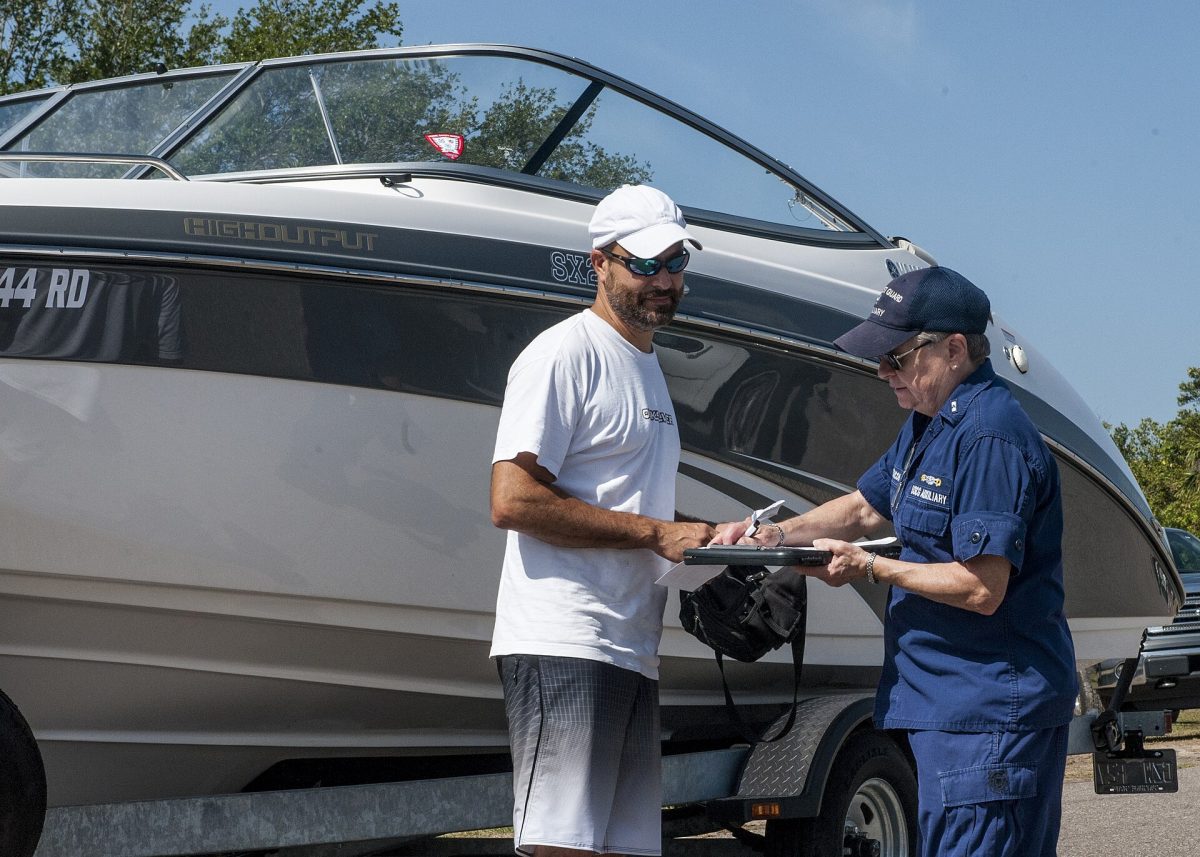
A Coast Guard Auxiliary member conducts a free vessel safety check at a Florida boat ramp (file photo). Photo: Seaman Michael Clark / Wikimedia Commons (Public domain)
JACKSONVILLE, Fla. - Anyone who buys a boat with a motor in Northeast Florida has 30 days to get it titled and registered before it can legally stay on the water. The paperwork is handled by the county tax collector, not a marina or the Florida Fish and Wildlife Conservation Commission. Fees are set by state law and depend mostly on the boat's length, from $5.50 a year for the smallest motorized craft to $189.75 for vessels 110 feet and longer.
The rules come from Chapter 328 of the Florida Statutes and the Florida Department of Highway Safety and Motor Vehicles, which oversees vessel titles and registrations statewide. In Duval County, the work is done at Duval County Tax Collector offices or by mail. St. Johns, Clay, Nassau and Baker county owners use their own county tax collectors, which follow the same state fee schedule.
Step 1: Find out whether your boat needs a title and registration
"All motorized vessels operating on Florida's public waterways must be titled and registered," according to FLHSMV. That includes a small jon boat with an outboard and a canoe with a trolling motor attached. Under state law, any canoe with a propulsion motor falls into the smallest fee class regardless of its length.
Some boats are exempt from registration. FLHSMV lists non-motor-powered vessels under 16 feet, non-motor-powered canoes, kayaks, racing shells and rowing sculls of any length, boats used only on private lakes and ponds, U.S. government vessels and boats used only as a ship's lifeboat. Federally documented vessels and boats with an active out-of-state or Coast Guard number that stay in Florida no more than 90 consecutive days are exempt from Florida titling, according to FLHSMV.
Step 2: Gather proof of ownership
What you bring depends on where the boat came from. For a new boat, the Duval County Tax Collector requires a Manufacturer's Statement of Origin completed and notarized by the selling dealer, plus a dealer sales tax invoice, proof that sales tax was paid or a Form DR-40 sales tax exemption. For a used boat already titled in Florida, the seller and buyer complete the "Transfer of Title by Seller" section on the existing title, and the registration is transferred at the same time.
Boats coming from other states take a little more. If the boat comes from a state that titles boats, the tax collector asks for the out-of-state title and Form HSMV 82040, the Application for Florida Title. If it comes from a state that does not title boats, owners need the most recent original registration, a notarized bill of sale and, if required, a pencil tracing of the hull identification number, and the tax collector notes that "photocopies not accepted."
FLHSMV says a bill of sale or manufacturer's certificate should fully describe the boat. That means the manufacturer's name, year, type, hull material, propulsion, fuel, use, hull identification number and length. A missing hull identification number is one of the most common reasons paperwork gets held up, so it pays to check the number on the transom against the documents before handing over money.
Step 3: Know what you will pay
Florida's annual registration fees are set in Section 328.72 of the Florida Statutes. The table below shows the full fee for each class and the reduced fee available to owners of a recreational boat equipped with a registered emergency position-indicating radio beacon, or EPIRB, or owners of a registered personal locator beacon. Fees are charged for each 12-month period a boat is registered.
| Class | Boat length | Annual fee | Reduced fee with EPIRB or PLB |
|---|---|---|---|
| A-1 | Under 12 feet, and all motorized canoes | $5.50 | $2.95 |
| A-2 | 12 feet to under 16 feet | $16.25 | $11.00 |
| 1 | 16 feet to under 26 feet | $28.75 | $20.40 |
| 2 | 26 feet to under 40 feet | $78.25 | $57.50 |
| 3 | 40 feet to under 65 feet | $127.75 | $94.95 |
| 4 | 65 feet to under 110 feet | $152.75 | $113.40 |
| 5 | 110 feet and longer | $189.75 | $141.15 |
Other charges are added at the counter. State law adds a $2.25 service fee for each registration issued, replaced or renewed and a $1 surcharge for each year of registration, and FLHSMV lists a 50-cent FRVIS fee on top of that. Title fees are separate: $5.25 for an electronic title, $7.75 for a paper title or $11 for an expedited title, plus $1 for each lien and $4 more for a boat previously registered outside Florida.
Sales tax is due at titling if it was not already paid. According to FLHSMV, tax on a dealer sale applies to the boat, motor, trailer and accessories. In a private sale, tax applies to the boat, an inboard motor and the trailer, while an outboard motor and accessories may be exempt if they are itemized and priced separately on the bill of sale.
The reduced beacon fee comes with conditions. Owners must show proof at registration, including the beacon owner's name, the expiration date of the beacon's registration with the National Oceanic and Atmospheric Administration and the beacon's unique identification number. A person who owns a personal locator beacon can get the reduced fee on only one boat.
Step 4: Apply within 30 days
New and used buyers have 30 days to title and register, and FLHSMV says proof of the purchase date must be kept aboard during that time. "Operating an unregistered vessel after 30 days is a second-degree misdemeanor," the agency says. For an ownership transfer, the Duval County Tax Collector adds that "ownership must be transferred within 30 days or a $10 late fee will be charged."
Duval owners can register at any Duval County Tax Collector office or by mail. The tax collector's vessel page lists branches including Yates, Mandarin, Neptune Beach, North Main Street, Roosevelt, Soutel, St. Johns Square, Westside and Ed Ball. The page also lists the Kernan branch as closed July 24, 2026, and the Hogan branch as closing Sept. 2, so owners should confirm a branch is open before making the trip.
Step 5: Put the numbers and decal on the boat
Registration comes with a number and a decal, and both have rules. FLHSMV says the registration number must be painted or permanently attached to both sides of the bow, on the forward half of the boat, in block letters at least 3 inches tall. The characters must read left to right and be a color that contrasts with the hull.
The yearly decal goes on the port, or left, side of the boat. It must be placed immediately before or after the registration number, and expired decals must be removed. FWC also says the certificate of registration "must be on board and available for inspection" whenever the boat is operated.
Step 6: Renew on time
For boats owned by individuals, registration runs on the owner's birth month, according to state law. The renewal period is the 30 days ending at midnight on the owner's birthday, and owners can choose a one-year or two-year registration. Boats owned by companies and government agencies renew on a July 1 to June 30 cycle.
Letting a registration lapse carries civil penalties under Sections 328.72 and 327.73. A registration expired six months or less can bring a fine of up to $100. A registration expired more than six months can bring up to $250 for a first offense and up to $500 for later offenses, though the rule does not apply to boats lawfully stored at a dock or marina.
Other rules to know before launching
Registration is not the only requirement on the water. FWC says anyone born on or after Jan. 1, 1988, who operates a boat powered by 10 horsepower or more must pass an approved boating safety course and carry a Boating Safety Education ID Card along with photo identification. Visiting boaters can use a valid out-of-state registration for up to 90 days, but the Duval County Tax Collector says a boat kept in Florida longer than that must be registered here.
Some of the money stays local. State law sends part of each registration fee, from $2.85 for a Class A-2 boat to $86.85 for a Class 5 vessel, to the county. Counties may spend that money only on items such as channel markers, public boat ramps, docks and removing derelict vessels.
Where to find more information
FLHSMV's Vessel Titling and Registrations page lists exemptions, title documents and fees. Duval owners can check required documents and office locations on the Duval County Tax Collector's vessel page or call (904) 255-5700. Boating education card details are on FWC's boating regulations page.
Sources: Florida Statutes s. 328.72 and s. 327.73 (2026); Florida Department of Highway Safety and Motor Vehicles; Duval County Tax Collector; Florida Fish and Wildlife Conservation Commission

News organizations may republish this story with credit. See our guidelines.
Know someone who'd want to read this? Email it to a friend.
Own a Jacksonville business? Introductory ad rates from $125/month. See ad options Follow Jax Times on FacebookLocal news, events and people, in your feed every day.Most read this week
- Florida's 3 Constitutional Amendments on the Nov. 3 Ballot, Explained in Plain English
- Clay County Voter Guide: 7 Early Voting Sites, Key Races and What to Know Before Nov. 3
- Early Voting in Jacksonville Starts Tuesday: All 24 Sites, the Hours, What to Bring and What's on Your Ballot
- Jacksonville Fair 2026 Guide: Dates, Gate Times, Ticket Prices, Free Days and Every Concert (Nov. 5-15)
- The Cummer Museum by the Numbers: 5,000 Works, a 400-Year-Old Oak and a $1.3 Million Garden Rescue
More stories
 Local Green Cove Springs by the Numbers: 2,200 Gallons a Minute, 9,786 People and a Town Since 1874
 Local Fort George Island by the Numbers: A 3600 B.C. Shell Ring, a 1928 Club and Mount Cornelia
 Local Amelia Island Lighthouse by the Numbers: 188 Years, 64 Feet and $10 Tours Twice a Month
 Local 630-CITY in 6 Steps: How to Report Potholes, Broken Signals and Other Problems in Jacksonville
Comments
Be respectful. No personal attacks, hate speech, spam or anyone's private information. Every comment is reviewed before it appears. Comment rules
No comments yet. Be the first to share your thoughts.