St. Augustine's 2 Spanish Stone Forts: 1672 Groundbreaking, a 1742 Watchtower and the Sieges That Shaped Florida
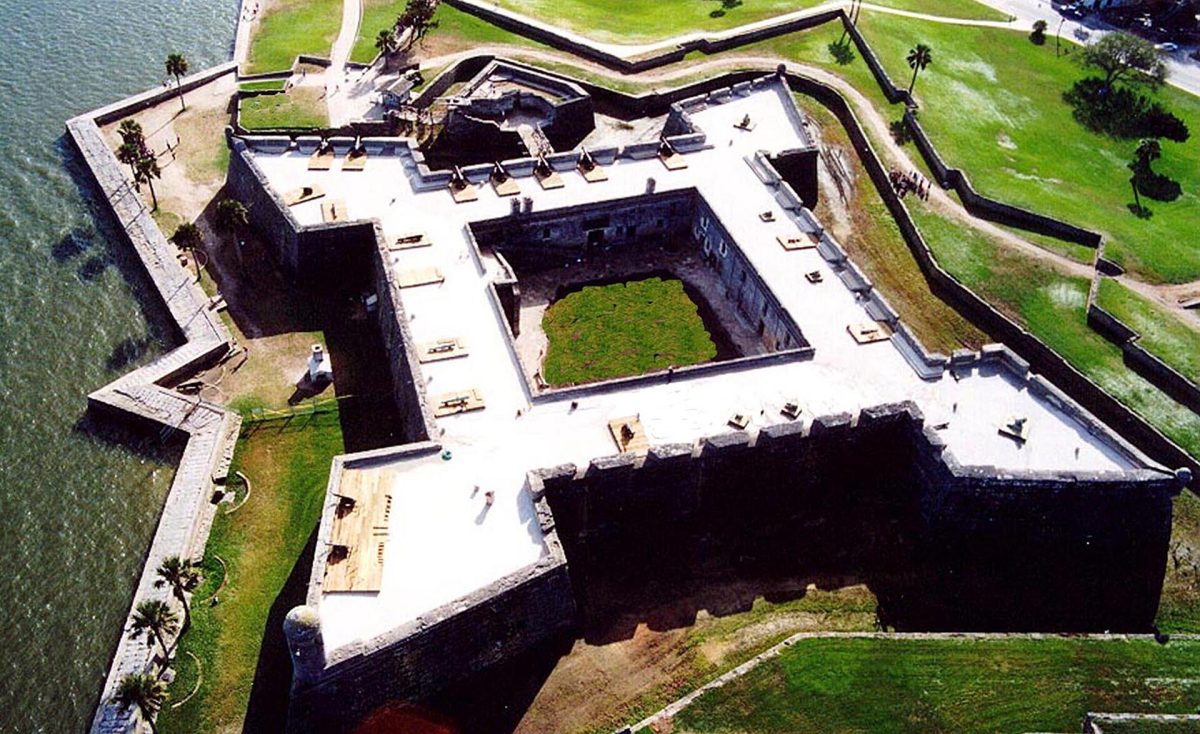
Castillo de San Marcos, begun in 1672, is the oldest masonry fort in the United States. Photo: National Park Service (public domain)
St. Augustine, Florida, has two surviving Spanish stone fortifications built 70 years apart for different purposes: Castillo de San Marcos, begun in 1672 to protect the city, and Fort Matanzas, started in 1740 to defend its southern waterway. Both were built from coquina limestone, a locally available stone that helped preserve two of the most important structures from Spanish colonial Florida.
The larger Castillo took 23 years to complete and endured attacks without being captured in battle. The smaller Fort Matanzas was built after British forces exposed a weakness in St. Augustine's defenses, and its cannons were already confronting an approaching British force in 1742.
Their history is not simply a story of old buildings that survived. The forts reflect an international struggle over shipping routes, the forced labor of Indigenous people and enslaved Africans, and a colonial system that changed repeatedly as European powers competed for Florida.
Today, both are National Park Service monuments. Visitors can explore the Castillo in downtown St. Augustine or take a ferry to Fort Matanzas farther south, although the two sites have significantly different admission and operating rules.
1. Castillo de San Marcos: Why Spain began building a stone fortress in 1672
St. Augustine was established in 1565, but its earliest defenses were not the stone walls seen today. Wooden forts came first, and the National Park Service notes that at least two of them were also called Castillo de San Marcos.
The stone fortress replaced that cycle of wooden forts with something meant to last, built from coquina, the only stone native to the area.
Gov. Manuel de Cendoya and engineer Ignacio Daza led the start of the project. According to the park service, the governor and his officers broke ground on the afternoon of Oct. 2, 1672.
2. Why did the Castillo take 23 years to finish?
The Castillo was not declared finished until August 1695. The project ran long and far over budget.
The National Park Service identifies six governors who oversaw portions of the project after work began. Cendoya and Daza both died within months of the groundbreaking, leaving successors to continue the construction.
Funding also presented problems. The National Park Service reports that Cendoya initially anticipated spending approximately 70,000 pesos, but the completed project cost at least 138,375 pesos.
That final amount was nearly twice the original expectation. The park service estimates it as approximately $2.85 million in 2020 U.S. dollars, although that modern comparison is an interpretive estimate rather than a direct measure of what such a fortress would cost today.
The long construction process produced the oldest surviving masonry fortress in the United States. Its walls and defensive structures became the physical center of St. Augustine's Spanish military system.
The Castillo also represented a substantial commitment of labor. Understanding who performed that work is essential to understanding the building's history.
3. Who actually built Castillo de San Marcos?
The National Park Service says as many as 300 Native people served the crown in St. Augustine. Laborers came from the Guale, Timucua and Apalachee nations.
Many were compelled to work for Spanish authorities. Their duties included quarrying stone, transporting materials and digging foundations, often under physically demanding conditions.
The park service documents complaints about mistreatment and inadequate compensation. Workers sometimes remained away from their families longer than originally required, adding to the burdens imposed on their communities.
Africans, both free and enslaved, also participated in construction. The National Park Service records that 18 enslaved Africans belonging to the Spanish crown joined the workforce in 1687.
That same year, freedom seekers from the English Carolina colony reached St. Augustine. Governor Diego de Quiroga allowed the group to remain, and several of the men worked at the Castillo as laborers or ironsmiths.
The workforce also included Spanish convicts, professional craftsmen and soldiers. One worker the park service names, Andres, spent 16 years on the Castillo as a stonecutter.
The surviving fortress is therefore evidence not only of Spanish military engineering but also of the work performed by people whose contributions were often overlooked in traditional accounts of colonial architecture.
4. What is coquina, and why did Spain use it?
Both Castillo de San Marcos and Fort Matanzas were built using coquina, a type of limestone made from compressed shell fragments. The material was available in the St. Augustine region and became central to the construction of the two defenses.
The park service calls coquina the only stone native to the area. It made the structures look different from European castles built of harder stone.
Its physical properties also influenced how the fortifications responded to cannon fire. The park service describes coquina as compressible, with millions of microscopic air pockets, so cannonballs tended to burrow in rather than shatter the walls, much like a BB fired into Styrofoam.
The Castillo's defensive design complemented the material. It included thick walls, projecting bastions, an open gun deck and a surrounding moat.
The fort's angular shape allowed defenders to position weapons to protect adjoining walls and approaches. This arrangement reflected developments in European military architecture designed to withstand artillery attacks.
These features were tested during actual sieges. The Castillo's survival was not simply the result of strong stone but also of its defensive layout and the people who maintained and defended it.
5. How did the Castillo survive attacks in 1702 and 1740?
The Castillo's first major test came in 1702, only seven years after construction was declared complete. English forces laid siege to St. Augustine, and the stone fortress gave residents a place of refuge.
During one English siege, the park service says, the Castillo housed more than 1,500 people for 51 days.
A second major siege followed in 1740. British forces under James Oglethorpe attacked St. Augustine as part of the wider conflict between Britain and Spain.
Oglethorpe had established Savannah and the Georgia colony in 1733 and Fort Frederica on St. Simons Island in 1736. The National Park Service describes the War of Jenkins' Ear as part of the political setting for his campaign against Spanish Florida.
The 1740 siege lasted from May until July 20, according to the park service. Gov. Manuel de Montiano had made the fort even stronger by raising the walls and adding arched casemates, so cannon could be mounted all around the gun deck.
The British did not capture the fortress. However, the attacks revealed a strategic problem that the Castillo's thick walls could not solve.
St. Augustine could be threatened not only from the main harbor but also from an approach farther south. That vulnerability led directly to construction of Fort Matanzas.
6. Fort Matanzas: Why Spain needed another fort in 1740
Fort Matanzas was built to guard the southern approach to St. Augustine through Matanzas Inlet. The location mattered because hostile ships could potentially use the waterway to reach the settlement from a direction not fully protected by the Castillo.
After the 1740 siege, Governor Montiano recognized that the inlet needed a permanent defense. Construction began in the fall of that year.
Unlike the Castillo, Fort Matanzas was a compact fortified watchtower rather than a large refuge for the city's population. Its principal purpose was to control the inlet and prevent enemy vessels from moving through the southern approach.
The National Park Service reports that workers quarried coquina near El Piñon, a small inlet once located south of Matanzas. Building on marshy ground presented challenges.
Workers drove long wooden piles into the marsh to support the stonework. This foundation system helped support a military structure in an environment much different from the Castillo's downtown waterfront setting.
The tower was completed in 1742, making it approximately seven decades younger than the beginning of construction at the Castillo.
Its smaller dimensions reflected its specialized mission. Rather than sheltering hundreds of residents, it was designed to observe approaching vessels and use artillery to defend a narrow waterway.
7. The little fort that fired on a British force in 1742
The construction of Fort Matanzas was itself contested. The National Park Service documents British efforts to interfere with Spanish activity near the inlet before the fort was completed.
In July 1741, British vessels attacked Spanish ships near Matanzas. During the confrontation, a Spanish vessel ran aground, and British gunfire killed two Spanish crewmen and wounded two others.
A Spanish galliot, a shallow-draft armed vessel, helped prevent the British from pressing their attack. The British eventually withdrew, allowing fort construction to continue.
In September 1742, Oglethorpe returned to the area. By then, Fort Matanzas had been completed and was capable of firing its cannons.
The National Park Service reports that the fort fired at the approaching British, who withdrew without returning fire. Oglethorpe made another attempt the following April, but heavy surf prevented his forces from approaching the inlet or landing successfully.
The events demonstrate why the Spanish invested in a separate southern defense. Even a relatively small fortified tower could help deny an opposing force access through a strategically important waterway.
Fort Matanzas did not need to match the size of the Castillo to serve its purpose. It occupied a location where controlling access mattered more than providing large-scale shelter.
8. Why does the name Matanzas have such a dark history?
The name Matanzas predates the stone fort by nearly two centuries. According to the National Park Service, it comes from the Spanish word meaning slaughters and refers to the killing of French captives in 1565.
The conflict began when French Protestants, known as Huguenots, established a settlement in territory claimed by Spain. The Spanish crown sent Pedro Menéndez de Avilés to remove the French presence and establish Spanish control.
Jean Ribault led French forces toward the Spanish settlement, but a hurricane wrecked his ships along the Florida coast. Survivors attempted to return north, eventually encountering Spanish forces near the inlet.
The National Park Service documents two separate killings of French captives. In the first, 111 Frenchmen were killed after surrendering; in the second, another 134 were killed.
Together, those figures account for 245 deaths recorded in the park service's account. The killings contributed to the naming of the Matanzas River and inlet.
The fortified tower seen today did not exist when these events occurred. Its construction began in 1740, long after the 1565 killings.
That distinction is important because the name reflects an earlier chapter of the struggle for control of Florida, not a battle fought at the completed stone fort.
9. What happened when Spain no longer controlled Florida?
The Castillo's history continued long after Spanish construction ended. Under later American control it was known as Fort Marion, and it served as a prison as well as a fort.
The National Park Service documents the incarceration of Seminole people there, and later of Cheyenne, Arapaho, Kiowa, Comanche and Caddo prisoners from the Great Plains. In the late 1800s, the U.S. government imprisoned more than 500 Apache people at Fort Marion.
Castillo de San Marcos and Fort Matanzas were declared national monuments on Oct. 15, 1924, while the Castillo was still called Fort Marion. An act of Congress restored the original name, Castillo de San Marcos, in 1942.
The National Park Service now preserves the fortifications as historic monuments rather than operating military installations.
10. What can visitors see at the two forts today?
The visitor experiences differ significantly because the buildings served different original purposes. Castillo de San Marcos is a substantial fortress within downtown St. Augustine, while Fort Matanzas is a smaller structure reached only by passenger ferry.
At the Castillo, visitors can explore historic rooms, walk through the defensive spaces and examine the architecture. The building's walls, bastions and gun deck help illustrate how defenders responded to artillery threats.
At Fort Matanzas, visitors cross the Matanzas River aboard a National Park Service ferry. The trip includes ranger interpretation and an opportunity to examine the preserved watchtower.
The physical setting also helps explain the different military roles. The Castillo protected the settlement itself, while Fort Matanzas guarded an inlet farther south.
| Visitor detail | Castillo de San Marcos | Fort Matanzas |
|---|---|---|
| Construction | 1672–1695 | 1740–1742 |
| Original role | Defend city and shelter residents | Guard southern inlet |
| Building material | Coquina limestone | Coquina limestone |
| Adult admission | $15, ages 16 and older | Free |
| Children | Ages 15 and under free | Free |
| Access | Walk-in monument | Ferry required |
| Ferry service | Not applicable | Thursday–Monday only |
| Tuesday and Wednesday | Normal Castillo operating days | No ferry service |
The historic dates and admission arrangements come from the National Park Service's individual monument pages. Visitor operations may change because of weather, staffing or other park conditions.
How much does Castillo de San Marcos cost in 2026?
Castillo de San Marcos charges $15 per adult age 16 and older. The admission ticket is valid for seven consecutive days, according to the National Park Service.
Children age 15 and younger enter free when accompanied by an adult. The monument accepts only credit and debit cards for admission, not cash.
The park also offers a $45 annual Castillo entrance pass. It covers the named passholder and three additional adults entering together, subject to the published conditions.
The regular Castillo is open seven days a week except Thanksgiving Day and Christmas Day. First admission begins at 9 a.m., last admission is at 5 p.m., and visitors must leave by 5:15 p.m.
Its grounds are separate from the paid entrance area. Anyone planning to explore the interior should confirm operating conditions before visiting, especially when weather could affect access to the upper level.
The National Park Service's mailing address is 1 South Castillo Drive, St. Augustine, FL 32084. Visitor information is available at 904-829-6506.
How does the Fort Matanzas ferry work?
Admission to Fort Matanzas National Monument and its passenger ferry is free. However, there is no ferry service on Tuesdays or Wednesdays, even though the park's visitor center area remains accessible during its regular operating hours.
Ferries operate Thursday through Monday, weather and staffing permitting. The National Park Service lists scheduled departures at 9:30, 10:30 and 11:30 a.m., followed by 12:30, 1:30, 2:30 and 3:30 p.m.
Every passenger, including babies and children, must have a free boarding pass. Passes are distributed in person at the Fort Matanzas Visitor Center on a first-come, first-served basis.
The park does not accept telephone reservations or hold passes for visitors. It warns that all available boarding passes are sometimes distributed before 11 a.m., making early arrival important.
The complete ferry experience lasts approximately 45 to 55 minutes, according to the park's operating-hours information. Service can be canceled because of approaching lightning, high winds or other conditions.
The visitor center is located at 8635 A1A South, St. Augustine, FL 32080. The park reports limited parking and recommends carpooling.
For current ferry information, visitors can call 904-471-0116.
Why the two forts matter together
The Castillo and Fort Matanzas preserve different pieces of the same Spanish defensive system. One protected the people and harbor of St. Augustine; the other helped prevent an enemy from approaching through a vulnerable southern inlet.
Their construction histories also reveal different engineering challenges. The Castillo required more than two decades of labor and significant financial resources, while Fort Matanzas required workers to build a fortified stone structure on marshland.
Both sites reflect the ambitions and conflicts of the Spanish empire. They also preserve evidence of the people who provided the labor, including Indigenous communities, Africans, skilled craftsmen and others whose lives were shaped by colonial authority.
The two forts survived political changes that altered their military importance. The Castillo's later use as a prison further demonstrates that a historic building can carry difficult stories beyond its original purpose.
For St. Augustine, these surviving structures make centuries of history visible in the modern landscape. Seeing both offers a fuller understanding of why the city was fortified, how the defenses worked and what those buildings meant to the people whose lives intersected with them.
How we did this
Jax Times reviewed National Park Service historical records for Castillo de San Marcos and Fort Matanzas, including construction histories, military conflicts, architecture, labor and changes in ownership. We also examined the park service's current admission, operating-hours and ferry instructions.
All historical dates, names, figures and visitor policies come from National Park Service publications. The comparison distinguishes the Castillo's paid admission from Fort Matanzas' free ferry program and explicitly notes that Fort Matanzas ferry service does not operate Tuesdays or Wednesdays.
Source: National Park Service: Castillo de San Marcos and Fort Matanzas national monuments
News organizations may republish this story with credit. See our guidelines.
Know someone who'd want to read this? Email it to a friend.
Own a Jacksonville business? Introductory ad rates from $125/month. See ad optionsPlan your weekend with Jax Times
Get This Weekend in Jacksonville every Thursday: the best local events, free things to do and family fun, plus each evening's local news. Free, and you can unsubscribe anytime.
Most read this week
- Florida's 3 Constitutional Amendments on the Nov. 3 Ballot, Explained in Plain English
- Duval and St. Johns School Calendars 2026-27: Every Day Off Left This School Year, Side by Side
- Florida Is Holding $3 Billion in Unclaimed Money. Here's How Jacksonville and St. Augustine Residents Can Search for Free
- Early Voting in Jacksonville Starts Tuesday: All 24 Sites, the Hours, What to Bring and What's on Your Ballot
- Rent in Jacksonville and St. Johns County by ZIP Code: From $1,216 to $2,897 a Month
More stories
 Local Jacksonville and St. Augustine State Parks: 10 Questions About $3–$8 Admission, Annual Passes and Savings
 Local JAXPORT by the Numbers: Jacksonville Port's Last 5 Years Ranked, From 9.96 Million to 10.35 Million Tons
 Local Jacksonville Is Overdue for Its First 50-Degree Night: 35 Years of Data on When the Cold Arrives
 Local Jacksonville vs. Tampa, Orlando and Miami: 14 Questions Answered on Pay, Rent and Home Prices
Comments
Be respectful. No personal attacks, hate speech, spam or anyone's private information. Every comment is reviewed before it appears. Comment rules
No comments yet. Be the first to share your thoughts.