How to Get a Marriage License in Duval County in 5 Steps: $86 or $61 With a Premarital Course, a 3-Day Wait for Floridians, 60 Days to Wed
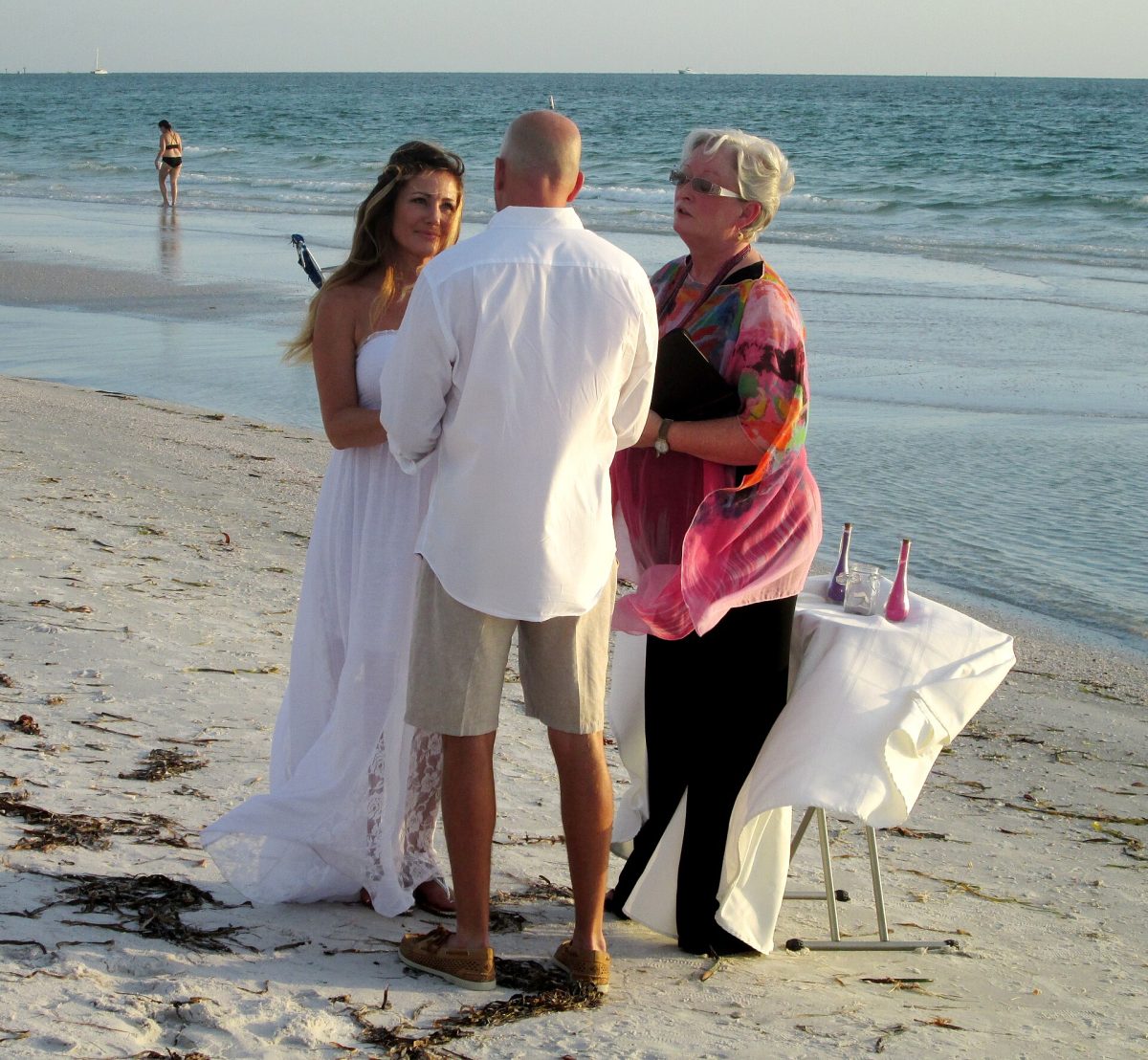
A wedding on Pass-a-Grille Beach in St. Pete Beach, Fla. A license issued in Duval County can be used for a ceremony anywhere in Florida. Photo: Beyond My Ken / Wikimedia Commons (CC BY-SA 4.0)
JACKSONVILLE, Fla. - Getting married in Duval County starts with a trip to the Clerk of Courts, an $86 fee and about 30 minutes of paperwork. The license is good for 60 days anywhere in Florida, and couples who sit through a four-hour premarital course pay $61 and skip the state's three-day waiting period. Here is how it works, based on the Duval County Clerk of Courts' pages and Florida statutes.
The clerk issues licenses at two locations. The main Marriage License Department is in Room 2403 of the Duval County Courthouse at 501 W. Adams St., which takes walk-ins only from 8 a.m. to 5 p.m. Monday through Friday, excluding holidays. The clerk's Beaches Branch at 1543 Atlantic Blvd. in Neptune Beach takes walk-ins or scheduled appointments from 8 a.m. to 4:30 p.m., and it is the only location where appointments are available.
Step 1: Check that you qualify
Both applicants must be 18 or older to apply on their own. Florida Statute 741.04 bars clerks from issuing a license to anyone under 18, with a narrow exception for 17-year-olds who have notarized written consent from a parent or guardian and whose partner is no more than two years older. The clerk's page notes that it charges $7 to notarize a parental consent form.
Residency is not required. Non-residents of Florida and of Duval County can apply, and a license issued in any Florida county is valid for a ceremony anywhere in the state. The clerk also notes that a Florida license cannot be used for a wedding outside Florida.
Step 2: Fill out the pre-application online
The clerk offers an eMarriage pre-application that couples can complete before they arrive. Submitting it does not make anyone married, the clerk's page stresses, and both parties still have to appear together in person. Doing the form ahead of time shortens the visit, which the clerk says takes about 30 minutes, so courthouse applicants should arrive by 4:30 p.m. at the latest.
Both applicants also have to read the Family Law Handbook, which Florida Statute 741.04 requires before a license can be issued. Each person signs a statement confirming they have read the handbook or watched the electronic version. The handbook covers the legal rights and responsibilities of marriage, and no blood test is required in Florida.

Step 3: Bring the right documents
Each applicant needs a valid government-issued photo ID that shows legal name, date of birth and signature. The clerk accepts a driver's license, passport, U.S. military ID, state ID card or alien registration card. Applicants must also provide their Social Security numbers, though the card itself is not required, and non-citizens can give an alien registration number instead.
Anyone who was married before must give the exact date the last marriage ended by divorce, death or annulment. The decree or death certificate itself does not have to be brought in, the clerk says. Couples who have children born in Florida together must complete the Affirmation of Children Born in Florida, state form DH743A.
Step 4: Pay the fee, or take the course and pay less
The standard license and application fee is $86. Couples who present a certificate from a premarital preparation course pay $61, a $25 reduction, according to the clerk's fee page. The clerk accepts cash, money orders and cashier's checks payable to the Duval County Clerk of Courts, along with MasterCard, Visa, Discover and American Express with a 3.5% surcharge.
The course has rules of its own. Florida Statute 741.0305 says it must run at least four hours and be taught by a licensed psychologist, clinical social worker, marriage and family therapist or mental health counselor, an official representative of a religious institution with relevant training, or another provider designated by the judicial circuit. The clerk says the course must be completed within one year before the application and that both parties must attend, and that providers should be registered with Duval County.
The bigger payoff is the waiting period. Florida Statute 741.04 requires clerks to delay a license's effective date by three days for Florida residents who do not submit a course certificate, with the effective date printed in bold on the license. Non-residents are exempt from the wait, and a county judge can waive it for residents who show good cause.
| Item | Duval County rule |
|---|---|
| Standard fee | $86 |
| Fee with premarital course certificate | $61 |
| Waiting period, Florida residents | 3 days, waived with course certificate |
| Waiting period, non-residents | None |
| License valid for | 60 days from issue, statewide |
| Courthouse hours (walk-in only) | 8 a.m. to 5 p.m., Monday to Friday |
| Beaches Branch hours (appointments available) | 8 a.m. to 4:30 p.m. |
Step 5: Hold the ceremony and return the license
Once the license is in hand, the clock starts. Florida Statute 741.041 makes a license valid for 60 days after issuance, and no one may perform the ceremony after that date, which the clerk writes on the document. Ceremonies may be performed by ordained clergy, elders in communion with a church, any Florida judge, a Florida notary public, or Quakers in their customary manner, the clerk's page says.
After the wedding, the signed license must go back to the clerk within 10 days. The officiant is responsible for returning it, but the clerk says anyone may bring it in, and the marriage cannot be recorded until it arrives. The clerk then forwards the record to the Florida Bureau of Vital Statistics, a process the Florida Department of Health says takes about 60 days.
Getting proof afterward
Couples who need a copy have two routes. Uncertified copies of Duval marriage records since 1988 are free to download from the clerk's Official Records search at or.duvalclerk.com, and certified copies are available from Official Records and Research in Room 1253 of the courthouse or by calling (904) 255-2025. The state also issues certified marriage certificates for marriages recorded since June 6, 1927.
The Bureau of Vital Statistics, at 1217 N. Pearl St. in Jacksonville, charges $5 for a search of one year and one certified copy, $4 for each additional copy and a $10 rush fee. Certificates for marriages since 1970 normally take three to five business days, the Department of Health says. Newlyweds who change their names should also notify the Social Security Administration, the Florida Department of Highway Safety and Motor Vehicles and the Supervisor of Elections, the clerk advises.
Sources: Duval County Clerk of Courts, Marriage License pages (accessed Nov. 8, 2026); Florida Statutes 741.04, 741.041 and 741.0305 (2026); Florida Department of Health, Bureau of Vital Statistics, Marriage Certificates (accessed Nov. 8, 2026)
News organizations may republish this story with credit. See our guidelines.
Know someone who'd want to read this? Email it to a friend.
Know which restaurants passed inspection
Get the week's restaurant inspection results every Sunday, This Weekend in Jacksonville every Thursday and each evening's local stories. Free, and you can unsubscribe anytime.
By signing up you agree to get the Jax Times email newsletter. Unsubscribe anytime with one click.