Jacksonville's Great Fire of 1901 by the Numbers: 8 Hours, 146 City Blocks, 2,368 Buildings and 7 Deaths
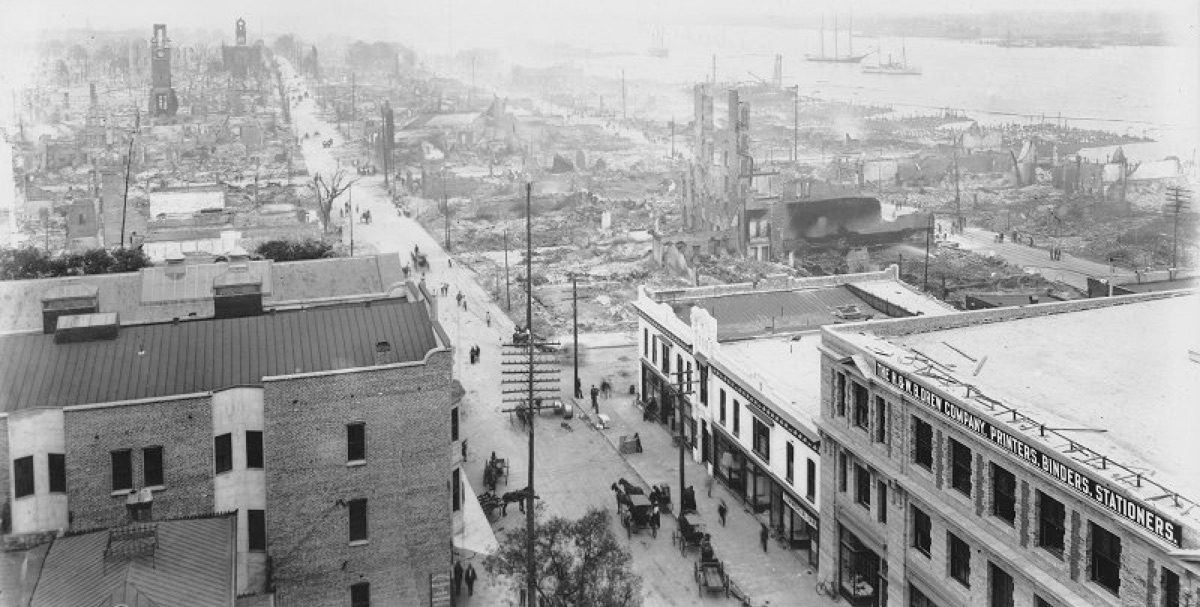
A bird's-eye view of the destruction left in the wake of the Great Fire of 1901 in Jacksonville. Photo: Unknown author / Wikimedia Commons (public domain)
JACKSONVILLE, Fla. - On May 3, 1901, a fire that started at a fiber factory on the west side of downtown burned 146 city blocks in about eight hours, destroying 2,368 buildings and leaving roughly 10,000 people homeless. Seven people died, according to the text of the Florida historical marker at Hemming Plaza. The marker calls it the most destructive burning of a Southern city in U.S. history.
More than a century later, the fire still shapes the look of downtown Jacksonville, from the Prairie School-style buildings that rose afterward to the marker and memorial fountain that mark where the flames passed. The marker says the fire destroyed Hemming Park and most structures in its path. Here are the numbers behind the Great Fire, how it began and what the city did next.
The Great Fire by the numbers
| Number | What it means |
|---|---|
| May 3, 1901 | Date of the fire, a Friday |
| About 8 hours | How long it burned |
| 146 | City blocks destroyed |
| 2,368 | Buildings destroyed, per the state marker |
| About 10,000 | People left homeless |
| 7 | People who died |
| 3rd | Rank among U.S. urban fires, after Chicago and San Francisco, according to Wikipedia |
| May 17, 1901 | Date civil authority was restored after martial law, according to Wikipedia |
Counts of buildings vary by source. The state marker and the Wikipedia article give 2,368 for the buildings destroyed, while other accounts round to about 2,300 or give slightly different totals. The figure of about 10,000 homeless is the one used on the marker, though an online heritage-marker listing cites almost 9,000.
How it started
The fire began at the Cleaveland Fibre Factory at the corner of Beaver and Davis streets, according to the state marker and Wikipedia. Sparks from a nearby chimney ignited a pile of Spanish moss that had been laid out to dry for use as mattress stuffing. The city was in a prolonged drought, and its buildings were mostly wood with wood-shingled roofs.
A plaque at the memorial fountain says the fire began at 12:30 p.m. and roared east, driven by wind and dry weather. It reached what was then Hemming Park by about 3:30 p.m., where the park's live oaks burned and only the Confederate monuments survived, according to the text of that plaque. Factory workers had first tried to put out the flames with buckets of water, according to Wikipedia, before shifting winds made the blaze uncontrollable.
What burned and what survived
The flames swept through the heart of the city's commercial district and many neighborhoods to the east. Among the losses were the Duval County Courthouse and its real estate records, according to Wikipedia. The Church of the Immaculate Conception was left in ruins, as a historic photograph shows.
Some buildings did survive. The brick St. Andrew's Episcopal Church, built in 1887, was the only major church to survive, according to Wikipedia. The Adams Building, completed in 1895, was undamaged, according to the description of a Commons photo of the building.
Martial law and relief
Florida Gov. William S. Jennings declared martial law and sent several state militia units into Jacksonville, according to Wikipedia. Civil authority was restored on May 17, according to Wikipedia. Many residents who lost their homes moved to other areas, including South Jacksonville across the St. Johns River, according to a sign photographed there.
Accounts of the fire also include criticism of the response. That criticism is part of the historical record. Wikipedia reports a claim by writer James Weldon Johnson that firemen focused on saving a white neighborhood while Black areas burned, and that claim is presented there as a reported account rather than a settled finding.
The rebuilding
The disaster opened the door for a building boom. New York architect Henry John Klutho helped rebuild the city in the Prairie School style, according to Wikipedia. His St. James Building, completed in 1912, now houses Jacksonville City Hall.
Klutho also designed public schools and houses, and some of his work remains in the Springfield Historic District. The St. James Building required 25 separate building contracts, according to the description of a Commons photo of its facade. Together, the buildings are a visible reminder of how quickly the city rebuilt.
Where to see it today
The Florida historical marker stands at Duval Street at Hemming Plaza, according to the state's heritage marker database, and it was erected in 2001. A memorial fountain to the fire stands in the same area, and its plaque describes where the flames passed. The St. James Building, now City Hall, is on Duval Street downtown.
Visitors who want to learn more can also look to local historical societies, which have published books and exhibits about the fire. The marker itself is outdoors at the plaza. No admission fee is listed for it in the state's marker database.
Sources: Florida Heritage marker text, "Jacksonville's 1901 Fire" (erected 2001, Hemming Plaza); Wikipedia, "Great Fire of 1901"; Wikimedia Commons file descriptions

News organizations may republish this story with credit. See our guidelines.
Know someone who'd want to read this? Email it to a friend.
Know which restaurants passed inspection
Get the week's restaurant inspection results every Sunday, This Weekend in Jacksonville every Thursday and each evening's local stories. Free, and you can unsubscribe anytime.
By signing up you agree to get the Jax Times email newsletter. Unsubscribe anytime with one click.
Most read this week
More stories
 Arts & Culture Jacksonville Symphony Plays Mahler's Ninth Nov. 6 and 7 at Jacoby Symphony Hall
 Arts & Culture Dickens on Centre Returns to Downtown Fernandina Beach Dec. 11-13
 Arts & Culture City of Artists Closing Reception Tonight at the Main Library
 Sports Northeast Florida High School Football Playoffs Open Nov. 13