Castillo de San Marcos by the Numbers: Begun Oct. 2, 1672, a Coquina Fort With 4 Bastions That Survived 2 Sieges
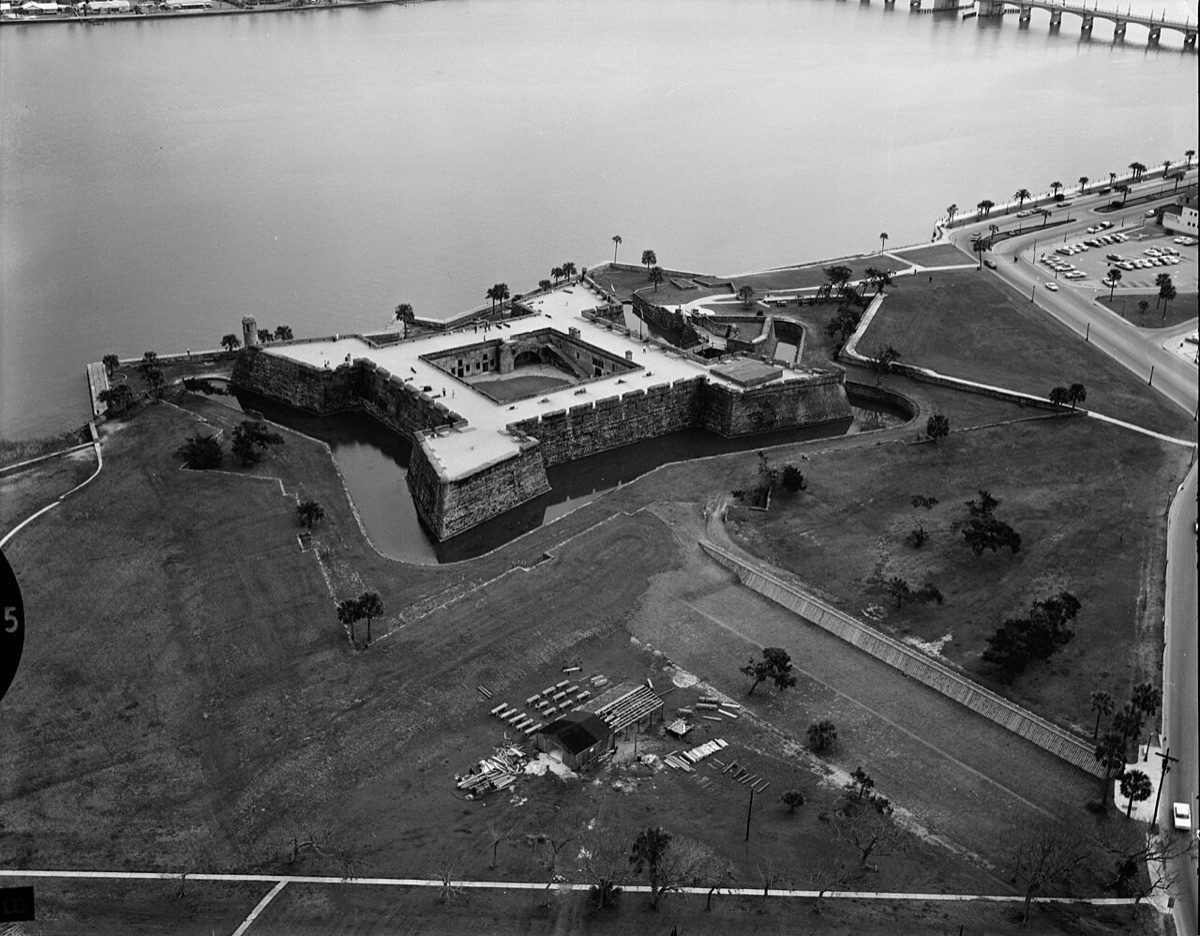
An aerial view of the Castillo de San Marcos from the northwest, showing its relation to the town, photographed by Jack E. Boucher for the Historic American Buildings Survey. Photo: Jack E. Boucher / Historic American Buildings Survey / Wikimedia Commons (public domain)
ST. AUGUSTINE, Fla. - The first coquina stones of the Castillo de San Marcos were laid on Oct. 2, 1672, and the core of the fort was finished in 1695, according to Wikipedia. It is the oldest masonry fort in the continental United States, standing on the western shore of Matanzas Bay. The National Park Service runs it as Castillo de San Marcos National Monument.
The fort has flown Spanish, British and American flags over its long history, and its walls of shell stone are still the first thing most visitors notice. The Spanish handed it to the British in 1763 and the Americans took it over after 1821. Here are the key numbers and dates, from the first stones to the entry fee today.
The Castillo by the numbers
| Number | What it means |
|---|---|
| Oct. 2, 1672 | First coquina stones laid |
| 1695 | Core of the fort completed |
| 4 | Bastions: San Pedro, San Agustin, San Carlos and San Pablo |
| 26 to 33 feet | Exterior wall height after the 1738 rebuild raised it from 26 feet |
| 2 | Major sieges: 1702 and 1740 |
| 27 days | How long the British bombarded the fort in 1740 |
| Oct. 15, 1924 | Designated a national monument |
| 1933 | Transferred from the War Department to the National Park Service |
| 624,841 | Visitors in 2022, according to Wikipedia |
Built from shell
The fort was designed by Spanish engineer Ignacio Daza, according to Wikipedia. It is built of coquina, a sedimentary rock made of bonded ancient shells, which is why its walls look pocked and golden rather than smooth. A close-up photograph of the wall shows the shell fragments embedded in the stone.
The reason the stone mattered is practical. Coquina is soft enough to absorb impact, so cannon shot tends to lodge in it rather than shatter it. That is the commonly cited explanation for the fort's endurance, though the sources reviewed for this story do not quantify it.
The fort has four corner bastions and a ravelin, a triangular outwork that protects the sally port, according to Wikipedia. A drawbridge beside the ravelin serves as the entrance today, according to a Commons photo description. A moat runs around the walls.
Two sieges
The first came in 1702, when Carolina Gov. James Moore Sr. besieged the fort starting in November, and it lasted about two months, according to Wikipedia. The fort held. The second came in 1740, when Georgia founder James Oglethorpe's forces bombarded it for 27 days before retreating.
The exterior wall was raised from 26 to 33 feet in the 1738 rebuild under Pedro Ruiz de Olano, according to Wikipedia. That rebuild came two years before the 1740 siege. The 1740 siege tested that rebuilt wall.
Flags and a new name
Spain turned the Castillo over to Britain on July 21, 1763, and the fort was renamed Fort St. Mark. Spanish troops returned to St. Augustine on July 12, 1784. After the United States took possession in 1821, the fort was renamed Fort Marion, honoring Revolutionary War hero Francis Marion, according to Wikipedia.
Beginning in 1875, Native American prisoners from the western Indian Wars were held at the fort under Richard Henry Pratt, who improved their conditions, according to Wikipedia. About 491 Apaches were held there in 1886 and 1887, including members of Geronimo's band, though Geronimo himself was sent to Fort Pickens, according to the same account. By then the fort carried the name Fort Marion, which it received after 1821.
Planning a visit
The park's address is 1 South Castillo Drive, St. Augustine, FL 32084, and its phone number is 904-829-6506, according to the National Park Service. The NPS fee page, last updated in March 2024, lists a $15 standard pass for adults ages 16 and older, valid for seven consecutive days, and says children 15 and under are free with an adult. An annual pass is listed at $45.
The park is cashless and accepts only credit and debit cards, according to the same page. The city lot in front of the fort charges $2.50 an hour, and a city garage is about a block away. Because the fee page is not recent, visitors should confirm prices and hours with the park before they go, since this story could not verify current operating hours.
Sources: National Park Service (Castillo de San Marcos fees page, last updated March 2024; history and culture page); Wikipedia, "Castillo de San Marcos"; Wikimedia Commons file descriptions

News organizations may republish this story with credit. See our guidelines.
Know someone who'd want to read this? Email it to a friend.
Know which restaurants passed inspection
Get the week's restaurant inspection results every Sunday, This Weekend in Jacksonville every Thursday and each evening's local stories. Free, and you can unsubscribe anytime.
By signing up you agree to get the Jax Times email newsletter. Unsubscribe anytime with one click.
Most read this week
More stories
 Arts & Culture Jacksonville Symphony Plays Mahler's Ninth Nov. 6 and 7 at Jacoby Symphony Hall
 Arts & Culture Dickens on Centre Returns to Downtown Fernandina Beach Dec. 11-13
 Arts & Culture City of Artists Closing Reception Tonight at the Main Library
 Sports Northeast Florida High School Football Playoffs Open Nov. 13