Jacksonville Orders Keystone to Stop Taking Coal Ash at Its Talleyrand Terminal and Remove It in 45 Days or Risk $2,000-a-Day Penalties
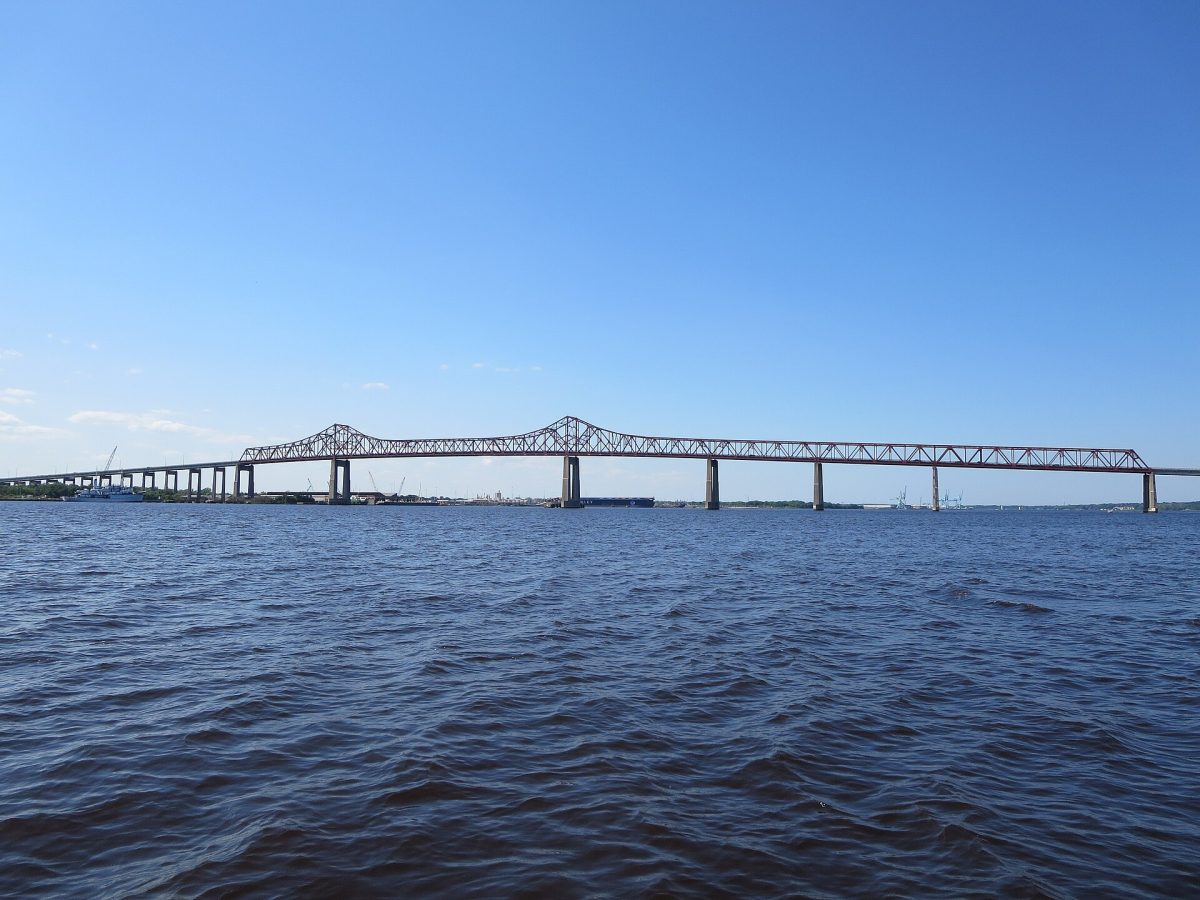
The Mathews Bridge seen from the St. Johns River in 2013. The bridge crosses the river beside the Talleyrand port area. Photo: Nichos / Wikimedia Commons (CC BY-SA 3.0)
JACKSONVILLE, Fla. - The City of Jacksonville has ordered the owners of Keystone Terminals on the St. Johns River to stop accepting coal ash and to haul away the ash already stored there within 45 days. Mayor Donna Deegan announced the order at a City Hall news conference on Tuesday, Nov. 17, saying the companies have run a solid waste facility without the certificate that city law requires. If Keystone does not comply, the city said it may go to court and seek civil penalties of up to $2,000 a day.
What the order requires
The order, dated Nov. 16, is aimed at Keystone Properties LLC and Keystone Investments II LLC. State corporation records list both companies at 1915 Wigmore St., the address of Keystone Terminals in the Talleyrand port area, according to the Jacksonville Daily Record. The city's release spells out four requirements for the companies.
- Stop receiving any additional solid waste, including coal ash, at the terminal.
- Remove all stored ash within 45 days and deliver it only to a facility lawfully permitted to accept it.
- Control dust and runoff during the removal.
- Report weekly to the city how much ash was removed and where it was taken.
The city's announcement did not give a calendar deadline for the removal. Counted from the order's Nov. 16 date, 45 days would run through Dec. 31. The city also said the order applies only to solid waste and does not restrict the terminal's lawful handling of other bulk materials.
Why the city says a certificate is needed
Under Chapter 380 of the city's Ordinance Code, any business that stores, processes or transfers solid waste in Duval County must hold a Certificate of Public Convenience and Necessity. The city says that local requirement is separate from, and in addition to, state and federal environmental permits. Before a certificate is granted, several city and state agencies review the facility, and the City Council holds a public hearing, with notice to nearby property owners, before it votes.
The city says Keystone has never applied for or received a certificate. "This operation has never been reviewed by the city as required by local ordinance code," Deegan said, according to Jacksonville Today. She said a council review and public hearing are "how we can verify an operation is safe or harmful for our neighbors."


The dispute dates to Oct. 13, when the city notified Keystone of a potential violation and gave the company 30 days to show that its operation was authorized. Keystone answered on Nov. 12, but the city said the response did not provide the information it asked for. Deegan told reporters the reply "was not satisfactory," Jacksonville Today reported.
Where the ash comes from
According to the city, Keystone receives coal ash shipped from a power plant in Puerto Rico, stores it at the terminal and trucks it to a landfill outside Florida. Jacksonville Today reported that the barges travel nearly 18 miles up the St. Johns River to Talleyrand and that the ash then goes to a landfill in Folkston, Georgia. Puerto Rico banned permanent coal ash storage in 2017, after which coal plants there began shipping ash by barge to Jacksonville, according to Jacksonville Today.
Citing the U.S. Environmental Protection Agency, the city said coal ash contains contaminants including mercury, cadmium and arsenic. Without proper management, the release says, those contaminants can pollute waterways, groundwater, drinking water and air. "The rules for handling solid waste in Jacksonville apply to everyone," Deegan said, calling residents' health and safety her top priority.
Keystone's response
In emailed statements to the Daily Record and Jacksonville Today, Keystone said it "values its role as a community and corporate partner" and that it responded to the city's October notice. The company said it does not believe the work at its Talleyrand facility requires this level of permitting, but that it is working with the city to resolve the issue. The statements did not say whether Keystone will ask for a meeting, apply for a certificate or challenge the order.
Under the order, Keystone may submit a written response and may request a meeting with the city. It may also apply for a certificate, but the city said applying does not allow the ash operation to continue while an application is pending. If Keystone does apply, city official Al Ferraro said the council could "inspect or do as much or as little as they want moving forward," Jacksonville Today reported.
A separate federal lawsuit
The city's order comes on top of a federal lawsuit filed Aug. 19 by St. Johns Riverkeeper and the Public Trust for Conservation under the federal Clean Water Act and Resource Conservation and Recovery Act. The suit alleges Keystone illegally discharged coal ash into the river, handled more than 2 billion pounds of ash since 2022 in unlined storage areas and failed to keep dust from reaching neighboring communities, according to Jacksonville Today. Those claims are allegations, and a court has not ruled on them.
John November, executive director and general counsel of the Public Trust for Conservation, praised the city's action. He told the Daily Record that coal ash is lightweight enough for wind or water to carry it far from where it is stored, and that some health effects can show up as long as 30 years after exposure. The lawsuit also points to March 2021, when a barge carrying Puerto Rico coal ash struck the jetties near the mouth of the St. Johns River and spilled up to 9,000 tons of ash, according to Jacksonville Today.
What happens next
Next, Keystone must stop new deliveries, begin the removal and start filing weekly reports. If it does not, the city can ask a court to enforce the order with penalties of up to $2,000 a day. Any certificate application would go to the City Council for a public hearing.
Sources: City of Jacksonville (Nov. 17, 2026); Jacksonville Daily Record (Nov. 17, 2026); Jacksonville Today (Nov. 17, 2026)

News organizations may republish this story with credit. See our guidelines.
Know someone who'd want to read this? Email it to a friend.
Know which restaurants passed inspection
Get the week's restaurant inspection results every Sunday, This Weekend in Jacksonville every Thursday and each evening's local stories. Free, and you can unsubscribe anytime.
By signing up you agree to get the Jax Times email newsletter. Unsubscribe anytime with one click.