A $350,000 Tax Rebate Could Bring a Cooking Oil Importer and 58 Jobs Paying $58,000 to Jacksonville's Rail Yard District
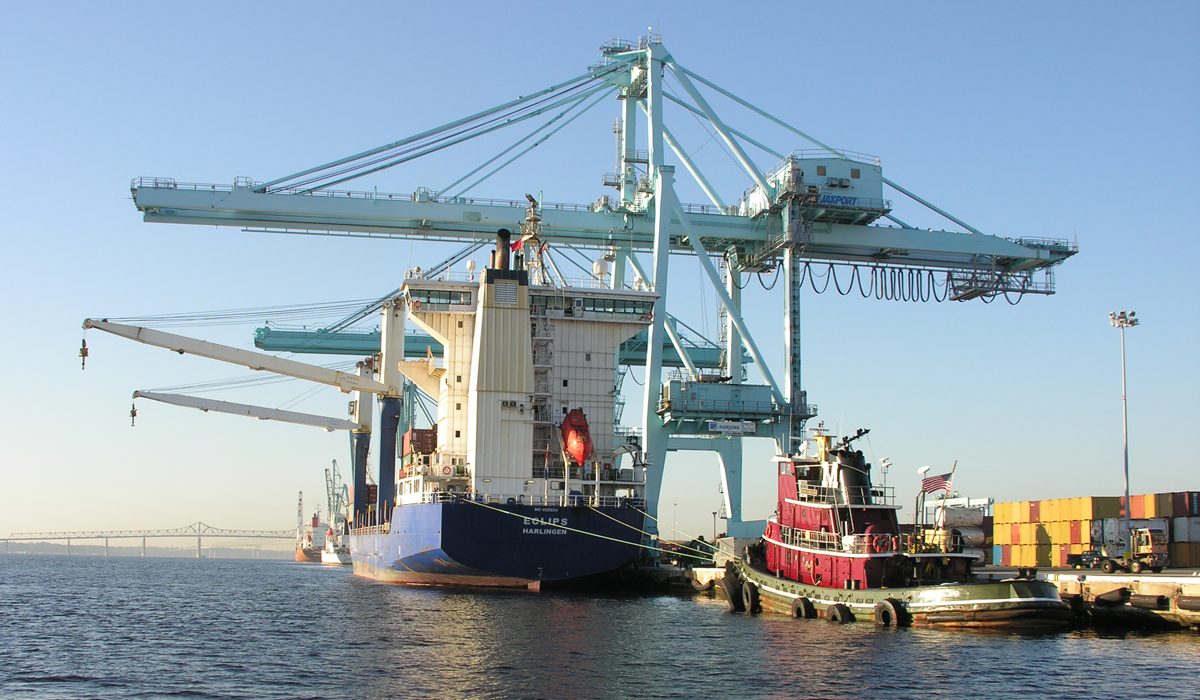
Cargo activity along the docks at JAXPORT's Talleyrand Marine Terminal, in a 2008 JAXPORT photo. Photo: JAXPORT / Wikimedia Commons (CC BY 2.0)
JACKSONVILLE, Fla. - A South Florida cooking oil importer could move its operations to Jacksonville's Rail Yard District with help from a city tax rebate worth up to $350,000. The company, known only by the code name Project Branch, would buy a 115,000-square-foot building near the junction of Interstates 95 and 10 and create at least 58 full-time jobs paying an average of $58,000 a year, according to an Office of Economic Development memo reported by the Jacksonville Daily Record on Nov. 20. The proposal was scheduled to go before the Mayor's Budget Review Committee on Monday, Nov. 23, and the City Council must also review it before any money is promised.
The company now runs a cooking oil and food services distribution business from a facility in South Florida, the Daily Record reported. In Jacksonville it would import cooking oil products from Africa and the Mediterranean, then process, package and distribute them from the new building. The memo calls the site's closeness to rail lines and Jacksonville Port Authority facilities "essential" to the project.
What the city would give, and what it would get
| Term | Project Branch (2026) |
|---|---|
| Incentive | Recapture Enhanced Value (REV) grant, up to $350,000 |
| Length and share | 6 years, 50% |
| Jobs | At least 58 full-time by Dec. 31, 2028 |
| Average pay | $58,000 a year |
| Investment | At least $20 million |
| City's estimated return | $3.27 for every $1 |
A REV grant is not a check up front. It refunds part of the new property tax revenue that a development or improvement creates, and it can cover both real estate and business equipment, the Daily Record reported. In this case the company would get back half of that new tax money for six years, up to the $350,000 cap, after it buys and renovates the building and installs equipment worth at least $20 million combined.
The memo puts the city's return at $3.27 for every $1 in incentives. The 58 jobs at the stated average would add up to roughly $3.4 million a year in payroll, a Jax Times calculation from the memo's figures. Spread across those jobs, the maximum grant works out to a little over $6,000 per position.


How it compares to a similar deal a year ago
The city has used the same tool, in nearly the same way, before. In November 2025, the Mayor's Budget Review Committee unanimously accepted a five-year, 50% REV grant capped at $275,000 for a code-named manufacturer called Project Underground, News4JAX reported. That company planned at least $10 million in new investment and 100 to 120 mostly production jobs in Northwest Jacksonville averaging above $40,000 a year, and city staff estimated a return of 3.8 to 1.
Set side by side, the two deals show the trade-off. Project Branch promises fewer jobs, but its $58,000 average pay compares with "above $40,000" for Project Underground, and it pledges twice the investment. Its maximum grant is $75,000 larger, its term one year longer and its estimated return lower, at $3.27 to Project Underground's $3.80.
Both companies also had other suitors. Project Branch is weighing sites in Georgia and elsewhere in Northeast Florida, and the Office of Economic Development says incentives are an important factor in its choice, according to the Daily Record. In the 2025 deal, Office of Economic Development Executive Director Ed Randolph said "there are at least two other states and municipalities that are courting them with similar incentives," News4JAX reported.
Why the Rail Yard District
The Rail Yard District is a 4.5-square-mile industrial and commercial area just west of downtown, bounded by I-10 on the south, I-95 on the east, Kings Road on the north and Huron Street on the west, the Daily Record reported in 2018. It takes its name from the active tracks that run through it, and three railroads operate there. At the time, the district held about 350 businesses with about 6,000 workers, including Beaver Street Fisheries, which also runs the Jacksonville Farmers Market.
Business owners there have long argued that the area gets overlooked. "This neighborhood is invisible," Beaver Street Fisheries executive Jeff Edwards, then president of the district's business council, told the Daily Record in 2018, because people do not know the businesses exist. The memo's emphasis on rail and port access lines up with what defines the district: tracks running through it and interstates on two of its sides.
What to watch next
The first test was Monday's budget committee meeting; its result had not been reported as of Tuesday afternoon. A recommendation from that panel would send the incentive to the City Council as legislation. The company's real name and the building's address have not been made public, and state law allows economic development deals to use code names until they are final, the Office of Economic Development noted. If the deal is approved, the company has until Dec. 31, 2028, to hire the 58 workers, and the rebate would be paid only on new tax value the project actually creates.
Sources: Jax Daily Record (Nov. 20, 2026; Sept. 21, 2018); News4JAX (Nov. 24, 2025); City of Jacksonville Office of Economic Development
News organizations may republish this story with credit. See our guidelines.
Know someone who'd want to read this? Email it to a friend.
Know which restaurants passed inspection
Get the week's restaurant inspection results every Sunday, This Weekend in Jacksonville every Thursday and each evening's local stories. Free, and you can unsubscribe anytime.
By signing up you agree to get the Jax Times email newsletter. Unsubscribe anytime with one click.